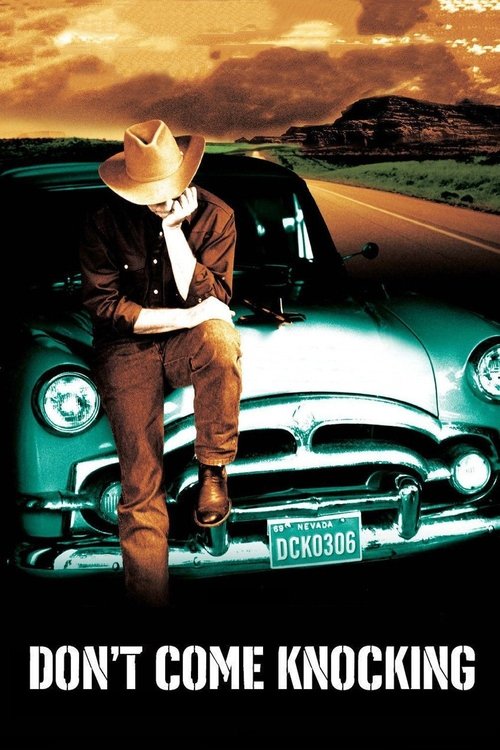
Don't Come Knocking
Howard Spence has seen better days. Once a big Western movie star, he now drowns his disgust for his selfish and failed life with alcohol, drugs and young women. If he were to die now, nobody would shed a tear over him, that's the sad truth. Until one day Howard learns that he might have a child somewhere out there...
The film box office disappointment against its limited budget of $11.0M, earning $4.7M globally (-58% loss). While initial box office returns were modest, the film has gained appreciation for its compelling narrative within the drama genre.
1 win & 7 nominations


Plot Structure
Story beats plotted across runtime


Narrative Arc
Emotional journey through the story's key moments
Story Circle
Blueprint 15-beat structure
Arcplot Score Breakdown
Weighted: Precision (70%) + Arc (15%) + Theme (15%)
Don't Come Knocking (2005) demonstrates meticulously timed narrative architecture, characteristic of Wim Wenders's storytelling approach. This structural analysis examines how the film's 15-point plot structure maps to proven narrative frameworks across 2 hours and 3 minutes. With an Arcplot score of 6.8, the film balances conventional beats with creative variation.
Characters
Cast & narrative archetypes

Howard Spence
Doreen
Sutter
Sky
Earl
Howard's Mother
Main Cast & Characters
Howard Spence
Played by Sam Shepard
An aging Western film star who abandons his latest movie to confront his past and search for the family he abandoned.
Doreen
Played by Jessica Lange
Howard's former lover from Montana, dignified and guarded after being abandoned years ago.
Sutter
Played by Tim Roth
A persistent bond recovery agent hired to track down Howard and bring him back to the film set.
Sky
Played by Sarah Polley
A young waitress who claims to be Howard's daughter, searching for connection with her absent father.
Earl
Played by Gabriel Mann
Howard's estranged son who must decide whether to accept his father back into his life.
Howard's Mother
Played by Eva Marie Saint
Howard's elderly mother who represents his last remaining connection to his origins.
Structural Analysis
The Status Quo at 1 minutes (1% through the runtime) establishes Howard Spence, an aging Western movie star, sits alone in his trailer on a film set in the Utah desert, visibly disconnected and hollow despite his fame—a man who has everything yet feels nothing.. The analysis reveals that this early placement immediately immerses viewers in the story world.
The inciting incident occurs at 15 minutes when Howard impulsively mounts a horse and rides off into the desert, abandoning the film production—a desperate break from his suffocating existence that sets the insurance investigator Sutter on his trail.. At 12% through the film, this Disruption aligns precisely with traditional story structure. This beat shifts the emotional landscape, launching the protagonist into the central conflict.
The First Threshold at 31 minutes marks the transition into Act II, occurring at 25% of the runtime. This shows the protagonist's commitment to Howard makes the active choice to travel to Butte, Montana to find Doreen and meet the son he never knew existed—committing to confronting his abandoned past rather than continuing to flee., moving from reaction to action.
At 62 minutes, the Midpoint arrives at 50% of the runtime—precisely centered, creating perfect narrative symmetry. Significantly, this crucial beat Earl publicly confronts and humiliates Howard, making clear his profound rage at being abandoned. Howard realizes reconciliation won't be easy—his charm and fame mean nothing to the son he deserted. The stakes escalate from reunion to reckoning., fundamentally raising what's at risk. The emotional intensity shifts, dividing the narrative into clear before-and-after phases.
The Collapse moment at 92 minutes (75% through) represents the emotional nadir. Here, Earl destroys his own music equipment in a fit of rage, symbolically rejecting any possibility of inherited gifts from his father. Howard witnesses the full devastation his abandonment has caused—the death of hope for easy reconciliation and the metaphorical death of the idealized reunion he imagined., indicates the protagonist at their lowest point. This beat's placement in the final quarter sets up the climactic reversal.
The Second Threshold at 98 minutes initiates the final act resolution at 80% of the runtime. Howard realizes that redemption isn't about being forgiven or accepted—it's about showing up and staying present despite rejection. He chooses to remain in Butte rather than return to Hollywood, committing to being available even if unwanted., demonstrating the transformation achieved throughout the journey.
Emotional Journey
Don't Come Knocking's emotional architecture traces a deliberate progression across 15 carefully calibrated beats.
Narrative Framework
This structural analysis employs systematic plot point analysis that identifies crucial turning points. By mapping Don't Come Knocking against these established plot points, we can identify how Wim Wenders utilizes or subverts traditional narrative conventions. The plot point approach reveals not only adherence to structural principles but also creative choices that distinguish Don't Come Knocking within the drama genre.
Wim Wenders's Structural Approach
Among the 3 Wim Wenders films analyzed on Arcplot, the average structural score is 6.9, demonstrating varied approaches to story architecture. Don't Come Knocking takes a more unconventional approach compared to the director's typical style. For comparative analysis, explore the complete Wim Wenders filmography.
Comparative Analysis
Additional drama films include After Thomas, South Pacific and Dirty Dancing: Havana Nights. For more Wim Wenders analyses, see Perfect Days, Wings of Desire.
Plot Points by Act
Act I
SetupStatus Quo
Howard Spence, an aging Western movie star, sits alone in his trailer on a film set in the Utah desert, visibly disconnected and hollow despite his fame—a man who has everything yet feels nothing.
Theme
A crew member remarks that Howard has been running from everything his whole life—you can't outrun your own shadow. The theme of confronting one's past versus perpetual escape is established.
Worldbuilding
Howard's empty existence is established: the hollow glamour of movie stardom, his alienation from meaningful connection, the production chaos around him, and the vast emptiness of the Western landscape mirroring his inner void.
Disruption
Howard impulsively mounts a horse and rides off into the desert, abandoning the film production—a desperate break from his suffocating existence that sets the insurance investigator Sutter on his trail.
Resistance
Howard travels to Elko, Nevada to see his estranged mother for the first time in thirty years. She provides tough guidance, revealing that Doreen, a woman from his past, tried to contact him years ago about a son. Howard debates whether to pursue this information or continue running.
Act II
ConfrontationFirst Threshold
Howard makes the active choice to travel to Butte, Montana to find Doreen and meet the son he never knew existed—committing to confronting his abandoned past rather than continuing to flee.
Mirror World
Howard meets Earl, his adult son—an angry, struggling musician who represents the damage caused by Howard's abandonment. Earl embodies the thematic question: can the wounds of paternal absence ever heal?
Premise
Howard explores Butte and attempts to connect with his past: confronting Doreen, who is now a waitress still carrying resentment; being rejected by Earl; discovering he may also have a daughter named Sky; and navigating the insurance investigator Sutter who tracks him.
Midpoint
Earl publicly confronts and humiliates Howard, making clear his profound rage at being abandoned. Howard realizes reconciliation won't be easy—his charm and fame mean nothing to the son he deserted. The stakes escalate from reunion to reckoning.
Opposition
Howard's attempts at connection are met with resistance from all sides: Earl's continued rejection, Doreen's ambivalence, Sky's mysterious presence, and Sutter's persistent pursuit representing the Hollywood system pulling him back. Howard's own inability to truly change becomes the greatest obstacle.
Collapse
Earl destroys his own music equipment in a fit of rage, symbolically rejecting any possibility of inherited gifts from his father. Howard witnesses the full devastation his abandonment has caused—the death of hope for easy reconciliation and the metaphorical death of the idealized reunion he imagined.
Crisis
Howard sits alone in the stark Montana landscape, processing the wreckage of his attempt at redemption. He must accept that he cannot undo thirty years of absence with a few days of presence—the pain he caused is real and may be permanent.
Act III
ResolutionSecond Threshold
Howard realizes that redemption isn't about being forgiven or accepted—it's about showing up and staying present despite rejection. He chooses to remain in Butte rather than return to Hollywood, committing to being available even if unwanted.
Synthesis
Howard makes tentative connections: a fragile acknowledgment from Earl, a possible relationship with Sky, and a peaceful acceptance from Doreen. He lets Sutter find him, facing consequences rather than running. The scattered family doesn't reunite perfectly but achieves proximity and possibility.
Transformation
Howard stands in the Montana light, no longer the isolated movie star in his trailer but a man present among people whose lives he affected. The Western landscape remains vast, but he is no longer running through it—he has finally stopped.