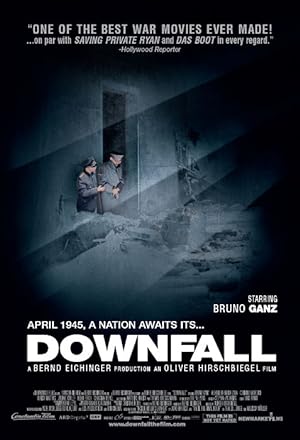
Downfall
Charting the last 10 days of Hitler's life, from his 56th birthday on April 20th, 1945 to his suicide on April 30th, Downfall uses multiple characters to show the chaos of a country coming apart at the seams, from Hitler's henchman under the streets of Berlin, to the soldiers and civilians fighting and dying as the Soviet Army ravaged the city above. Nominated for an Oscar for Best Foreign Language Film in 2005.
Despite a respectable budget of $16.0M, Downfall became a solid performer, earning $92.2M worldwide—a 476% return.
Nominated for 1 Oscar. 22 wins & 34 nominations


Plot Structure
Story beats plotted across runtime


Narrative Arc
Emotional journey through the story's key moments
Story Circle
Blueprint 15-beat structure
Arcplot Score Breakdown
Weighted: Precision (70%) + Arc (15%) + Theme (15%)
Downfall (2004) reveals carefully calibrated narrative design, characteristic of Oliver Hirschbiegel's storytelling approach. This structural analysis examines how the film's 15-point plot structure maps to proven narrative frameworks across 2 hours and 36 minutes. With an Arcplot score of 3.4, the film takes an unconventional approach to traditional narrative frameworks.
Characters
Cast & narrative archetypes

Adolf Hitler
Traudl Junge
Albert Speer
Joseph Goebbels
Magda Goebbels
Hermann Fegelein
Eva Braun
Heinrich Himmler
Main Cast & Characters
Adolf Hitler
Played by Bruno Ganz
Führer of Nazi Germany in his final days, descending into paranoia and delusion as the Third Reich collapses around him.
Traudl Junge
Played by Alexandra Maria Lara
Hitler's young secretary who witnesses the final days in the bunker and narrates portions of the film.
Albert Speer
Played by Heino Ferch
Reich Minister of Armaments who attempts to reason with Hitler and ultimately defies his orders to destroy Germany.
Joseph Goebbels
Played by Ulrich Matthes
Minister of Propaganda, fanatically loyal to Hitler to the bitter end, orchestrating the murder-suicide of his entire family.
Magda Goebbels
Played by Corinna Harfouch
Wife of Joseph Goebbels who murders her six children before committing suicide, embodying fanatical devotion to Nazi ideology.
Hermann Fegelein
Played by Thomas Kretschmann
SS officer and Eva Braun's brother-in-law who attempts to flee Berlin and is executed for desertion.
Eva Braun
Played by Juliane Köhler
Hitler's longtime companion who marries him hours before their joint suicide in the bunker.
Heinrich Himmler
Played by Ulrich Noethen
Reichsführer-SS who secretly attempts peace negotiations, seen as the ultimate betrayal by Hitler.
Structural Analysis
The Status Quo at 2 minutes (1% through the runtime) establishes November 1942: Young Traudl Junge arrives nervously at Hitler's headquarters to interview for secretary position, establishing her innocent perspective before witnessing the regime's final collapse.. Of particular interest, this early placement immediately immerses viewers in the story world.
The inciting incident occurs at 16 minutes when Hitler receives definitive news that Steiner's army cannot counter-attack and the Soviet encirclement is complete. The military situation has become irreversibly hopeless, triggering Hitler's infamous breakdown.. At 11% through the film, this Disruption aligns precisely with traditional story structure. This beat shifts the emotional landscape, launching the protagonist into the central conflict.
The First Threshold at 35 minutes marks the transition into Act II, occurring at 22% of the runtime. This indicates the protagonist's commitment to Hitler declares he will remain in Berlin and commit suicide rather than flee or surrender. This irrevocable decision seals the fate of all those who choose to stay with him in the bunker., moving from reaction to action.
At 69 minutes, the Midpoint arrives at 44% of the runtime—arriving early, accelerating into Act IIb complications. Of particular interest, this crucial beat Hitler marries Eva Braun in a bizarre ceremony amid the bunker's collapse. A false moment of "normality" and intimacy that highlights the complete detachment from reality. Stakes raised: even personal rituals cannot mask doom., fundamentally raising what's at risk. The emotional intensity shifts, dividing the narrative into clear before-and-after phases.
The Collapse moment at 105 minutes (67% through) represents the emotional nadir. Here, Hitler and Eva Braun commit suicide in the bunker. The literal death of the regime's center; the "whiff of death" is explicit. All remaining hope or delusion dies with them., illustrates the protagonist at their lowest point. This beat's placement in the final quarter sets up the climactic reversal.
The Second Threshold at 113 minutes initiates the final act resolution at 72% of the runtime. Traudl and others make the active choice to attempt escape from the bunker and Berlin. They shed their uniforms and identities, seeking to survive and face whatever comes after the regime., demonstrating the transformation achieved throughout the journey.
Emotional Journey
Downfall's emotional architecture traces a deliberate progression across 15 carefully calibrated beats.
Narrative Framework
This structural analysis employs systematic plot point analysis that identifies crucial turning points. By mapping Downfall against these established plot points, we can identify how Oliver Hirschbiegel utilizes or subverts traditional narrative conventions. The plot point approach reveals not only adherence to structural principles but also creative choices that distinguish Downfall within the biography genre.
Oliver Hirschbiegel's Structural Approach
Among the 4 Oliver Hirschbiegel films analyzed on Arcplot, the average structural score is 6.2, demonstrating varied approaches to story architecture. Downfall takes a more unconventional approach compared to the director's typical style. For comparative analysis, explore the complete Oliver Hirschbiegel filmography.
Comparative Analysis
Additional biography films include After Thomas, Taking Woodstock and The Fire Inside. For more Oliver Hirschbiegel analyses, see Diana, The Experiment and The Invasion.
Plot Points by Act
Act I
SetupStatus Quo
November 1942: Young Traudl Junge arrives nervously at Hitler's headquarters to interview for secretary position, establishing her innocent perspective before witnessing the regime's final collapse.
Theme
Schenck discusses the futility of continuing to defend Berlin, stating "We're all just delaying the inevitable." The theme of complicity, denial, and accountability in the face of inevitable collapse is established.
Worldbuilding
April 1945: The film establishes the Berlin bunker world - Hitler's deteriorating command, loyal inner circle, crumbling German defenses, and advancing Soviet forces. Key characters introduced: Goebbels, Speer, Generals, Eva Braun.
Disruption
Hitler receives definitive news that Steiner's army cannot counter-attack and the Soviet encirclement is complete. The military situation has become irreversibly hopeless, triggering Hitler's infamous breakdown.
Resistance
Hitler's rage and breakdown; generals debate evacuation vs. staying; Speer admits sabotaging scorched earth orders; various characters wrestle with whether to flee Berlin or remain loyal to the doomed Führer.
Act II
ConfrontationFirst Threshold
Hitler declares he will remain in Berlin and commit suicide rather than flee or surrender. This irrevocable decision seals the fate of all those who choose to stay with him in the bunker.
Mirror World
Peter, the young boy soldier, represents innocence corrupted by fanaticism. His storyline parallels Traudl's journey - both young people caught in the machinery of the regime, but making different moral choices.
Premise
The descent into chaos: Berlin falls apart under Soviet bombardment; futile last-stand battles; the surreal disconnect between bunker delusions and street-level reality; Eva Braun's party; Goebbels' fanaticism intensifies.
Midpoint
Hitler marries Eva Braun in a bizarre ceremony amid the bunker's collapse. A false moment of "normality" and intimacy that highlights the complete detachment from reality. Stakes raised: even personal rituals cannot mask doom.
Opposition
Total collapse accelerates: Himmler's betrayal revealed; executions of "traitors"; Fegelein shot; Speer's final farewell; street battles reach the bunker; characters face final moral choices about escape, suicide, or surrender.
Collapse
Hitler and Eva Braun commit suicide in the bunker. The literal death of the regime's center; the "whiff of death" is explicit. All remaining hope or delusion dies with them.
Crisis
Aftermath of Hitler's death: bodies burned; Goebbels murders his children and commits suicide with his wife; remaining bunker inhabitants process the horror and decide whether to flee or die.
Act III
ResolutionSecond Threshold
Traudl and others make the active choice to attempt escape from the bunker and Berlin. They shed their uniforms and identities, seeking to survive and face whatever comes after the regime.
Synthesis
Desperate escape through destroyed Berlin: navigating Soviet forces, witnessing mass suicides, encountering the boy Peter again. Schenck and Traudl survive; others die. The regime's final dissolution plays out in the rubble.
Transformation
Real footage of elderly Traudl Junge reflects on her guilt and complicity: "I could have found out." The innocent girl from the opening has become a survivor bearing moral responsibility for her choices.