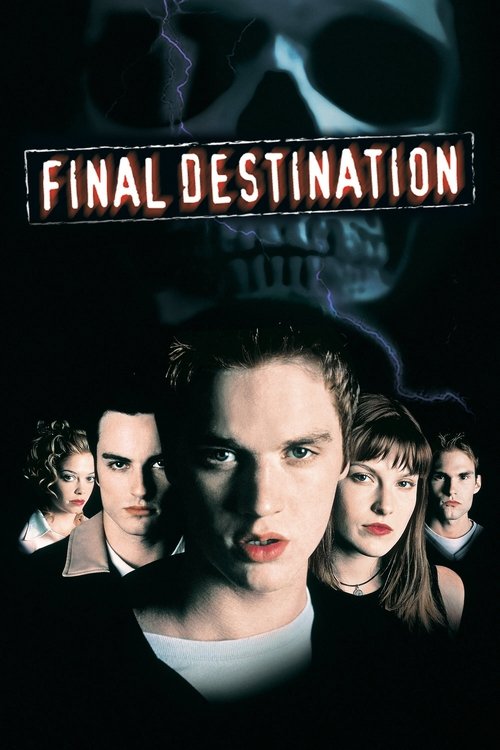
Final Destination
After a teenager has a terrifying vision of him and his friends dying in a plane crash, he prevents the accident only to have Death hunt them down, one by one.
Despite a mid-range budget of $23.0M, Final Destination became a financial success, earning $112.9M worldwide—a 391% return.
3 wins & 5 nominations


Plot Structure
Story beats plotted across runtime


Narrative Arc
Emotional journey through the story's key moments
Story Circle
Blueprint 15-beat structure
Arcplot Score Breakdown
Weighted: Precision (70%) + Arc (15%) + Theme (15%)
Final Destination (2000) demonstrates strategically placed plot construction, characteristic of James Wong's storytelling approach. This structural analysis examines how the film's 15-point plot structure maps to proven narrative frameworks across 1 hour and 38 minutes. With an Arcplot score of 7.3, the film balances conventional beats with creative variation.
Characters
Cast & narrative archetypes

Alex Browning
Clear Rivers
Carter Horton
Billy Hitchcock
Tod Waggner
Terry Chaney
William Bludworth
Main Cast & Characters
Alex Browning
Played by Devon Sawa
High school student who has a premonition of a plane explosion and saves several classmates, only to face Death's design as survivors begin dying in mysterious accidents.
Clear Rivers
Played by Ali Larter
Alex's intelligent and loyal friend who believes his premonition and helps him try to cheat death while grappling with survivor guilt.
Carter Horton
Played by Kerr Smith
Aggressive and antagonistic jock who resents Alex for saving him and struggles with loss of control over his own fate.
Billy Hitchcock
Played by Seann William Scott
Carter's loyal friend and comic relief who tries to maintain normalcy despite the supernatural danger stalking the survivors.
Tod Waggner
Played by Chad Donella
Alex's best friend, sensitive and loyal, who becomes one of the first victims of Death's design in a tragic bathroom accident.
Terry Chaney
Played by Amanda Detmer
Carter's girlfriend who serves as a voice of reason and challenges Carter's reckless behavior before meeting her own fate.
William Bludworth
Played by Tony Todd
Mysterious mortician who seems to understand Death's design and provides cryptic guidance to the survivors about their fate.
Structural Analysis
The Status Quo at 1 minutes (1% through the runtime) establishes Alex Browning prepares for his senior class trip to Paris, packing and reflecting on his normal high school life. His bedroom and interactions with family establish his ordinary world of teenage concerns and excitement about the trip.. Significantly, this early placement immediately immerses viewers in the story world.
The inciting incident occurs at 12 minutes when Alex experiences a horrifying premonition of the plane exploding mid-flight, seeing his classmates die in vivid, terrifying detail. He wakes screaming, causing a disturbance that gets him, Carter, Clear, Billy, Ms. Lewton, Terry, and teacher Mr. Murnau removed from the flight.. At 12% through the film, this Disruption aligns precisely with traditional story structure. This beat shifts the emotional landscape, launching the protagonist into the central conflict.
The First Threshold at 24 minutes marks the transition into Act II, occurring at 25% of the runtime. This shows the protagonist's commitment to Tod dies in a freak bathroom accident—strangled by a clothesline and drowned in his bathtub. Alex witnesses the aftermath and realizes this was no accident. He makes the active choice to investigate Death's pattern, accepting that their survival has consequences and they are still marked for death., moving from reaction to action.
At 48 minutes, the Midpoint arrives at 49% of the runtime—precisely centered, creating perfect narrative symmetry. Notably, this crucial beat After Ms. Lewton's death, Alex realizes the order follows the seating chart from the plane. He and Clear now know exactly who's next: Carter, then Billy, then Clear, then himself. The stakes crystallize—false hope of understanding the pattern is replaced by the terror of knowing when death will strike., fundamentally raising what's at risk. The emotional intensity shifts, dividing the narrative into clear before-and-after phases.
The Collapse moment at 73 minutes (74% through) represents the emotional nadir. Here, Clear is next. She locks herself in her car to hide from death, but it finds her anyway—a gas leak threatens to incinerate her. Alex desperately tries to save her but seemingly fails as an explosion erupts. This is Alex's darkest moment: the whiff of death, the apparent loss of the person he's closest to, and the confirmation that death cannot be cheated., demonstrates the protagonist at their lowest point. This beat's placement in the final quarter sets up the climactic reversal.
The Second Threshold at 79 minutes initiates the final act resolution at 81% of the runtime. Alex synthesizes the knowledge: saving someone can skip them in Death's design. Since Carter saved Clear, the order has shifted—Alex is now next. Armed with this understanding and renewed determination, Alex prepares for death's final attempt, accepting he must face it head-on to break the pattern., demonstrating the transformation achieved throughout the journey.
Emotional Journey
Final Destination's emotional architecture traces a deliberate progression across 15 carefully calibrated beats.
Narrative Framework
This structural analysis employs systematic plot point analysis that identifies crucial turning points. By mapping Final Destination against these established plot points, we can identify how James Wong utilizes or subverts traditional narrative conventions. The plot point approach reveals not only adherence to structural principles but also creative choices that distinguish Final Destination within the horror genre.
James Wong's Structural Approach
Among the 4 James Wong films analyzed on Arcplot, the average structural score is 7.1, reflecting strong command of classical structure. Final Destination represents one of the director's most structurally precise works. For comparative analysis, explore the complete James Wong filmography.
Comparative Analysis
Additional horror films include Thinner, A Nightmare on Elm Street and Mary Reilly. For more James Wong analyses, see Dragonball Evolution, The One and Final Destination 3.
Plot Points by Act
Act I
SetupStatus Quo
Alex Browning prepares for his senior class trip to Paris, packing and reflecting on his normal high school life. His bedroom and interactions with family establish his ordinary world of teenage concerns and excitement about the trip.
Theme
At the airport, a fellow passenger mentions "death has a design" when discussing fate and control. This casual comment foreshadows the central thematic question: Can you cheat death, or is our fate predetermined?
Worldbuilding
The senior class gathers at JFK Airport for their Paris trip. We meet the ensemble: Carter (aggressive boyfriend), Terry (his girlfriend), Clear (introspective observer), Billy (comic relief), Ms. Lewton (teacher), and the teachers chaperoning. Social dynamics, teenage tensions, and anticipation are established as they board Flight 180.
Disruption
Alex experiences a horrifying premonition of the plane exploding mid-flight, seeing his classmates die in vivid, terrifying detail. He wakes screaming, causing a disturbance that gets him, Carter, Clear, Billy, Ms. Lewton, Terry, and teacher Mr. Murnau removed from the flight.
Resistance
In the terminal, the group argues about Alex's outburst. Carter is furious, calling Alex crazy. Then Flight 180 explodes exactly as Alex foresaw, killing everyone aboard. FBI agents question Alex. The survivors grapple with shock, guilt, and the impossible reality that Alex's vision saved them. Alex becomes isolated, suspected, and haunted.
Act II
ConfrontationFirst Threshold
Tod dies in a freak bathroom accident—strangled by a clothesline and drowned in his bathtub. Alex witnesses the aftermath and realizes this was no accident. He makes the active choice to investigate Death's pattern, accepting that their survival has consequences and they are still marked for death.
Mirror World
Clear seeks out Alex after Tod's funeral. Unlike the others, she believes him and wants to understand. She becomes his ally and confidante, representing faith versus skepticism, trust versus paranoia. Their partnership embodies the theme: working together to fight fate.
Premise
Alex and Clear investigate the pattern of Death's design. They research omens, consult with eccentric mortician William Bludworth who confirms "Death doesn't like to be cheated," and try to warn the other survivors. Terry dies next (hit by a bus), then Ms. Lewton in an elaborate kitchen/knife accident. The premise delivers: inventive, Rube Goldberg-style death sequences as they race to understand the order.
Midpoint
After Ms. Lewton's death, Alex realizes the order follows the seating chart from the plane. He and Clear now know exactly who's next: Carter, then Billy, then Clear, then himself. The stakes crystallize—false hope of understanding the pattern is replaced by the terror of knowing when death will strike.
Opposition
Armed with the sequence, Alex tries to save Carter and Billy. Carter, fatalistic and angry, drives recklessly, challenging death. At a train crossing, Alex saves Carter from being hit by the train, seemingly skipping him in the sequence. But immediately after, Billy is decapitated by shrapnel. Death adapts. The rules aren't as simple as they thought. Paranoia and helplessness intensify.
Collapse
Clear is next. She locks herself in her car to hide from death, but it finds her anyway—a gas leak threatens to incinerate her. Alex desperately tries to save her but seemingly fails as an explosion erupts. This is Alex's darkest moment: the whiff of death, the apparent loss of the person he's closest to, and the confirmation that death cannot be cheated.
Crisis
Alex sits in devastation, believing Clear is dead and that he's next and final. He reflects on the futility of fighting fate. But then Clear emerges alive—Carter saved her at the last second, intervening in the design. This sparks the realization: intervention can disrupt the sequence. New hope emerges from despair.
Act III
ResolutionSecond Threshold
Alex synthesizes the knowledge: saving someone can skip them in Death's design. Since Carter saved Clear, the order has shifted—Alex is now next. Armed with this understanding and renewed determination, Alex prepares for death's final attempt, accepting he must face it head-on to break the pattern.
Synthesis
Death comes for Alex in his house through an elaborate chain reaction involving leaking water, electrical hazards, and fire. Alex navigates the deadly Rube Goldberg maze, narrowly escaping as his house explodes. Carter and Clear intervene to save him, seemingly completing the cycle. The survivors believe they've finally won and cheated death for good.
Transformation
Six months later in Paris (the trip they never took), Alex, Clear, and Carter toast their survival at a café. But omens appear—the same signs that preceded earlier deaths. Carter is suddenly killed by a swinging sign. The final image reveals the dark truth: you can delay death, but never escape it. Death's design is inevitable.