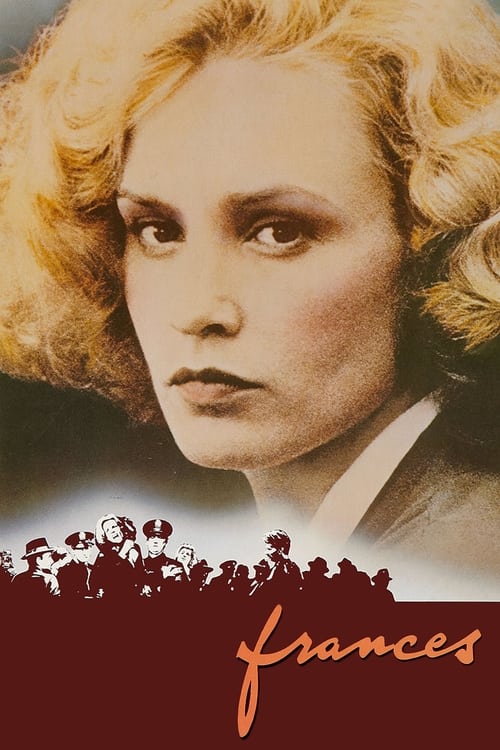
Frances
The true story of Frances Farmer's meteoric rise to fame in Hollywood and the tragic turn her life took when she was blacklisted.
The film disappointed at the box office against its small-scale budget of $8.0M, earning $5.0M globally (-37% loss). While initial box office returns were modest, the film has gained appreciation for its unique voice within the drama genre.
Nominated for 2 Oscars. 2 wins & 10 nominations







Plot Structure
Story beats plotted across runtime


Narrative Arc
Emotional journey through the story's key moments
Story Circle
Blueprint 15-beat structure
Arcplot Score Breakdown
Weighted: Precision (70%) + Arc (15%) + Theme (15%)
Frances (1982) demonstrates deliberately positioned story structure, characteristic of Graeme Clifford's storytelling approach. This structural analysis examines how the film's 15-point plot structure maps to proven narrative frameworks across 2 hours and 20 minutes. With an Arcplot score of 7.1, the film balances conventional beats with creative variation.
Characters
Cast & narrative archetypes

Frances Farmer
Lillian Farmer
Harry York
Clifford Odets
Ernest Farmer
Harold Clurman
Main Cast & Characters
Frances Farmer
Played by Jessica Lange
A passionate actress whose fierce independence and mental health struggles lead to her tragic institutionalization and the loss of her artistic dreams.
Lillian Farmer
Played by Kim Stanley
Frances's domineering mother who believes she knows what's best, ultimately facilitating her daughter's commitment to psychiatric institutions.
Harry York
Played by Sam Shepard
A radical playwright and Frances's lover who shares her political idealism but cannot save her from her downward spiral.
Clifford Odets
Played by Jeffrey DeMunn
The famous playwright who has an affair with Frances and represents both artistic inspiration and Hollywood's compromises.
Ernest Farmer
Played by Bart Burns
Frances's passive father who is unable to stand up to his wife or protect his daughter from institutional abuse.
Harold Clurman
Played by James Broderick
The theatrical director who works with Frances and recognizes her talent but is ultimately powerless to help her.
Structural Analysis
The Status Quo at 2 minutes (1% through the runtime) establishes Young Frances Farmer wins a writing contest in Seattle, showing her fierce intelligence and rebellious spirit against conventional thinking.. The analysis reveals that this early placement immediately immerses viewers in the story world.
The inciting incident occurs at 17 minutes when Frances is offered a contract with Paramount Pictures, disrupting her academic life and pulling her toward Hollywood stardom.. At 12% through the film, this Disruption aligns precisely with traditional story structure. This beat shifts the emotional landscape, launching the protagonist into the central conflict.
The First Threshold at 34 minutes marks the transition into Act II, occurring at 24% of the runtime. This illustrates the protagonist's commitment to Frances actively chooses to fight the studio system rather than conform, refusing to play publicity games and speaking out against Hollywood phoniness., moving from reaction to action.
At 68 minutes, the Midpoint arrives at 49% of the runtime—precisely centered, creating perfect narrative symmetry. Structural examination shows that this crucial beat Frances's public defiance escalates into a highly publicized arrest and legal troubles, marking a false defeat where her rebellion begins to have serious consequences., fundamentally raising what's at risk. The emotional intensity shifts, dividing the narrative into clear before-and-after phases.
The Collapse moment at 104 minutes (74% through) represents the emotional nadir. Here, Frances undergoes a transorbital lobotomy, a literal death of her spirit and identity, the most devastating violation of her selfhood., demonstrates the protagonist at their lowest point. This beat's placement in the final quarter sets up the climactic reversal.
The Second Threshold at 112 minutes initiates the final act resolution at 80% of the runtime. Frances is released and attempts to resume some form of life, carrying the knowledge of what resistance to conformity cost her., demonstrating the transformation achieved throughout the journey.
Emotional Journey
Frances's emotional architecture traces a deliberate progression across 15 carefully calibrated beats.
Narrative Framework
This structural analysis employs structural analysis methodology used to understand storytelling architecture. By mapping Frances against these established plot points, we can identify how Graeme Clifford utilizes or subverts traditional narrative conventions. The plot point approach reveals not only adherence to structural principles but also creative choices that distinguish Frances within the drama genre.
Comparative Analysis
Additional drama films include After Thomas, South Pacific and Dirty Dancing: Havana Nights.
Plot Points by Act
Act I
SetupStatus Quo
Young Frances Farmer wins a writing contest in Seattle, showing her fierce intelligence and rebellious spirit against conventional thinking.
Theme
Frances's mother Lillian says, "You have to learn to play the game," foreshadowing the central conflict between authenticity and conformity.
Worldbuilding
Establishment of Frances's intellectual pursuits, her difficult relationship with her controlling mother, her college years, and her discovery by Hollywood talent scouts.
Disruption
Frances is offered a contract with Paramount Pictures, disrupting her academic life and pulling her toward Hollywood stardom.
Resistance
Frances debates whether to accept Hollywood's terms, travels to Los Angeles, struggles with the studio system, and begins to clash with industry expectations while her mother pushes her forward.
Act II
ConfrontationFirst Threshold
Frances actively chooses to fight the studio system rather than conform, refusing to play publicity games and speaking out against Hollywood phoniness.
Mirror World
Frances meets and begins a relationship with Clifford Odets, a fellow artist who represents authenticity and artistic integrity, embodying the alternative to Hollywood superficiality.
Premise
Frances pursues her acting career on her own terms, achieves Broadway success, navigates her passionate relationship with Odets, and increasingly rebels against Hollywood control and her mother's manipulation.
Midpoint
Frances's public defiance escalates into a highly publicized arrest and legal troubles, marking a false defeat where her rebellion begins to have serious consequences.
Opposition
The forces against Frances intensify: her mother has her institutionalized, she endures brutal psychiatric treatments, loses her freedom and autonomy, and faces the full power of family and medical establishment.
Collapse
Frances undergoes a transorbital lobotomy, a literal death of her spirit and identity, the most devastating violation of her selfhood.
Crisis
Post-lobotomy Frances exists in a diminished state, processing the profound loss of who she was, her fire extinguished.
Act III
ResolutionSecond Threshold
Frances is released and attempts to resume some form of life, carrying the knowledge of what resistance to conformity cost her.
Synthesis
Frances makes brief attempts at performing again, confronts her diminished reality, and the film shows the tragic aftermath of her struggle against the system that destroyed her.
Transformation
Final image of Frances alone, broken but surviving, a stark contrast to the vibrant, defiant young woman from the opening - transformation through tragedy.