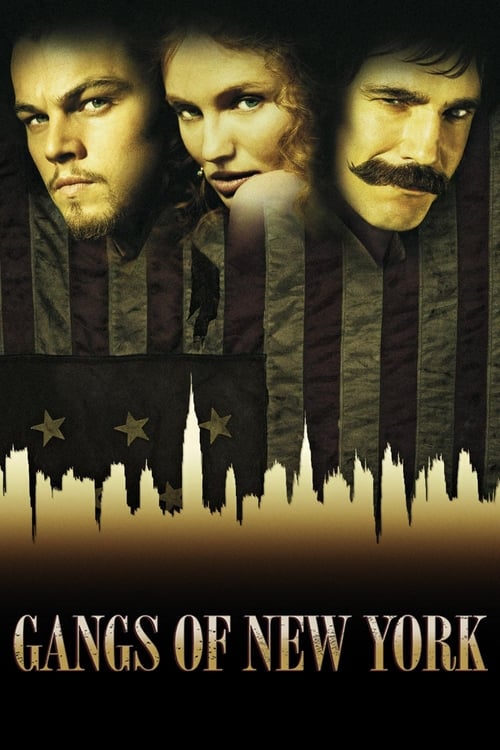
Gangs of New York
In 1862, Amsterdam Vallon returns to the Five Points area of New York City seeking revenge against Bill the Butcher; his father's killer.
Working with a significant budget of $100.0M, the film achieved a steady performer with $193.8M in global revenue (+94% profit margin).
Nominated for 10 Oscars. 50 wins & 135 nominations


Plot Structure
Story beats plotted across runtime


Narrative Arc
Emotional journey through the story's key moments
Story Circle
Blueprint 15-beat structure
Characters
Cast & narrative archetypes

Amsterdam Vallon
Bill "The Butcher" Cutting
Jenny Everdeane
Priest Vallon
Boss William "Boss" Tweed
Johnny Sirocco
Happy Jack Mulraney
Walter "Monk" McGinn
Main Cast & Characters
Amsterdam Vallon
Played by Leonardo DiCaprio
Son of a murdered gang leader who returns to Five Points seeking revenge against Bill the Butcher
Bill "The Butcher" Cutting
Played by Daniel Day-Lewis
Ruthless nativist gang leader who killed Amsterdam's father and rules Five Points with an iron fist
Jenny Everdeane
Played by Cameron Diaz
Skilled pickpocket and con artist who becomes romantically involved with Amsterdam
Priest Vallon
Played by Liam Neeson
Amsterdam's father and leader of the Dead Rabbits gang, killed by Bill the Butcher in the opening battle
Boss William "Boss" Tweed
Played by Jim Broadbent
Corrupt political boss of Tammany Hall who manipulates elections and controls New York politics
Johnny Sirocco
Played by Henry Thomas
Ruthless enforcer for Bill the Butcher and member of the Natives gang
Happy Jack Mulraney
Played by John C. Reilly
Corrupt police officer who works for both Boss Tweed and Bill the Butcher
Walter "Monk" McGinn
Played by Brendan Gleeson
Priest turned prizefighter and close friend of Amsterdam who helps him navigate Five Points
Structural Analysis
The Status Quo at 1 minutes (1% through the runtime) establishes Young Amsterdam watches his father Priest Vallon prepare for battle in 1846, establishing the tribal warfare of Five Points and the world of honor Amsterdam knew before everything changed.. Notably, this early placement immediately immerses viewers in the story world.
The inciting incident occurs at 20 minutes when Amsterdam witnesses Bill the Butcher's power and brutality firsthand at a public gathering, seeing the man who killed his father celebrated as a hero. The festering wound of his father's murder becomes urgent - he cannot ignore his purpose for returning.. At 12% through the film, this Disruption aligns precisely with traditional story structure. This beat shifts the emotional landscape, launching the protagonist into the central conflict.
The First Threshold at 41 minutes marks the transition into Act II, occurring at 25% of the runtime. This illustrates the protagonist's commitment to Amsterdam actively saves Bill's life during an assassination attempt, earning his trust and a place at his right hand. He commits to the long game of infiltration, crossing into a dangerous double life where he must become close to the man he intends to kill., moving from reaction to action.
At 83 minutes, the Midpoint arrives at 49% of the runtime—precisely centered, creating perfect narrative symmetry. Structural examination shows that this crucial beat Amsterdam appears to have everything aligned: Bill's complete trust, Jenny's love, a plan for revenge, and growing support from the Irish community. But this false victory begins to crack when Bill starts sensing something familiar about Amsterdam, and the stakes raise as the Draft Riots approach., fundamentally raising what's at risk. The emotional intensity shifts, dividing the narrative into clear before-and-after phases.
The Collapse moment at 124 minutes (74% through) represents the emotional nadir. Here, Amsterdam lies defeated and humiliated in the streets, beaten and branded by Bill. His revenge has failed, his identity exposed, his honor destroyed. The whiff of death: he is symbolically dead, and the old tribal world of his father is revealed as finished, unable to stand against Bill or the changing city., indicates the protagonist at their lowest point. This beat's placement in the final quarter sets up the climactic reversal.
The Second Threshold at 133 minutes initiates the final act resolution at 79% of the runtime. Amsterdam realizes the fight isn't just personal revenge - it's about ending Bill's reign of terror and the old tribal system entirely. He rallies the Dead Rabbits not for his father's honor alone, but for a new Five Points. He synthesizes his father's courage with a broader purpose., demonstrating the transformation achieved throughout the journey.
Emotional Journey
Gangs of New York's emotional architecture traces a deliberate progression across 15 carefully calibrated beats.
Narrative Framework
This structural analysis employs systematic plot point analysis that identifies crucial turning points. By mapping Gangs of New York against these established plot points, we can identify how Martin Scorsese utilizes or subverts traditional narrative conventions. The plot point approach reveals not only adherence to structural principles but also creative choices that distinguish Gangs of New York within the crime genre.
Martin Scorsese's Structural Approach
Among the 18 Martin Scorsese films analyzed on Arcplot, the average structural score is 6.0, showcasing experimental approaches to narrative form. Gangs of New York exemplifies the director's characteristic narrative technique. For comparative analysis, explore the complete Martin Scorsese filmography.
Comparative Analysis
Additional crime films include The Bad Guys, Rustom and The Whole Ten Yards. For more Martin Scorsese analyses, see Casino, Killers of the Flower Moon and After Hours.
Plot Points by Act
Act I
SetupStatus Quo
Young Amsterdam watches his father Priest Vallon prepare for battle in 1846, establishing the tribal warfare of Five Points and the world of honor Amsterdam knew before everything changed.
Theme
Priest Vallon tells young Amsterdam "The blood stays on the blade" - foreshadowing the cycle of revenge and the question of whether violence and tribal loyalty define identity or destroy it.
Worldbuilding
The 1846 battle at Paradise Square where Bill the Butcher kills Priest Vallon, followed by a 16-year time jump. Adult Amsterdam returns from Hellgate reformatory to Five Points in 1862, now ruled by Bill. The world is established: tribal gangs, Tammany Hall corruption, Draft Riots brewing, and Bill's complete dominance.
Disruption
Amsterdam witnesses Bill the Butcher's power and brutality firsthand at a public gathering, seeing the man who killed his father celebrated as a hero. The festering wound of his father's murder becomes urgent - he cannot ignore his purpose for returning.
Resistance
Amsterdam debates how to approach his revenge. Johnny Sirocco mentors him on surviving Five Points. He works his way into Bill's inner circle, concealing his identity, learning Bill's routines and vulnerabilities while wrestling with the risk of his plan.
Act II
ConfrontationFirst Threshold
Amsterdam actively saves Bill's life during an assassination attempt, earning his trust and a place at his right hand. He commits to the long game of infiltration, crossing into a dangerous double life where he must become close to the man he intends to kill.
Mirror World
Amsterdam's relationship with Jenny Everdeane deepens. She represents a different path - survival through adaptability rather than revenge, challenging his single-minded purpose and showing him what life beyond vengeance might offer.
Premise
Amsterdam lives the promise of the premise: operating as Bill's trusted lieutenant while secretly plotting revenge. He explores Five Points' power dynamics, grows closer to Jenny, navigates Tammany Hall politics, and prepares for his moment. The fun is in watching him play both sides.
Midpoint
Amsterdam appears to have everything aligned: Bill's complete trust, Jenny's love, a plan for revenge, and growing support from the Irish community. But this false victory begins to crack when Bill starts sensing something familiar about Amsterdam, and the stakes raise as the Draft Riots approach.
Opposition
Bill discovers Amsterdam's true identity as Priest Vallon's son. Amsterdam's revenge attempt fails publicly and humiliatingly. Bill brands him and banishes him rather than killing him - a worse fate. Meanwhile, the Civil War Draft Riots explode, Jenny's loyalty wavers, and Amsterdam loses his support network. Everything closes in.
Collapse
Amsterdam lies defeated and humiliated in the streets, beaten and branded by Bill. His revenge has failed, his identity exposed, his honor destroyed. The whiff of death: he is symbolically dead, and the old tribal world of his father is revealed as finished, unable to stand against Bill or the changing city.
Crisis
Amsterdam's dark night as he recovers physically and emotionally. He grapples with whether revenge still matters, whether his father's way has any meaning in this new world. Jenny and his remaining allies stand by him, but he must find a new reason to fight beyond simple vengeance.
Act III
ResolutionSecond Threshold
Amsterdam realizes the fight isn't just personal revenge - it's about ending Bill's reign of terror and the old tribal system entirely. He rallies the Dead Rabbits not for his father's honor alone, but for a new Five Points. He synthesizes his father's courage with a broader purpose.
Synthesis
The final battle at Paradise Square. As the Draft Riots rage and Navy ships bombard Five Points, Amsterdam faces Bill in single combat. He kills Bill, fulfilling his revenge, but the old world dies with him - literally buried by cannonfire and progress. The tribal age ends as America transforms.
Transformation
Amsterdam stands with Jenny at his father's and Bill's graves, now overgrown and forgotten beneath the emerging Manhattan skyline. He has completed his revenge but found something beyond it - accepting that the past must be buried for the future to rise. The blood has finally left the blade.