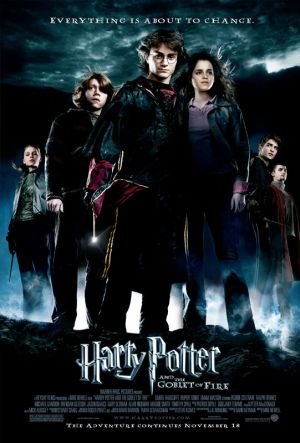
Harry Potter and the Goblet of Fire
Harry's (Daniel Radcliffe's) fourth year at Hogwarts is about to start and he is enjoying the summer vacation with his friends. They get the tickets to The Quidditch World Cup Final, but after the match is over, people dressed like Lord Voldemort's (Ralph Fiennes') "Death Eaters" set a fire to all of the visitors' tents, coupled with the appearance of Voldemort's symbol, the "Dark Mark" in the sky, which causes a frenzy across the magical community. That same year, Hogwarts is hosting "The Triwizard Tournament", a magical tournament between three well-known schools of magic : Hogwarts, Beauxbatons, and Durmstrang. The contestants have to be above the age of seventeen, and are chosen by a magical object called "The Goblet of Fire". On the night of selection, however, the Goblet spews out four names instead of the usual three, with Harry unwittingly being selected as the Fourth Champion. Since the magic cannot be reversed, Harry is forced to go with it and brave three exceedingly difficult tasks.
Despite a blockbuster budget of $150.0M, Harry Potter and the Goblet of Fire became a financial success, earning $895.9M worldwide—a 497% return. This commercial performance validated the ambitious narrative scope, showing that audiences embrace fresh perspective even at blockbuster scale.
Nominated for 1 Oscar. 13 wins & 48 nominations


Plot Structure
Story beats plotted across runtime


Narrative Arc
Emotional journey through the story's key moments
Story Circle
Blueprint 15-beat structure
Arcplot Score Breakdown
Weighted: Precision (70%) + Arc (15%) + Theme (15%)
Harry Potter and the Goblet of Fire (2005) exemplifies meticulously timed narrative design, characteristic of Mike Newell's storytelling approach. This structural analysis examines how the film's 15-point plot structure maps to proven narrative frameworks across 2 hours and 37 minutes. With an Arcplot score of 3.3, the film takes an unconventional approach to traditional narrative frameworks.
Characters
Cast & narrative archetypes

Harry Potter
Hermione Granger
Ron Weasley
Lord Voldemort
Albus Dumbledore
Alastor "Mad-Eye" Moody
Cedric Diggory
Severus Snape
Sirius Black
Barty Crouch Jr.
Main Cast & Characters
Harry Potter
Played by Daniel Radcliffe
A teenage wizard thrust into the dangerous Triwizard Tournament against his will, facing deadly challenges while uncovering a dark conspiracy.
Hermione Granger
Played by Emma Watson
Harry's brilliant and loyal friend who supports him through the tournament while navigating her own romantic complications.
Ron Weasley
Played by Rupert Grint
Harry's best friend who struggles with jealousy when Harry's name emerges from the Goblet of Fire, testing their friendship.
Lord Voldemort
Played by Ralph Fiennes
The dark wizard who orchestrates the tournament conspiracy to use Harry's blood in his resurrection ritual.
Albus Dumbledore
Played by Michael Gambon
Hogwarts headmaster who guides and protects Harry while navigating the political complexities of the Triwizard Tournament.
Alastor "Mad-Eye" Moody
Played by Brendan Gleeson
The new Defense Against the Dark Arts teacher who mentors Harry, though his true identity harbors a sinister secret.
Cedric Diggory
Played by Robert Pattinson
The honorable Hufflepuff champion who represents fair play and becomes a tragic victim of Voldemort's plot.
Severus Snape
Played by Alan Rickman
The suspicious Potions Master whose loyalties remain ambiguous throughout the tournament events.
Sirius Black
Played by Gary Oldman
Harry's godfather who provides emotional support and warnings from hiding via magical communications.
Barty Crouch Jr.
Played by David Tennant
Death Eater who impersonates Mad-Eye Moody to manipulate Harry into Voldemort's trap.
Structural Analysis
The Status Quo at 2 minutes (1% through the runtime) establishes Harry wakes from a nightmare at the Burrow after witnessing Voldemort and Wormtail plotting murder at the Riddle House. His scar burns with pain, establishing that dark forces are stirring and Harry's connection to Voldemort remains dangerous.. Of particular interest, this early placement immediately immerses viewers in the story world.
The inciting incident occurs at 17 minutes when Death Eaters attack the Quidditch World Cup campsite, terrorizing Muggles and wizards alike. Harry is separated from his friends and witnesses the Dark Mark conjured in the sky—the first public sign that Voldemort's followers are mobilizing again.. At 11% through the film, this Disruption aligns precisely with traditional story structure. This beat shifts the emotional landscape, launching the protagonist into the central conflict.
The First Threshold at 34 minutes marks the transition into Act II, occurring at 22% of the runtime. This illustrates the protagonist's commitment to The Goblet of Fire unexpectedly selects Harry as a fourth champion despite his not entering. Dumbledore's urgent questioning and the binding magical contract mean Harry has no choice but to compete—he is thrust into a deadly tournament against his will., moving from reaction to action.
At 71 minutes, the Midpoint arrives at 45% of the runtime—arriving early, accelerating into Act IIb complications. The analysis reveals that this crucial beat After Harry's triumphant performance against the dragon, Ron reconciles with him in the Gryffindor common room, admitting he was wrong to doubt his friend. Their friendship restored, Harry is no longer alone—a false victory before darker trials ahead., fundamentally raising what's at risk. The emotional intensity shifts, dividing the narrative into clear before-and-after phases.
The Collapse moment at 105 minutes (67% through) represents the emotional nadir. Here, Harry and Cedric grab the Triwizard Cup together, but it's a Portkey that transports them to a graveyard. Wormtail appears and, on Voldemort's command, murders Cedric with the Killing Curse. Harry watches helplessly as an innocent dies—the ultimate "whiff of death."., illustrates the protagonist at their lowest point. This beat's placement in the final quarter sets up the climactic reversal.
The Second Threshold at 114 minutes initiates the final act resolution at 73% of the runtime. When Harry and Voldemort's wands connect through Priori Incantatem, the spirits of Voldemort's victims emerge—including Harry's parents. They give Harry the strength and time to escape, transforming his understanding: love and sacrifice provide protection against evil., demonstrating the transformation achieved throughout the journey.
Emotional Journey
Harry Potter and the Goblet of Fire's emotional architecture traces a deliberate progression across 15 carefully calibrated beats.
Narrative Framework
This structural analysis employs structural analysis methodology used to understand storytelling architecture. By mapping Harry Potter and the Goblet of Fire against these established plot points, we can identify how Mike Newell utilizes or subverts traditional narrative conventions. The plot point approach reveals not only adherence to structural principles but also creative choices that distinguish Harry Potter and the Goblet of Fire within the adventure genre.
Mike Newell's Structural Approach
Among the 11 Mike Newell films analyzed on Arcplot, the average structural score is 6.9, demonstrating varied approaches to story architecture. Harry Potter and the Goblet of Fire takes a more unconventional approach compared to the director's typical style. For comparative analysis, explore the complete Mike Newell filmography.
Comparative Analysis
Additional adventure films include The Black Stallion, The Bad Guys and Puss in Boots. For more Mike Newell analyses, see Prince of Persia: The Sands of Time, Mona Lisa Smile and Four Weddings and a Funeral.
Plot Points by Act
Act I
SetupStatus Quo
Harry wakes from a nightmare at the Burrow after witnessing Voldemort and Wormtail plotting murder at the Riddle House. His scar burns with pain, establishing that dark forces are stirring and Harry's connection to Voldemort remains dangerous.
Theme
Arthur Weasley warns the children to stick together at the Quidditch World Cup: "Dark times lie ahead." This foreshadows the film's exploration of how difficult times reveal character, and how unity and loyalty become essential when facing evil.
Worldbuilding
The magical world expands dramatically: Harry experiences the Quidditch World Cup with the Weasleys, witnesses international wizarding culture, and sees the joy of the magical community. His relationships with Ron and Hermione are established as central to his identity.
Disruption
Death Eaters attack the Quidditch World Cup campsite, terrorizing Muggles and wizards alike. Harry is separated from his friends and witnesses the Dark Mark conjured in the sky—the first public sign that Voldemort's followers are mobilizing again.
Resistance
At Hogwarts, Dumbledore announces the Triwizard Tournament and introduces visitors from Beauxbatons and Durmstrang. Mad-Eye Moody arrives as the new Defense Against the Dark Arts teacher, demonstrating the Unforgivable Curses. The age restriction is set, seemingly excluding Harry.
Act II
ConfrontationFirst Threshold
The Goblet of Fire unexpectedly selects Harry as a fourth champion despite his not entering. Dumbledore's urgent questioning and the binding magical contract mean Harry has no choice but to compete—he is thrust into a deadly tournament against his will.
Mirror World
Ron refuses to believe Harry didn't enter his name, their friendship fracturing from jealousy and mistrust. Hermione becomes Harry's primary emotional support, and this rift forces Harry to confront what true friendship means when facing impossible challenges alone.
Premise
Harry navigates the tournament's challenges: Rita Skeeter's malicious journalism, learning about dragons from Hagrid, Moody's suspicious helpfulness, and the spectacular First Task where Harry outflies a Hungarian Horntail. The Yule Ball brings teenage awkwardness and romantic tension.
Midpoint
After Harry's triumphant performance against the dragon, Ron reconciles with him in the Gryffindor common room, admitting he was wrong to doubt his friend. Their friendship restored, Harry is no longer alone—a false victory before darker trials ahead.
Opposition
Pressure mounts as Harry completes the Second Task in the Black Lake, rescuing Ron. Barty Crouch Sr. appears mad and is later found murdered. Harry experiences disturbing visions of Voldemort. The Third Task begins in the hedge maze, where champions face magical obstacles and each other.
Collapse
Harry and Cedric grab the Triwizard Cup together, but it's a Portkey that transports them to a graveyard. Wormtail appears and, on Voldemort's command, murders Cedric with the Killing Curse. Harry watches helplessly as an innocent dies—the ultimate "whiff of death."
Crisis
Harry is bound to Tom Riddle's gravestone as Wormtail performs the dark ritual using Harry's blood. Voldemort is reborn in physical form, summons his Death Eaters, and tortures Harry with the Cruciatus Curse. Harry faces death alone, forced to duel the most powerful dark wizard in history.
Act III
ResolutionSecond Threshold
When Harry and Voldemort's wands connect through Priori Incantatem, the spirits of Voldemort's victims emerge—including Harry's parents. They give Harry the strength and time to escape, transforming his understanding: love and sacrifice provide protection against evil.
Synthesis
Harry escapes with Cedric's body. Moody is revealed to be Barty Crouch Jr. using Polyjuice Potion—he manipulated the entire tournament to deliver Harry to Voldemort. Under Veritaserum, Crouch confesses everything. The truth is exposed, though the Ministry's denial begins.
Transformation
Dumbledore addresses the school about Cedric's death and Voldemort's return: "Dark and difficult times lie ahead. We must choose between what is right and what is easy." Harry watches Durmstrang and Beauxbatons depart, forever changed—no longer innocent, but resolute.