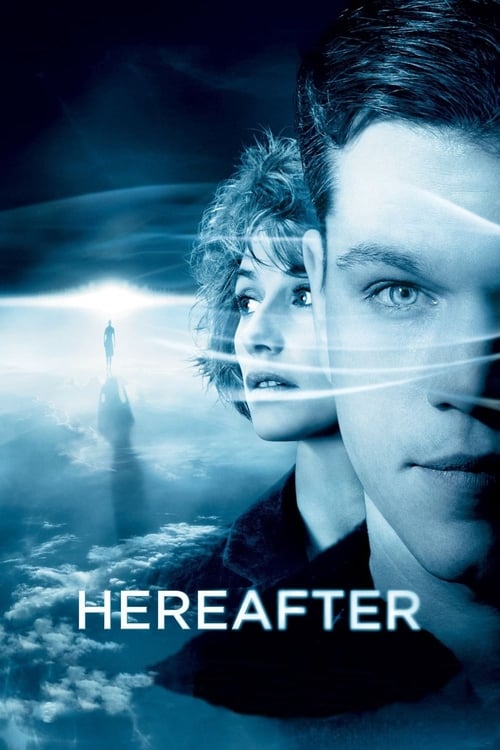
Hereafter
Three people — a blue-collar American, a French journalist and a London school boy — are touched by death in different ways.
Despite a moderate budget of $50.0M, Hereafter became a solid performer, earning $107.0M worldwide—a 114% return.
Nominated for 1 Oscar. 4 wins & 15 nominations


Plot Structure
Story beats plotted across runtime


Narrative Arc
Emotional journey through the story's key moments
Story Circle
Blueprint 15-beat structure
Arcplot Score Breakdown
Weighted: Precision (70%) + Arc (15%) + Theme (15%)
Hereafter (2010) reveals meticulously timed narrative design, characteristic of Clint Eastwood's storytelling approach. This structural analysis examines how the film's 15-point plot structure maps to proven narrative frameworks across 2 hours and 9 minutes. With an Arcplot score of 6.9, the film balances conventional beats with creative variation.
Characters
Cast & narrative archetypes

George Lonegan
Marie Lelay
Marcus
Jason
Billy Lonegan
Main Cast & Characters
George Lonegan
Played by Matt Damon
A reluctant psychic who can communicate with the dead but views his gift as a curse that isolates him from normal life.
Marie Lelay
Played by Cécile de France
A French journalist who has a near-death experience during the 2004 tsunami and becomes obsessed with understanding the afterlife.
Marcus
Played by Frankie McLaren
A young British boy dealing with grief after losing his twin brother, desperately seeking to connect with him again.
Jason
Played by George McLaren
Marcus's twin brother who dies in a tragic accident, leaving Marcus devastated and searching for closure.
Billy Lonegan
Played by Jay Mohr
George's opportunistic brother who manages his psychic business and constantly pressures him to profit from his abilities.
Structural Analysis
The Status Quo at 1 minutes (1% through the runtime) establishes Marie LeLay enjoys a romantic vacation in Indonesia with Didier, establishing her successful life as a French television journalist before the catastrophic tsunami strikes.. Of particular interest, this early placement immediately immerses viewers in the story world.
The inciting incident occurs at 15 minutes when Marie's near-death experience becomes an obsession that disrupts her career; George is pressured by his brother Billy to resume psychic readings; Marcus and Jason's mother enters rehab, and Jason is killed by street thugs.. At 12% through the film, this Disruption aligns precisely with traditional story structure. This beat shifts the emotional landscape, launching the protagonist into the central conflict.
The First Threshold at 33 minutes marks the transition into Act II, occurring at 25% of the runtime. This reveals the protagonist's commitment to George quits his factory job after being manipulated into giving readings to coworkers. Marie is forced to take leave from her television job when her near-death research becomes too controversial. Marcus is placed in foster care. All three actively choose to pursue their obsessions with death and the afterlife., moving from reaction to action.
At 65 minutes, the Midpoint arrives at 50% of the runtime—precisely centered, creating perfect narrative symmetry. Of particular interest, this crucial beat George performs a reading for Melanie, revealing tragic details about her father's death and her daughter. This moment of genuine connection through his gift simultaneously destroys their relationship—she cannot bear to see him again. George realizes his ability makes normal life impossible., fundamentally raising what's at risk. The emotional intensity shifts, dividing the narrative into clear before-and-after phases.
The Collapse moment at 96 minutes (75% through) represents the emotional nadir. Here, George, isolated in his London hotel room, reaches his lowest point—completely alone, cut off from both the living (failed relationship with Melanie) and unable to escape his connection to the dead. Marcus faces potential permanent separation from his foster family. Marie is professionally destroyed., indicates the protagonist at their lowest point. This beat's placement in the final quarter sets up the climactic reversal.
The Second Threshold at 102 minutes initiates the final act resolution at 79% of the runtime. At the London Book Fair, George discovers Marie's book and recognizes her from a vision. Marcus, through persistent research, discovers George is attending a Dickens reading at the book fair. The three storylines converge as fate/synchronicity brings them together., demonstrating the transformation achieved throughout the journey.
Emotional Journey
Hereafter's emotional architecture traces a deliberate progression across 15 carefully calibrated beats.
Narrative Framework
This structural analysis employs proven narrative structure principles that track dramatic progression. By mapping Hereafter against these established plot points, we can identify how Clint Eastwood utilizes or subverts traditional narrative conventions. The plot point approach reveals not only adherence to structural principles but also creative choices that distinguish Hereafter within the drama genre.
Clint Eastwood's Structural Approach
Among the 32 Clint Eastwood films analyzed on Arcplot, the average structural score is 6.5, demonstrating varied approaches to story architecture. Hereafter represents one of the director's most structurally precise works. For comparative analysis, explore the complete Clint Eastwood filmography.
Comparative Analysis
Additional drama films include After Thomas, South Pacific and Dirty Dancing: Havana Nights. For more Clint Eastwood analyses, see True Crime, Million Dollar Baby and The Gauntlet.
Plot Points by Act
Act I
SetupStatus Quo
Marie LeLay enjoys a romantic vacation in Indonesia with Didier, establishing her successful life as a French television journalist before the catastrophic tsunami strikes.
Theme
During the aftermath of the tsunami, Marie experiences a near-death vision of shadowy figures in white light, introducing the film's central question: what lies beyond death?
Worldbuilding
Establishes three separate worlds: Marie's high-profile journalism career in Paris, George's isolated life in San Francisco hiding his psychic abilities while working at a factory, and the London twins Marcus and Jason living with their drug-addicted mother.
Disruption
Marie's near-death experience becomes an obsession that disrupts her career; George is pressured by his brother Billy to resume psychic readings; Marcus and Jason's mother enters rehab, and Jason is killed by street thugs.
Resistance
Marie struggles to return to normal work but begins researching near-death experiences. George reluctantly performs one reading for Billy's client, reopening painful memories. Marcus, now alone, desperately seeks ways to contact his dead twin brother.
Act II
ConfrontationFirst Threshold
George quits his factory job after being manipulated into giving readings to coworkers. Marie is forced to take leave from her television job when her near-death research becomes too controversial. Marcus is placed in foster care. All three actively choose to pursue their obsessions with death and the afterlife.
Mirror World
George enrolls in an Italian cooking class where he meets Melanie, a genuine romantic connection that represents the possibility of normal human connection and living life in the present rather than dwelling on death.
Premise
George explores a relationship with Melanie while working on self-improvement. Marie writes her book about near-death experiences. Marcus visits fraudulent psychics seeking contact with Jason. The film explores its premise: how do these characters navigate life after encountering death?
Midpoint
George performs a reading for Melanie, revealing tragic details about her father's death and her daughter. This moment of genuine connection through his gift simultaneously destroys their relationship—she cannot bear to see him again. George realizes his ability makes normal life impossible.
Opposition
George falls into deeper isolation, traveling to London alone. Marie's book is published but professionally ostracizes her. Marcus continues his desperate search, encountering only frauds and exploitation. The characters' obsessions with the afterlife increasingly separate them from the living world.
Collapse
George, isolated in his London hotel room, reaches his lowest point—completely alone, cut off from both the living (failed relationship with Melanie) and unable to escape his connection to the dead. Marcus faces potential permanent separation from his foster family. Marie is professionally destroyed.
Crisis
George wanders London in despair. Marcus faces a crisis with his foster placement. Marie attends a book fair in London, uncertain of her future. The three characters are in the same city, each at their darkest moment, not yet knowing their paths will converge.
Act III
ResolutionSecond Threshold
At the London Book Fair, George discovers Marie's book and recognizes her from a vision. Marcus, through persistent research, discovers George is attending a Dickens reading at the book fair. The three storylines converge as fate/synchronicity brings them together.
Synthesis
George gives Marcus the reading he desperately needs, providing genuine closure with Jason. George and Marie connect, recognizing each other's authentic experience with death. Rather than isolation, their encounters with the afterlife become the foundation for genuine human connection with others who understand.
Transformation
George and Marie meet in a café, tentatively beginning a relationship. Unlike the opening where characters were isolated in their separate lives, they now connect through shared understanding. Death, rather than separating them from life, has led them to each other. Marcus smiles, at peace.