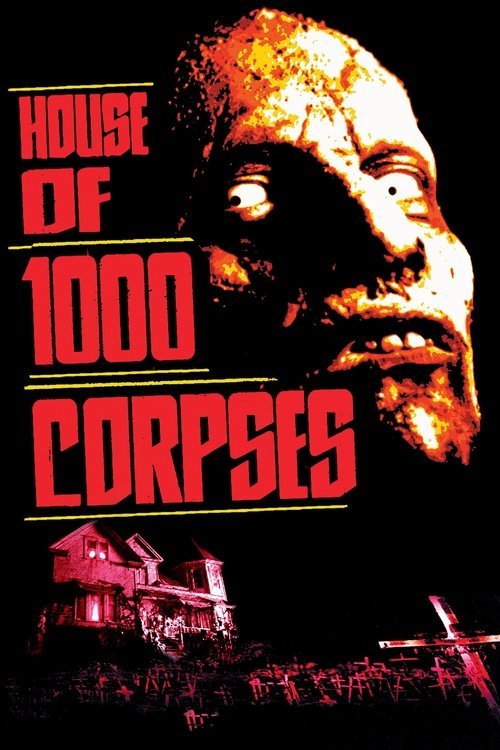
House of 1000 Corpses
Two teenage couples traveling across the backwoods of Texas searching for urban legends of serial killers end up as prisoners of a bizarre and sadistic backwater family of serial killers.
Despite its modest budget of $7.0M, House of 1000 Corpses became a solid performer, earning $17.9M worldwide—a 156% return.
4 wins & 8 nominations


Plot Structure
Story beats plotted across runtime


Narrative Arc
Emotional journey through the story's key moments
Story Circle
Blueprint 15-beat structure
Arcplot Score Breakdown
Weighted: Precision (70%) + Arc (15%) + Theme (15%)
House of 1000 Corpses (2003) exhibits precise plot construction, characteristic of Rob Zombie's storytelling approach. This structural analysis examines how the film's 15-point plot structure maps to proven narrative frameworks across 1 hour and 29 minutes. With an Arcplot score of 7.3, the film balances conventional beats with creative variation.
Characters
Cast & narrative archetypes

Captain Spaulding
Baby Firefly
Otis Driftwood
Mother Firefly
Jerry Goldsmith
Denise Willis
Bill Hudley
Mary Knowles
Main Cast & Characters
Captain Spaulding
Played by Sid Haig
A demented clown who runs a gas station and roadside attraction, serving as the first contact point for the doomed travelers.
Baby Firefly
Played by Sheri Moon Zombie
A sadistic and sexually aggressive member of the Firefly family who lures victims and participates gleefully in their torture.
Otis Driftwood
Played by Bill Moseley
The most brutal and intelligent member of the Firefly clan, an artist who creates grotesque sculptures from human remains.
Mother Firefly
Played by Karen Black
The matriarch of the murderous Firefly family who initially appears welcoming before revealing her true nature.
Jerry Goldsmith
Played by Chris Hardwick
A young man traveling cross-country researching roadside attractions who becomes one of the Firefly family's victims.
Denise Willis
Played by Erin Daniels
Jerry's girlfriend and part of the doomed group of travelers who falls victim to the Firefly family.
Bill Hudley
Played by Rainn Wilson
One of the travelers researching roadside attractions, he becomes separated and tortured by the family.
Mary Knowles
Played by Jennifer Jostyn
Bill's girlfriend and member of the ill-fated group of young travelers.
Structural Analysis
The Status Quo at 1 minutes (1% through the runtime) establishes Four young friends on a cross-country road trip researching offbeat roadside attractions, carefree and enjoying their Halloween adventure in rural Texas.. The analysis reveals that this early placement immediately immerses viewers in the story world.
The inciting incident occurs at 10 minutes when The group decides to search for Dr. Satan's hanging tree despite warnings, picking up hitchhiker Baby who directs them down a dark road into danger.. At 12% through the film, this Disruption aligns precisely with traditional story structure. This beat shifts the emotional landscape, launching the protagonist into the central conflict.
The First Threshold at 22 minutes marks the transition into Act II, occurring at 24% of the runtime. This indicates the protagonist's commitment to The group accepts Mother Firefly's invitation to wait inside the house for a tow truck, actively choosing to enter the nightmare despite red flags., moving from reaction to action.
At 43 minutes, the Midpoint arrives at 49% of the runtime—precisely centered, creating perfect narrative symmetry. Significantly, this crucial beat The family fully reveals their murderous intent. The victims are separated, tortured, and terrorized in elaborate ritualistic fashion. All pretense drops., fundamentally raising what's at risk. The emotional intensity shifts, dividing the narrative into clear before-and-after phases.
The Collapse moment at 66 minutes (74% through) represents the emotional nadir. Here, The surviving victims are dragged underground to Dr. Satan's lair, discovering the horrific reality beneath the house. Hope of escape dies., indicates the protagonist at their lowest point. This beat's placement in the final quarter sets up the climactic reversal.
The Second Threshold at 72 minutes initiates the final act resolution at 81% of the runtime. Denise makes a final desperate attempt to escape through the underground tunnels, finding brief hope of survival., demonstrating the transformation achieved throughout the journey.
Emotional Journey
House of 1000 Corpses's emotional architecture traces a deliberate progression across 15 carefully calibrated beats.
Narrative Framework
This structural analysis employs a 15-point narrative structure framework that maps key story moments. By mapping House of 1000 Corpses against these established plot points, we can identify how Rob Zombie utilizes or subverts traditional narrative conventions. The plot point approach reveals not only adherence to structural principles but also creative choices that distinguish House of 1000 Corpses within the horror genre.
Rob Zombie's Structural Approach
Among the 4 Rob Zombie films analyzed on Arcplot, the average structural score is 7.1, reflecting strong command of classical structure. House of 1000 Corpses represents one of the director's most structurally precise works. For comparative analysis, explore the complete Rob Zombie filmography.
Comparative Analysis
Additional horror films include Thinner, A Nightmare on Elm Street and Mary Reilly. For more Rob Zombie analyses, see The Devil's Rejects, Halloween and Halloween II.
Plot Points by Act
Act I
SetupStatus Quo
Four young friends on a cross-country road trip researching offbeat roadside attractions, carefree and enjoying their Halloween adventure in rural Texas.
Theme
Captain Spaulding tells the group about local legend Dr. Satan at his gas station museum, foreshadowing the horror that lies beneath the surface of Americana.
Worldbuilding
Introduction to the four protagonists, their dynamic, and the rural Halloween landscape. Captain Spaulding's roadside attraction establishes the film's grotesque aesthetic.
Disruption
The group decides to search for Dr. Satan's hanging tree despite warnings, picking up hitchhiker Baby who directs them down a dark road into danger.
Resistance
Baby leads them to the Firefly house where they meet the family. Initial unease builds as the group debates whether to stay or leave, with car trouble trapping them.
Act II
ConfrontationFirst Threshold
The group accepts Mother Firefly's invitation to wait inside the house for a tow truck, actively choosing to enter the nightmare despite red flags.
Mirror World
Jerry and Bill meet Otis and Rufus in the barn, establishing the depraved family members who reflect the dark inversion of American family values.
Premise
The horror premise unfolds as the Firefly family's true nature is revealed through psychological torture, capture, and nightmarish imagery.
Midpoint
The family fully reveals their murderous intent. The victims are separated, tortured, and terrorized in elaborate ritualistic fashion. All pretense drops.
Opposition
The Firefly family escalates their sadistic games. Police investigation begins but proves futile. Victims attempt escape but are hunted down systematically.
Collapse
The surviving victims are dragged underground to Dr. Satan's lair, discovering the horrific reality beneath the house. Hope of escape dies.
Crisis
Underground nightmare intensifies as Dr. Satan performs surgical experiments. The victims face complete helplessness in the subterranean hell.
Act III
ResolutionSecond Threshold
Denise makes a final desperate attempt to escape through the underground tunnels, finding brief hope of survival.
Synthesis
Chase through the tunnels and final confrontation. Denise seemingly escapes only to be recaptured. The horror proves inescapable.
Transformation
Denise screams as she's dragged back by Dr. Satan's creatures. The nightmare has no exit, inverting the opening's carefree road trip into eternal damnation.