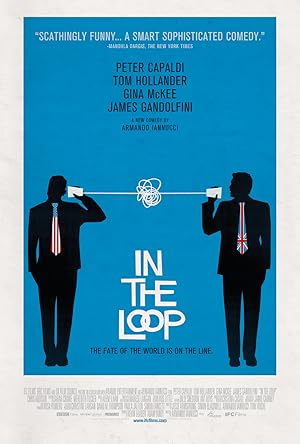
In the Loop
The US President and UK Prime Minister fancy a war. But not everyone agrees that war is a good thing. The US General Miller doesn't think so and neither does the British Secretary of State for International Development, Simon Foster. But, after Simon accidentally backs military action on TV, he suddenly has a lot of friends in Washington, DC. If Simon can get in with the right DC people, if his entourage of one can sleep with the right intern, and if they can both stop the Prime Minister's chief spin-doctor Malcolm Tucker rigging the vote at the UN, they can halt the war. If they don't... well, they can always sack their Director of Communications Judy, who they never liked anyway and who's back home dealing with voters with blocked drains and a man who's angry about a collapsing wall.
Despite its tight budget of $1.1M, In the Loop became a commercial success, earning $6.2M worldwide—a 464% return. The film's bold vision connected with viewers, demonstrating that strong storytelling can transcend budget limitations.
Nominated for 1 Oscar. 16 wins & 43 nominations


Plot Structure
Story beats plotted across runtime


Narrative Arc
Emotional journey through the story's key moments
Story Circle
Blueprint 15-beat structure
Arcplot Score Breakdown
Weighted: Precision (70%) + Arc (15%) + Theme (15%)
In the Loop (2009) exemplifies meticulously timed story structure, characteristic of Armando Iannucci's storytelling approach. This structural analysis examines how the film's 15-point plot structure maps to proven narrative frameworks across 1 hour and 46 minutes. With an Arcplot score of 7.2, the film balances conventional beats with creative variation.
Characters
Cast & narrative archetypes

Malcolm Tucker
Simon Foster
Toby Wright
Lt. General George Miller
Karen Clarke
Linton Barwick
Judy Molloy
Jamie MacDonald
Main Cast & Characters
Malcolm Tucker
Played by Peter Capaldi
The Prime Minister's ruthless Director of Communications who terrorizes government officials with profane threats to maintain party discipline.
Simon Foster
Played by Tom Hollander
Bumbling Minister for International Development whose offhand remarks about war thrust him into the center of international crisis.
Toby Wright
Played by Chris Addison
Simon Foster's young aide who tries to manage the political fallout while navigating Washington politics.
Lt. General George Miller
Played by James Gandolfini
U.S. military officer skeptical of the war who leaks information to derail the march to conflict.
Karen Clarke
Played by Mimi Kennedy
U.S. Assistant Secretary of State opposed to war who attempts to undermine hawkish colleagues.
Linton Barwick
Played by David Rasche
Hawkish U.S. Assistant Secretary of Defense for Policy who manipulates intelligence to justify military intervention.
Judy Molloy
Played by Anna Chlumsky
Ambitious aide to Karen Clarke who sees the crisis as career opportunity while developing feelings for Toby.
Jamie MacDonald
Played by Paul Higgins
Malcolm Tucker's equally profane and aggressive junior colleague in the communications office.
Structural Analysis
The Status Quo at 1 minutes (1% through the runtime) establishes Minister Simon Foster fumbles through a radio interview, establishing the chaotic bureaucratic world where political careers hang on careless words and media management trumps substance.. Notably, this early placement immediately immerses viewers in the story world.
The inciting incident occurs at 13 minutes when Simon Foster off-handedly tells a reporter that war is "unforeseeable," triggering a media firestorm that thrusts him from obscurity into the center of the US-UK war debate.. At 12% through the film, this Disruption aligns precisely with traditional story structure. This beat shifts the emotional landscape, launching the protagonist into the central conflict.
The First Threshold at 26 minutes marks the transition into Act II, occurring at 24% of the runtime. This shows the protagonist's commitment to Simon and Toby are summoned to Washington DC to attend crucial war committee meetings, actively choosing to enter the international political arena where they're hopelessly outmatched., moving from reaction to action.
At 52 minutes, the Midpoint arrives at 49% of the runtime—precisely centered, creating perfect narrative symmetry. Structural examination shows that this crucial beat A fabricated intelligence report supporting the war case surfaces, representing a false defeat: the pro-war faction gains ammunition while the anti-war voices (including Simon accidentally) become complicit in the march to war., fundamentally raising what's at risk. The emotional intensity shifts, dividing the narrative into clear before-and-after phases.
The Collapse moment at 79 minutes (74% through) represents the emotional nadir. Here, Simon's constituents' wall collapses, a literal and metaphorical destruction representing all is lost: his credibility is destroyed, Karen is politically neutered, and the war will proceed regardless of truth or opposition., demonstrates the protagonist at their lowest point. This beat's placement in the final quarter sets up the climactic reversal.
The Second Threshold at 84 minutes initiates the final act resolution at 80% of the runtime. Simon decides to make a principled stand at the UN, finally choosing honesty over political survival. Toby chooses to leak documents exposing the truth, accepting the consequences., demonstrating the transformation achieved throughout the journey.
Emotional Journey
In the Loop's emotional architecture traces a deliberate progression across 15 carefully calibrated beats.
Narrative Framework
This structural analysis employs proven narrative structure principles that track dramatic progression. By mapping In the Loop against these established plot points, we can identify how Armando Iannucci utilizes or subverts traditional narrative conventions. The plot point approach reveals not only adherence to structural principles but also creative choices that distinguish In the Loop within the comedy genre.
Armando Iannucci's Structural Approach
Among the 3 Armando Iannucci films analyzed on Arcplot, the average structural score is 7.2, reflecting strong command of classical structure. In the Loop takes a more unconventional approach compared to the director's typical style. For comparative analysis, explore the complete Armando Iannucci filmography.
Comparative Analysis
Additional comedy films include The Bad Guys, Ella Enchanted and The Evening Star. For more Armando Iannucci analyses, see The Death of Stalin, The Personal History of David Copperfield.
Plot Points by Act
Act I
SetupStatus Quo
Minister Simon Foster fumbles through a radio interview, establishing the chaotic bureaucratic world where political careers hang on careless words and media management trumps substance.
Theme
Malcolm Tucker warns that "to walk the road of peace, sometimes we need to be ready to climb the mountain of conflict," ironically stating the theme: the absurdity of justifying war through bureaucratic doubletalk.
Worldbuilding
Introduction to the interconnected worlds of British and American political machinery: ambitious staffers, manipulative spin doctors, hawkish generals, and weak ministers all maneuvering around the possibility of Middle Eastern military intervention.
Disruption
Simon Foster off-handedly tells a reporter that war is "unforeseeable," triggering a media firestorm that thrusts him from obscurity into the center of the US-UK war debate.
Resistance
Malcolm Tucker attempts damage control, forcing Simon to clarify his statement, but this only amplifies the chaos. Assistant Toby navigates between warring factions while anti-war US official Karen Clarke sees Simon as a potential ally.
Act II
ConfrontationFirst Threshold
Simon and Toby are summoned to Washington DC to attend crucial war committee meetings, actively choosing to enter the international political arena where they're hopelessly outmatched.
Mirror World
Introduction to Liza Weld, an idealistic State Department official who represents the thematic counterpoint: genuine principle versus cynical maneuvering. Her relationship with Toby will expose the cost of complicity.
Premise
The fun and games of political satire: absurd committee meetings, leaked intelligence reports, profanity-laced tirades from Malcolm Tucker, backroom dealing between war hawks and peace advocates, and escalating miscommunications that push nations toward conflict.
Midpoint
A fabricated intelligence report supporting the war case surfaces, representing a false defeat: the pro-war faction gains ammunition while the anti-war voices (including Simon accidentally) become complicit in the march to war.
Opposition
The war machinery accelerates as opposition crumbles. Karen Clarke fights to expose the false intelligence, Toby struggles with moral compromise, and Simon's attempts to hedge collapse under Malcolm's manipulation and his own weakness.
Collapse
Simon's constituents' wall collapses, a literal and metaphorical destruction representing all is lost: his credibility is destroyed, Karen is politically neutered, and the war will proceed regardless of truth or opposition.
Crisis
Dark reflection on complicity and powerlessness. Characters confront their roles in the machine: Toby faces his betrayal of Liza, Karen recognizes systemic defeat, and Simon spirals in desperation.
Act III
ResolutionSecond Threshold
Simon decides to make a principled stand at the UN, finally choosing honesty over political survival. Toby chooses to leak documents exposing the truth, accepting the consequences.
Synthesis
The finale plays out with bittersweet irony: Simon gives his honest testimony but is politically destroyed, Toby's leak causes scandal but changes nothing fundamental, and the bureaucratic machine grinds forward undeterred.
Transformation
Simon, now a backbencher stripped of power, tends to constituent concerns in his drab office—transformed from ambitious minister to broken civil servant, the system unchanged but having consumed another soul.