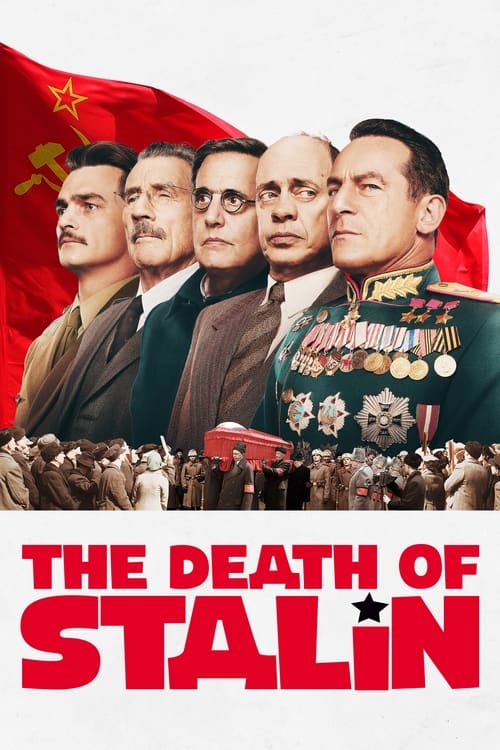
The Death of Stalin
When dictator Joseph Stalin dies, his parasitic cronies square off in a frantic power struggle to become the next Soviet leader. As they bumble, brawl and back-stab their way to the top, the question remains — just who is running the government?
Working with a small-scale budget of $13.0M, the film achieved a steady performer with $24.6M in global revenue (+89% profit margin).
Nominated for 2 BAFTA 18 wins & 40 nominations


Plot Structure
Story beats plotted across runtime


Narrative Arc
Emotional journey through the story's key moments
Story Circle
Blueprint 15-beat structure
Arcplot Score Breakdown
Weighted: Precision (70%) + Arc (15%) + Theme (15%)
The Death of Stalin (2017) reveals carefully calibrated narrative architecture, characteristic of Armando Iannucci's storytelling approach. This structural analysis examines how the film's 15-point plot structure maps to proven narrative frameworks across 1 hour and 47 minutes. With an Arcplot score of 7.2, the film balances conventional beats with creative variation.
Characters
Cast & narrative archetypes

Nikita Khrushchev
Georgy Malenkov
Lavrentiy Beria
Georgy Zhukov
Vyacheslav Molotov
Anastas Mikoyan
Svetlana Stalina
Vasily Stalin
Main Cast & Characters
Nikita Khrushchev
Played by Steve Buscemi
Deputy General Secretary who navigates the deadly power struggle following Stalin's death with cunning pragmatism and survival instinct.
Georgy Malenkov
Played by Jeffrey Tambor
The weak, insecure successor to Stalin who struggles with authority and seeks approval while being manipulated by stronger personalities.
Lavrentiy Beria
Played by Simon Russell Beale
The sadistic head of the NKVD who uses fear, intelligence, and ruthless cunning to consolidate power after Stalin's death.
Georgy Zhukov
Played by Jason Isaacs
The decorated war hero and military commander whose loyalty and direct approach prove decisive in the power struggle.
Vyacheslav Molotov
Played by Michael Palin
The loyal Old Bolshevik whose wife is imprisoned, torn between devotion to Stalin and personal suffering.
Anastas Mikoyan
Played by Paul Whitehouse
An Armenian Old Bolshevik and pragmatic survivor who aligns with Khrushchev against Beria.
Svetlana Stalina
Played by Andrea Riseborough
Stalin's daughter who witnesses the chaos and corruption surrounding her father's death with growing disillusionment.
Vasily Stalin
Played by Rupert Friend
Stalin's alcoholic, delusional son who cannot accept his father's death and represents the end of an era.
Structural Analysis
The Status Quo at 1 minutes (1% through the runtime) establishes Radio Moscow scrambles to re-record a concert for Stalin after failing to tape it live. The terror of the regime is immediately established as staff panic over the possibility of displeasing the dictator.. Structural examination shows that this early placement immediately immerses viewers in the story world.
The inciting incident occurs at 13 minutes when Stalin suffers a cerebral hemorrhage after reading Yudina's note and collapses alone in his office. The dictator lies in his own urine, undiscovered, as guards are too terrified to enter his room.. At 12% through the film, this Disruption aligns precisely with traditional story structure. This beat shifts the emotional landscape, launching the protagonist into the central conflict.
The First Threshold at 26 minutes marks the transition into Act II, occurring at 25% of the runtime. This indicates the protagonist's commitment to Stalin is officially declared dead. The power vacuum is now real and permanent. The Committee members must actively choose their alliances and strategies—there is no going back to the old order., moving from reaction to action.
At 52 minutes, the Midpoint arrives at 49% of the runtime—precisely centered, creating perfect narrative symmetry. Significantly, this crucial beat The public viewing of Stalin's body becomes a massacre when NKVD troops open fire on mourners who breach barricades. The false victory of the "orderly transition" collapses into chaos. Khrushchev realizes Beria engineered the disaster to blame the military and gain more power., fundamentally raising what's at risk. The emotional intensity shifts, dividing the narrative into clear before-and-after phases.
The Collapse moment at 79 minutes (74% through) represents the emotional nadir. Here, Beria reveals he has evidence to destroy Khrushchev and mocks his failed scheming. Khrushchev appears defeated—his conspiracy seems exposed. The "whiff of death" is literal: Beria controls who lives and dies, and Khrushchev is on the wrong side of that power., reveals the protagonist at their lowest point. This beat's placement in the final quarter sets up the climactic reversal.
The Second Threshold at 85 minutes initiates the final act resolution at 79% of the runtime. Khrushchev secures Marshal Zhukov's commitment to use the Army against the NKVD. The synthesis: combining political maneuvering with military force. Zhukov's soldiers will seize NKVD positions while Khrushchev handles the political theater of denouncing Beria in Committee., demonstrating the transformation achieved throughout the journey.
Emotional Journey
The Death of Stalin's emotional architecture traces a deliberate progression across 15 carefully calibrated beats.
Narrative Framework
This structural analysis employs a 15-point narrative structure framework that maps key story moments. By mapping The Death of Stalin against these established plot points, we can identify how Armando Iannucci utilizes or subverts traditional narrative conventions. The plot point approach reveals not only adherence to structural principles but also creative choices that distinguish The Death of Stalin within the comedy genre.
Armando Iannucci's Structural Approach
Among the 3 Armando Iannucci films analyzed on Arcplot, the average structural score is 7.2, reflecting strong command of classical structure. The Death of Stalin takes a more unconventional approach compared to the director's typical style. For comparative analysis, explore the complete Armando Iannucci filmography.
Comparative Analysis
Additional comedy films include The Bad Guys, Ella Enchanted and The Evening Star. For more Armando Iannucci analyses, see The Personal History of David Copperfield, In the Loop.
Plot Points by Act
Act I
SetupStatus Quo
Radio Moscow scrambles to re-record a concert for Stalin after failing to tape it live. The terror of the regime is immediately established as staff panic over the possibility of displeasing the dictator.
Theme
Pianist Maria Yudina slips a note to Stalin with the recording: "You have ruined a great nation." The theme is stated—tyranny corrupts everything it touches, and those who serve it are complicit in its crimes.
Worldbuilding
The world of Stalinist terror is established: NKVD death squads execute prisoners, the Presidium gathers for drunken dinners with Stalin, and everyone lives in fear. Beria, Khrushchev, Malenkov, and others jockey for position while pretending loyalty.
Disruption
Stalin suffers a cerebral hemorrhage after reading Yudina's note and collapses alone in his office. The dictator lies in his own urine, undiscovered, as guards are too terrified to enter his room.
Resistance
The Presidium members discover Stalin's body and descend into panicked incompetence. They debate whether to call doctors (most competent ones having been purged), how to appear appropriately grief-stricken, and begin positioning for power. Beria immediately starts destroying evidence of his crimes.
Act II
ConfrontationFirst Threshold
Stalin is officially declared dead. The power vacuum is now real and permanent. The Committee members must actively choose their alliances and strategies—there is no going back to the old order.
Mirror World
Stalin's children, Svetlana and Vasily, arrive and represent the human cost of the regime. Svetlana's grief is genuine while the Committee uses her. Vasily is an alcoholic wreck, a product of his father's dysfunction—embodying what power without accountability creates.
Premise
The dark comedy of bureaucratic power struggles plays out. Beria and Khrushchev form an uneasy alliance while maneuvering against each other. Malenkov is installed as a puppet leader. The funeral arrangements become battlegrounds. Beria releases prisoners to gain popular support while Khrushchev organizes mourners.
Midpoint
The public viewing of Stalin's body becomes a massacre when NKVD troops open fire on mourners who breach barricades. The false victory of the "orderly transition" collapses into chaos. Khrushchev realizes Beria engineered the disaster to blame the military and gain more power.
Opposition
Beria consolidates power aggressively, using NKVD files to blackmail Committee members. Khrushchev secretly begins recruiting allies against Beria, including Marshal Zhukov and Molotov. The stakes escalate as it becomes clear only one faction will survive. Beria moves to remove the military from Moscow.
Collapse
Beria reveals he has evidence to destroy Khrushchev and mocks his failed scheming. Khrushchev appears defeated—his conspiracy seems exposed. The "whiff of death" is literal: Beria controls who lives and dies, and Khrushchev is on the wrong side of that power.
Crisis
Khrushchev faces his dark night—he must choose between submission to Beria (and likely eventual execution) or risking everything on a coup that could fail. He processes the stakes: his family, his life, and the future of the country hang in the balance.
Act III
ResolutionSecond Threshold
Khrushchev secures Marshal Zhukov's commitment to use the Army against the NKVD. The synthesis: combining political maneuvering with military force. Zhukov's soldiers will seize NKVD positions while Khrushchev handles the political theater of denouncing Beria in Committee.
Synthesis
The coup unfolds with brutal efficiency. Zhukov's forces neutralize NKVD guards. Beria is arrested during a Committee meeting in a scene of farcical violence. A kangaroo court is convened. Beria is beaten, sentenced to death for treason, and executed by firing squad in a basement—the same fate he delivered to thousands.
Transformation
Khrushchev sits in power at a concert hall, applauding as Maria Yudina plays. The transformation is ambiguous—the tyrant is replaced but the system endures. A young Brezhnev is shown positioning himself behind Khrushchev, foreshadowing the next cycle of power struggle. Nothing has truly changed.