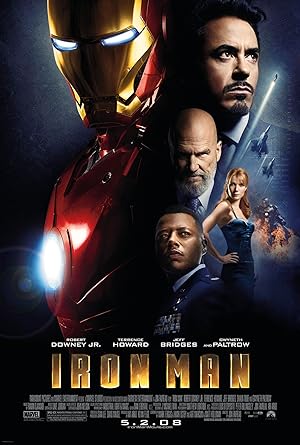
Iron Man
Tony Stark. Genius, billionaire, playboy, philanthropist. Son of legendary inventor and weapons contractor Howard Stark. When Tony Stark is assigned to give a weapons presentation to an Iraqi unit led by Lt. Col. James Rhodes, he's given a ride on enemy lines. That ride ends badly when Stark's Humvee that he's riding in is attacked by enemy combatants. He survives - barely - with a chest full of shrapnel and a car battery attached to his heart. In order to survive he comes up with a way to miniaturize the battery and figures out that the battery can power something else. Thus Iron Man is born. He uses the primitive device to escape from the cave in Iraq. Once back home, he then begins work on perfecting the Iron Man suit. But the man who was put in charge of Stark Industries has plans of his own to take over Tony's technology for other matters.
Despite a significant budget of $140.0M, Iron Man became a commercial success, earning $585.2M worldwide—a 318% return.
Nominated for 2 Oscars. 24 wins & 73 nominations


Plot Structure
Story beats plotted across runtime


Narrative Arc
Emotional journey through the story's key moments
Story Circle
Blueprint 15-beat structure
Arcplot Score Breakdown
Weighted: Precision (70%) + Arc (15%) + Theme (15%)
Iron Man (2008) reveals meticulously timed narrative architecture, characteristic of Jon Favreau's storytelling approach. This structural analysis examines how the film's 15-point plot structure maps to proven narrative frameworks across 2 hours and 6 minutes. With an Arcplot score of 6.3, the film takes an unconventional approach to traditional narrative frameworks.
Characters
Cast & narrative archetypes

Tony Stark / Iron Man
Pepper Potts
Obadiah Stane
James Rhodes
Phil Coulson
Yinsen
Main Cast & Characters
Tony Stark / Iron Man
Played by Robert Downey Jr.
Billionaire genius inventor and weapons manufacturer who becomes a superhero after being captured by terrorists
Pepper Potts
Played by Gwyneth Paltrow
Tony Stark's loyal personal assistant and voice of reason who keeps his life organized
Obadiah Stane
Played by Jeff Bridges
Tony's mentor and business partner who secretly betrays him to take control of Stark Industries
James Rhodes
Played by Terrence Howard
Tony's best friend and military liaison who tries to keep him grounded
Phil Coulson
Played by Clark Gregg
S.H.I.E.L.D. agent who investigates Tony Stark and the Iron Man armor
Yinsen
Played by Shaun Toub
Fellow captive who saves Tony's life and inspires him to use his gifts for good
Structural Analysis
The Status Quo at 1 minutes (1% through the runtime) establishes Tony Stark, billionaire weapons manufacturer, is carefree and arrogant, enjoying his wealth and fame while demonstrating the Jericho missile in Afghanistan.. Notably, this early placement immediately immerses viewers in the story world.
The inciting incident occurs at 16 minutes when Tony's convoy is ambushed by terrorists using Stark weapons. He's critically wounded by his own missile and taken captive with shrapnel near his heart.. At 13% through the film, this Disruption is delayed, allowing extended setup of the story world. This beat shifts the emotional landscape, launching the protagonist into the central conflict.
The First Threshold at 32 minutes marks the transition into Act II, occurring at 25% of the runtime. This demonstrates the protagonist's commitment to Tony makes the active choice to escape using the Mark I armor he's built, crossing into a new world where he'll use his genius for protection rather than destruction., moving from reaction to action.
At 63 minutes, the Midpoint arrives at 50% of the runtime—precisely centered, creating perfect narrative symmetry. Notably, this crucial beat False victory: Tony successfully uses the Mark III armor to save villagers in Gulmira, proving Iron Man works. But he raises stakes by revealing his activity, drawing attention from both the military and Stane., fundamentally raising what's at risk. The emotional intensity shifts, dividing the narrative into clear before-and-after phases.
The Collapse moment at 95 minutes (75% through) represents the emotional nadir. Here, Obadiah paralyzes Tony and steals his arc reactor, leaving him to die. Tony crawls to his workshop desperately - a literal brush with death as his heart begins to fail., indicates the protagonist at their lowest point. This beat's placement in the final quarter sets up the climactic reversal.
The Second Threshold at 101 minutes initiates the final act resolution at 80% of the runtime. Tony replaces his arc reactor with Pepper's help and realizes he must stop Stane himself. The synthesis: combining his genius with his newfound responsibility to protect others., demonstrating the transformation achieved throughout the journey.
Emotional Journey
Iron Man's emotional architecture traces a deliberate progression across 15 carefully calibrated beats.
Narrative Framework
This structural analysis employs structural analysis methodology used to understand storytelling architecture. By mapping Iron Man against these established plot points, we can identify how Jon Favreau utilizes or subverts traditional narrative conventions. The plot point approach reveals not only adherence to structural principles but also creative choices that distinguish Iron Man within the action genre.
Jon Favreau's Structural Approach
Among the 8 Jon Favreau films analyzed on Arcplot, the average structural score is 6.8, demonstrating varied approaches to story architecture. Iron Man takes a more unconventional approach compared to the director's typical style. For comparative analysis, explore the complete Jon Favreau filmography.
Comparative Analysis
Additional action films include The Bad Guys, Puss in Boots and Venom: The Last Dance. For more Jon Favreau analyses, see Made, The Lion King and Iron Man 2.
Plot Points by Act
Act I
SetupStatus Quo
Tony Stark, billionaire weapons manufacturer, is carefree and arrogant, enjoying his wealth and fame while demonstrating the Jericho missile in Afghanistan.
Theme
Yinsen tells Tony, "Don't waste your life" - establishing the central theme of responsibility, legacy, and becoming more than a merchant of death.
Worldbuilding
Establishment of Tony's world: his genius, his recklessness, his relationship with Pepper and Rhodey, his weapons empire, and Obadiah Stane as his mentor figure.
Disruption
Tony's convoy is ambushed by terrorists using Stark weapons. He's critically wounded by his own missile and taken captive with shrapnel near his heart.
Resistance
Imprisoned in a cave, Tony debates whether to build weapons for terrorists. With Yinsen as his guide and mentor, he realizes he must change and decides to build the Mark I armor instead.
Act II
ConfrontationFirst Threshold
Tony makes the active choice to escape using the Mark I armor he's built, crossing into a new world where he'll use his genius for protection rather than destruction.
Mirror World
Tony deepens his relationship with Pepper Potts, who represents the humanity and connection he's been missing. She becomes his moral compass and thematic counterpoint to his isolation.
Premise
The fun and games: Tony builds increasingly sophisticated Iron Man suits, testing and refining the technology. We see the promise of what Iron Man can be - the superhero action we came for.
Midpoint
False victory: Tony successfully uses the Mark III armor to save villagers in Gulmira, proving Iron Man works. But he raises stakes by revealing his activity, drawing attention from both the military and Stane.
Opposition
Pressure intensifies as Tony discovers Obadiah's betrayal, learns Stane has been selling weapons to terrorists, and realizes his father figure ordered his assassination. Stane builds his own Iron Monger suit.
Collapse
Obadiah paralyzes Tony and steals his arc reactor, leaving him to die. Tony crawls to his workshop desperately - a literal brush with death as his heart begins to fail.
Crisis
Tony's darkest moment: betrayed by his mentor, nearly dead, with his technology weaponized against innocents. He must find the strength to continue despite losing everything he thought he could trust.
Act III
ResolutionSecond Threshold
Tony replaces his arc reactor with Pepper's help and realizes he must stop Stane himself. The synthesis: combining his genius with his newfound responsibility to protect others.
Synthesis
The finale: Tony battles Obadiah in the Iron Monger suit, using both his technology and his growth. He defeats Stane by accepting help from Pepper and sacrificing the arc reactor that powers Stark Industries.
Transformation
Tony publicly declares "I am Iron Man" at the press conference, fully embracing responsibility and transparency. The arrogant playboy who wasted his life has become a hero who owns his identity and purpose.