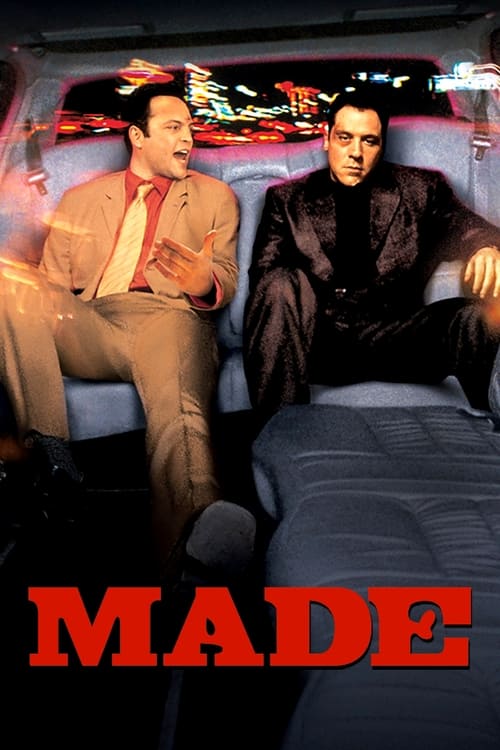
Made
Two aspiring boxers and lifelong friends get involved in a money-laundering scheme through a low-level organized crime group.
Working with a modest budget of $5.0M, the film achieved a respectable showing with $5.5M in global revenue (+10% profit margin).


Plot Structure
Story beats plotted across runtime


Narrative Arc
Emotional journey through the story's key moments
Story Circle
Blueprint 15-beat structure
Arcplot Score Breakdown
Weighted: Precision (70%) + Arc (15%) + Theme (15%)
Made (2001) reveals precise dramatic framework, characteristic of Jon Favreau's storytelling approach. This structural analysis examines how the film's 15-point plot structure maps to proven narrative frameworks across 1 hour and 35 minutes. With an Arcplot score of 6.8, the film balances conventional beats with creative variation.
Characters
Cast & narrative archetypes

Bobby
Ricky
Max
Ruiz
Jessica
Horrace
Main Cast & Characters
Bobby
Played by Jon Favreau
A struggling boxer and construction worker trying to provide for his girlfriend and her daughter while maintaining his dignity and moral compass.
Ricky
Played by Vince Vaughn
Bobby's longtime friend and loudmouth associate whose impulsive behavior and lack of self-awareness constantly creates problems during their errand to New York.
Max
Played by Peter Falk
A Los Angeles crime boss who sends Bobby and Ricky on a job to New York as a test of their capabilities.
Ruiz
Played by Sean Combs
A dangerous and unpredictable New York mobster who becomes increasingly irritated with Ricky's inappropriate behavior.
Jessica
Played by Famke Janssen
Bobby's girlfriend, a stripper and single mother who Bobby is trying to build a better life for.
Horrace
Played by Faizon Love
Ruiz's intimidating enforcer who accompanies the group and maintains order during the New York trip.
Structural Analysis
The Status Quo at 1 minutes (1% through the runtime) establishes Bobby loses a boxing match badly, establishing his status as a struggling fighter and working-class guy trying to make ends meet while dealing with his irresponsible best friend Ricky.. Significantly, this early placement immediately immerses viewers in the story world.
The inciting incident occurs at 12 minutes when Max, Bobby's mob-connected boss, fires them from the construction job after Ricky's behavior becomes too much. This threatens Bobby's ability to provide for Jessica and her daughter.. At 12% through the film, this Disruption aligns precisely with traditional story structure. This beat shifts the emotional landscape, launching the protagonist into the central conflict.
The First Threshold at 23 minutes marks the transition into Act II, occurring at 24% of the runtime. This indicates the protagonist's commitment to Bobby decides to take the New York job and brings Ricky with him despite knowing it's a bad idea. They board the plane to New York, entering the world of organized crime., moving from reaction to action.
At 48 minutes, the Midpoint arrives at 50% of the runtime—precisely centered, creating perfect narrative symmetry. Structural examination shows that this crucial beat During a meeting with the New York mob contacts, Ricky's erratic behavior reaches a peak, nearly getting them both killed. Bobby realizes the job is far more dangerous than he thought and that Ricky is a genuine liability., fundamentally raising what's at risk. The emotional intensity shifts, dividing the narrative into clear before-and-after phases.
The Collapse moment at 71 minutes (75% through) represents the emotional nadir. Here, The deal falls apart completely due to Ricky's interference. Bobby faces the real possibility of being killed by the mob for failing, and his future with Jessica seems lost. The friendship with Ricky appears dead., shows the protagonist at their lowest point. This beat's placement in the final quarter sets up the climactic reversal.
The Second Threshold at 76 minutes initiates the final act resolution at 80% of the runtime. Bobby realizes he can fix the situation by being honest and direct with the mob bosses, using his genuine nature rather than trying to play the game. He decides to take responsibility and clean up the mess without abandoning Ricky entirely., demonstrating the transformation achieved throughout the journey.
Emotional Journey
Made's emotional architecture traces a deliberate progression across 15 carefully calibrated beats.
Narrative Framework
This structural analysis employs structural analysis methodology used to understand storytelling architecture. By mapping Made against these established plot points, we can identify how Jon Favreau utilizes or subverts traditional narrative conventions. The plot point approach reveals not only adherence to structural principles but also creative choices that distinguish Made within the comedy genre.
Jon Favreau's Structural Approach
Among the 8 Jon Favreau films analyzed on Arcplot, the average structural score is 6.8, demonstrating varied approaches to story architecture. Made takes a more unconventional approach compared to the director's typical style. For comparative analysis, explore the complete Jon Favreau filmography.
Comparative Analysis
Additional comedy films include The Bad Guys, Ella Enchanted and The Evening Star. For more Jon Favreau analyses, see The Lion King, Iron Man 2 and The Jungle Book.
Plot Points by Act
Act I
SetupStatus Quo
Bobby loses a boxing match badly, establishing his status as a struggling fighter and working-class guy trying to make ends meet while dealing with his irresponsible best friend Ricky.
Theme
Jessica tells Bobby he needs to think about what's best for himself and her daughter, not just loyalty to Ricky. The theme of choosing between loyalty to a destructive friendship and a better future is stated.
Worldbuilding
Bobby works construction, trains at the gym, and tries to maintain his relationship with Jessica and her daughter. Ricky constantly causes problems with his big mouth and lack of boundaries, getting them both in trouble at work and socially.
Disruption
Max, Bobby's mob-connected boss, fires them from the construction job after Ricky's behavior becomes too much. This threatens Bobby's ability to provide for Jessica and her daughter.
Resistance
Max offers Bobby a chance to make money by delivering a package to New York. Bobby debates whether to take the job and whether to bring Ricky along. Jessica warns him about getting too deep with Max, but Bobby needs the money.
Act II
ConfrontationFirst Threshold
Bobby decides to take the New York job and brings Ricky with him despite knowing it's a bad idea. They board the plane to New York, entering the world of organized crime.
Mirror World
Bobby and Ricky meet Ruiz, the professional criminal they're supposed to work with in New York. Ruiz represents what Bobby could become if he stays in this world—competent but morally compromised.
Premise
Bobby and Ricky navigate the criminal underworld in New York. Ricky's loud, inappropriate behavior constantly threatens to blow their cover and ruin the job. Bobby tries to keep everything together while Ricky alienates everyone they meet.
Midpoint
During a meeting with the New York mob contacts, Ricky's erratic behavior reaches a peak, nearly getting them both killed. Bobby realizes the job is far more dangerous than he thought and that Ricky is a genuine liability.
Opposition
The situation deteriorates as Ricky continues to make mistakes and Bobby tries to salvage the deal. The criminals become increasingly hostile. Bobby's relationship with Ricky fractures as the pressure mounts and Bobby realizes his friend may get him killed.
Collapse
The deal falls apart completely due to Ricky's interference. Bobby faces the real possibility of being killed by the mob for failing, and his future with Jessica seems lost. The friendship with Ricky appears dead.
Crisis
Bobby confronts the reality that his loyalty to Ricky has cost him everything. He must decide whether to continue protecting his friend or finally put himself and Jessica first. Bobby sits with the weight of his choices.
Act III
ResolutionSecond Threshold
Bobby realizes he can fix the situation by being honest and direct with the mob bosses, using his genuine nature rather than trying to play the game. He decides to take responsibility and clean up the mess without abandoning Ricky entirely.
Synthesis
Bobby confronts Max and the other mob figures, taking accountability and negotiating a resolution. He sets boundaries with Ricky while still maintaining their friendship on healthier terms. Bobby proves his integrity and earns respect.
Transformation
Bobby returns to Jessica having grown into a man who can balance loyalty with self-respect. He's still friends with Ricky but no longer lets that friendship destroy his life. He's ready to be the partner and father figure Jessica and her daughter need.