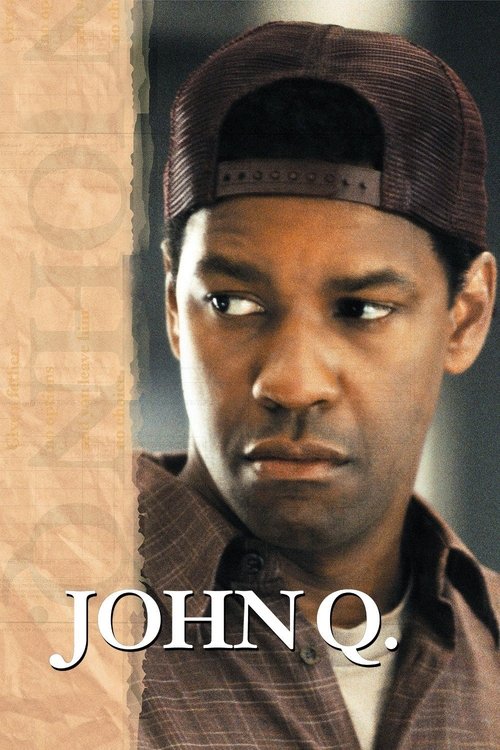
John Q
John Quincy Archibald is a father and husband whose son is diagnosed with an enlarged heart and then finds out he cannot receive a transplant because HMO insurance will not cover it. Therefore, he decides to take a hospital full of patients hostage until the hospital puts his son's name on the donor's list.
Despite a moderate budget of $36.0M, John Q became a box office success, earning $102.2M worldwide—a 184% return.
2 wins & 8 nominations


Plot Structure
Story beats plotted across runtime


Narrative Arc
Emotional journey through the story's key moments
Story Circle
Blueprint 15-beat structure
Arcplot Score Breakdown
Weighted: Precision (70%) + Arc (15%) + Theme (15%)
John Q (2002) showcases meticulously timed story structure, characteristic of Nick Cassavetes's storytelling approach. This structural analysis examines how the film's 15-point plot structure maps to proven narrative frameworks across 1 hour and 56 minutes. With an Arcplot score of 6.6, the film balances conventional beats with creative variation.
Characters
Cast & narrative archetypes

John Quincy Archibald
Denise Archibald
Lt. Frank Grimes
Rebecca Payne
Dr. Raymond Turner
Chief Gus Monroe
Lester Matthews
Mitch Quigley
Main Cast & Characters
John Quincy Archibald
Played by Denzel Washington
A factory worker who takes a hospital emergency room hostage when his insurance won't cover his son's heart transplant.
Denise Archibald
Played by Kimberly Elise
John's wife and Michael's mother who supports her husband's desperate actions to save their son.
Lt. Frank Grimes
Played by Robert Duvall
The police negotiator who attempts to peacefully resolve the hostage situation and comes to sympathize with John.
Rebecca Payne
Played by Anne Heche
The hospital administrator focused on financial concerns who refuses to admit Michael without payment guarantees.
Dr. Raymond Turner
Played by James Woods
The cardiac surgeon who initially refuses to operate on Michael due to payment issues but ultimately performs the surgery.
Chief Gus Monroe
Played by Ray Liotta
The police chief who takes a hardline approach to the hostage situation and clashes with the negotiator.
Lester Matthews
Played by Eddie Griffin
One of the hostages who initially antagonizes John but eventually becomes supportive of his cause.
Mitch Quigley
Played by Paul Johansson
A television reporter covering the hostage crisis who sensationalizes the story for ratings.
Structural Analysis
The Status Quo at 1 minutes (1% through the runtime) establishes John Quincy Archibald works reduced hours at a struggling factory while his wife Denise juggles bills. Despite financial hardship, they maintain a loving household with their son Michael, representing the fragile stability of working-class America.. The analysis reveals that this early placement immediately immerses viewers in the story world.
The inciting incident occurs at 14 minutes when Michael collapses during a Little League baseball game. At the hospital, doctors deliver devastating news: Michael has an enlarged heart and will die without a heart transplant, shattering the family's fragile world.. At 12% through the film, this Disruption aligns precisely with traditional story structure. This beat shifts the emotional landscape, launching the protagonist into the central conflict.
The First Threshold at 29 minutes marks the transition into Act II, occurring at 25% of the runtime. This reveals the protagonist's commitment to With Michael about to be discharged to die at home, John makes an irreversible choice: he pulls a gun in the hospital emergency room and takes everyone hostage, demanding that his son be placed on the heart transplant recipient list., moving from reaction to action.
At 58 minutes, the Midpoint arrives at 50% of the runtime—precisely centered, creating perfect narrative symmetry. The analysis reveals that this crucial beat Michael is officially placed on the transplant recipient list - a false victory. John has achieved his immediate goal, but the siege must continue as they now wait for a donor heart. The stakes have shifted from getting listed to surviving long enough., fundamentally raising what's at risk. The emotional intensity shifts, dividing the narrative into clear before-and-after phases.
The Collapse moment at 87 minutes (75% through) represents the emotional nadir. Here, With no heart available and time running out, John makes the ultimate decision: he will kill himself so that his own heart can be transplanted into Michael. He prepares to sacrifice his life, embodying the film's theme of parental love beyond all limits., illustrates the protagonist at their lowest point. This beat's placement in the final quarter sets up the climactic reversal.
The Second Threshold at 93 minutes initiates the final act resolution at 80% of the runtime. At the last possible moment, a donor heart becomes available. A young woman in another city has died in a car accident, and her heart is compatible with Michael. John lowers the gun as hope returns - his sacrifice is no longer necessary., demonstrating the transformation achieved throughout the journey.
Emotional Journey
John Q's emotional architecture traces a deliberate progression across 15 carefully calibrated beats.
Narrative Framework
This structural analysis employs a 15-point narrative structure framework that maps key story moments. By mapping John Q against these established plot points, we can identify how Nick Cassavetes utilizes or subverts traditional narrative conventions. The plot point approach reveals not only adherence to structural principles but also creative choices that distinguish John Q within the drama genre.
Nick Cassavetes's Structural Approach
Among the 6 Nick Cassavetes films analyzed on Arcplot, the average structural score is 6.8, demonstrating varied approaches to story architecture. John Q takes a more unconventional approach compared to the director's typical style. For comparative analysis, explore the complete Nick Cassavetes filmography.
Comparative Analysis
Additional drama films include After Thomas, South Pacific and Dirty Dancing: Havana Nights. For more Nick Cassavetes analyses, see The Other Woman, The Notebook and My Sister's Keeper.
Plot Points by Act
Act I
SetupStatus Quo
John Quincy Archibald works reduced hours at a struggling factory while his wife Denise juggles bills. Despite financial hardship, they maintain a loving household with their son Michael, representing the fragile stability of working-class America.
Theme
Denise tells John that they need to make sacrifices for Michael's future, establishing the film's central theme: how far a parent will go to protect their child, and the impossible choices forced upon those without resources.
Worldbuilding
The Archibald family's modest but loving life is established. John's hours have been cut from full-time to part-time, their car is repossessed, and they struggle to make ends meet. Michael plays baseball, dreams of growing up, and represents everything John works to protect.
Disruption
Michael collapses during a Little League baseball game. At the hospital, doctors deliver devastating news: Michael has an enlarged heart and will die without a heart transplant, shattering the family's fragile world.
Resistance
John learns his downgraded insurance won't cover the $250,000 transplant. He exhausts every option: begging the hospital administrator Rebecca Payne, consulting with Dr. Turner, attempting to sell possessions, organizing community fundraisers, and desperately seeking any path to save his son.
Act II
ConfrontationFirst Threshold
With Michael about to be discharged to die at home, John makes an irreversible choice: he pulls a gun in the hospital emergency room and takes everyone hostage, demanding that his son be placed on the heart transplant recipient list.
Mirror World
Inside the ER, John begins forming unexpected connections with his hostages. A pregnant woman, a domestic violence victim, and others reveal their own struggles with a broken system. The B-story emerges: John's humanity inspiring compassion even from those he holds captive.
Premise
The hostage standoff intensifies as John manages the ER with surprising compassion. He helps deliver the pregnant woman's baby, earns hostages' sympathy, negotiates with police chief Gus Monroe, and refuses to back down while Michael clings to life upstairs.
Midpoint
Michael is officially placed on the transplant recipient list - a false victory. John has achieved his immediate goal, but the siege must continue as they now wait for a donor heart. The stakes have shifted from getting listed to surviving long enough.
Opposition
Pressure mounts from all sides. A SWAT sniper takes position. Police attempt tactical entry. The hospital administration refuses to negotiate. Media coverage polarizes public opinion. John's control of the situation slowly erodes as hours pass without a donor heart.
Collapse
With no heart available and time running out, John makes the ultimate decision: he will kill himself so that his own heart can be transplanted into Michael. He prepares to sacrifice his life, embodying the film's theme of parental love beyond all limits.
Crisis
John says goodbye to Denise and Michael through the hospital window. He gives final instructions to Dr. Turner about the transplant. Michael begs his father not to do it. The moment is unbearable as John puts the gun to his head, ready to pull the trigger.
Act III
ResolutionSecond Threshold
At the last possible moment, a donor heart becomes available. A young woman in another city has died in a car accident, and her heart is compatible with Michael. John lowers the gun as hope returns - his sacrifice is no longer necessary.
Synthesis
Michael undergoes the heart transplant successfully. John surrenders peacefully to police. At trial, hostages testify on his behalf, and public opinion supports him. He is convicted but receives a lenient sentence, acknowledging both his crime and his desperate circumstances.
Transformation
Michael, now healthy, plays baseball again - the same sport where his heart first failed. John watches from the stands, his family intact. The closing image mirrors the opening but with profound transformation: a father who proved that love can move mountains, at great personal cost.