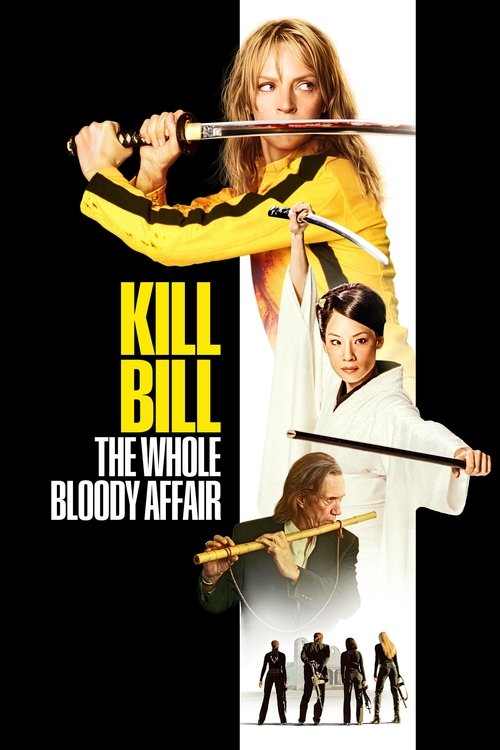
Kill Bill: The Whole Bloody Affair
A former assassin—known only as The Bride—wakes up from a coma after her former boss and lover, Bill, shoots her in the head and steals her unborn child during her wedding rehearsal. She soon embarks on a bloody quest for revenge, hunting down her ex-colleagues of the Deadly Viper Assassination Squad before confronting Bill himself. Quentin Tarantino’s complete Kill Bill, a combination of Volumes 1 and 2, previously deleted scenes, alternate takes, a full-color remaster of the Crazy 88 fight, a 7-minute anime sequence by Production I.G., and a built-in intermission.
The film commercial failure against its moderate budget of $55.0M, earning $5.8M globally (-89% loss). While initial box office returns were modest, the film has gained appreciation for its compelling narrative within the action genre.

Plot Structure
Story beats plotted across runtime


Narrative Arc
Emotional journey through the story's key moments
Story Circle
Blueprint 15-beat structure
Arcplot Score Breakdown
Weighted: Precision (70%) + Arc (15%) + Theme (15%)
Kill Bill: The Whole Bloody Affair (2011) reveals meticulously timed narrative architecture, characteristic of Quentin Tarantino's storytelling approach. This structural analysis examines how the film's 15-point plot structure maps to proven narrative frameworks across 4 hours and 7 minutes. With an Arcplot score of 6.4, the film takes an unconventional approach to traditional narrative frameworks.
Characters
Cast & narrative archetypes

The Bride (Beatrix Kiddo)
Bill
O-Ren Ishii (Cottonmouth)
Elle Driver (California Mountain Snake)
Vernita Green (Copperhead)
Budd (Sidewinder)
Hattori Hanzo
Pai Mei
Main Cast & Characters
The Bride (Beatrix Kiddo)
Played by Uma Thurman
Former assassin seeking revenge against her former team who attempted to kill her on her wedding day
Bill
Played by David Carradine
Leader of the Deadly Viper Assassination Squad and the Bride's former lover who ordered her death
O-Ren Ishii (Cottonmouth)
Played by Lucy Liu
Former member of the Deadly Viper squad who became the leader of the Tokyo yakuza
Elle Driver (California Mountain Snake)
Played by Daryl Hannah
One-eyed assassin and member of the Deadly Viper squad who harbors jealousy toward the Bride
Vernita Green (Copperhead)
Played by Vivica A. Fox
Former Deadly Viper member now living suburban life as a mother
Budd (Sidewinder)
Played by Michael Madsen
Former Deadly Viper member working as a bouncer, Bill's brother
Hattori Hanzo
Played by Sonny Chiba
Legendary retired sword-maker who crafts a special katana for the Bride
Pai Mei
Played by Gordon Liu Chia-hui
Legendary martial arts master who trains the Bride in deadly techniques
Structural Analysis
The Status Quo at 3 minutes (1% through the runtime) establishes The Bride lies beaten and bloody on the floor of a chapel in El Paso, shot in the head by Bill while pregnant, establishing her shattered world and the betrayal that will fuel her revenge.. Significantly, this early placement immediately immerses viewers in the story world.
The inciting incident occurs at 30 minutes when The Bride kills the hospital orderly Buck and his client, reclaiming her agency and taking her first steps toward revenge after discovering she was violated while comatose, transforming from victim to warrior.. At 12% through the film, this Disruption aligns precisely with traditional story structure. This beat shifts the emotional landscape, launching the protagonist into the central conflict.
The First Threshold at 61 minutes marks the transition into Act II, occurring at 25% of the runtime. This indicates the protagonist's commitment to Armed with her Hanzo sword, The Bride arrives at the House of Blue Leaves in Tokyo to confront O-Ren Ishii, actively choosing to enter the world of her former life and begin her bloody campaign., moving from reaction to action.
At 124 minutes, the Midpoint arrives at 50% of the runtime—precisely centered, creating perfect narrative symmetry. Structural examination shows that this crucial beat Budd buries The Bride alive in a coffin after ambushing her with rock salt, marking a false defeat where her seemingly unstoppable momentum is halted and she faces her most helpless moment., fundamentally raising what's at risk. The emotional intensity shifts, dividing the narrative into clear before-and-after phases.
The Collapse moment at 185 minutes (75% through) represents the emotional nadir. Here, Bill reveals that The Bride's daughter B.B. Is alive, shattering The Bride's entire understanding of her four-year quest and the foundation of her grief-fueled revenge mission., reveals the protagonist at their lowest point. This beat's placement in the final quarter sets up the climactic reversal.
The Second Threshold at 197 minutes initiates the final act resolution at 80% of the runtime. After putting B.B. To bed, The Bride chooses to confront Bill not with rage but with clarity, understanding that she must end this cycle to reclaim her life and become the mother her daughter deserves., demonstrating the transformation achieved throughout the journey.
Emotional Journey
Kill Bill: The Whole Bloody Affair's emotional architecture traces a deliberate progression across 15 carefully calibrated beats.
Narrative Framework
This structural analysis employs structural analysis methodology used to understand storytelling architecture. By mapping Kill Bill: The Whole Bloody Affair against these established plot points, we can identify how Quentin Tarantino utilizes or subverts traditional narrative conventions. The plot point approach reveals not only adherence to structural principles but also creative choices that distinguish Kill Bill: The Whole Bloody Affair within the action genre.
Quentin Tarantino's Structural Approach
Among the 11 Quentin Tarantino films analyzed on Arcplot, the average structural score is 4.6, showcasing experimental approaches to narrative form. Kill Bill: The Whole Bloody Affair represents one of the director's most structurally precise works. For comparative analysis, explore the complete Quentin Tarantino filmography.
Comparative Analysis
Additional action films include The Bad Guys, Puss in Boots and Venom: The Last Dance. For more Quentin Tarantino analyses, see Reservoir Dogs, Django Unchained and Pulp Fiction.
Plot Points by Act
Act I
SetupStatus Quo
The Bride lies beaten and bloody on the floor of a chapel in El Paso, shot in the head by Bill while pregnant, establishing her shattered world and the betrayal that will fuel her revenge.
Theme
Hattori Hanzo tells The Bride that revenge is never a straight line but a forest, stating the film's central theme about the circular, consuming nature of vengeance and the journey required to achieve it.
Worldbuilding
The Bride awakens from her coma four years later, discovers her baby is gone, and we learn through flashbacks about the Deadly Viper Assassination Squad, her past life as an assassin, and her death list of five names.
Disruption
The Bride kills the hospital orderly Buck and his client, reclaiming her agency and taking her first steps toward revenge after discovering she was violated while comatose, transforming from victim to warrior.
Resistance
The Bride travels to Okinawa to convince the legendary swordsmith Hattori Hanzo to make her a weapon worthy of killing Bill, learning patience and earning the master's respect and aid.
Act II
ConfrontationFirst Threshold
Armed with her Hanzo sword, The Bride arrives at the House of Blue Leaves in Tokyo to confront O-Ren Ishii, actively choosing to enter the world of her former life and begin her bloody campaign.
Mirror World
Through O-Ren Ishii's animated backstory, we see a parallel tale of revenge and transformation, mirroring The Bride's own journey from innocence to killer, establishing the cost of choosing violence.
Premise
The Bride delivers on the promise of stylized revenge, battling the Crazy 88 and O-Ren in spectacular combat, then tracking and eliminating Vernita Green, crossing two names off her list with brutal efficiency.
Midpoint
Budd buries The Bride alive in a coffin after ambushing her with rock salt, marking a false defeat where her seemingly unstoppable momentum is halted and she faces her most helpless moment.
Opposition
The Bride escapes her grave using Pai Mei's teachings, kills Budd and Elle Driver in brutal fashion, but the emotional stakes deepen as we learn more about her training and the humanity beneath the revenge.
Collapse
Bill reveals that The Bride's daughter B.B. is alive, shattering The Bride's entire understanding of her four-year quest and the foundation of her grief-fueled revenge mission.
Crisis
The Bride experiences profound emotional turmoil meeting her living daughter, watching her sleep, wrestling with the tension between her identity as mother versus assassin, and confronting what she truly wants.
Act III
ResolutionSecond Threshold
After putting B.B. to bed, The Bride chooses to confront Bill not with rage but with clarity, understanding that she must end this cycle to reclaim her life and become the mother her daughter deserves.
Synthesis
The Bride and Bill have their final conversation about truth, identity, and love, leading to her using the Five Point Palm Exploding Heart Technique, ending Bill and the cycle of violence with sorrow rather than triumph.
Transformation
The Bride lies in a bathroom with B.B., weeping with relief and gratitude, transformed from the bloodied bride on the chapel floor into a mother who has reclaimed her child and her humanity.