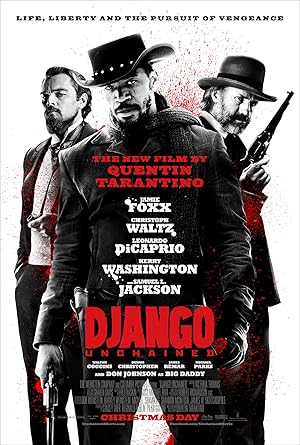
Django Unchained
In 1858, a bounty-hunter named King Schultz seeks out a slave named Django and buys him because he needs him to find some men he is looking for. After finding them, Django wants to find his wife, Broomhilda, who along with him were sold separately by his former owner for trying to escape. Schultz offers to help him if he chooses to stay with him and be his partner. Eventually they learn that she was sold to a plantation in Mississippi. Knowing they can't just go in and say they want her, they come up with a plan so that the owner will welcome them into his home and they can find a way.
Despite a significant budget of $100.0M, Django Unchained became a solid performer, earning $425.4M worldwide—a 325% return.
2 Oscars. 58 wins & 158 nominations
Roger Ebert
"Tarantino confronts the horrors of American slavery head-on, creating a revenge fantasy that is both brutally honest and wildly entertaining."Read Full Review


Plot Structure
Story beats plotted across runtime


Narrative Arc
Emotional journey through the story's key moments
Story Circle
Blueprint 15-beat structure
Arcplot Score Breakdown
Weighted: Precision (70%) + Arc (15%) + Theme (15%)
Django Unchained (2012) exhibits strategically placed plot construction, characteristic of Quentin Tarantino's storytelling approach. This structural analysis examines how the film's 15-point plot structure maps to proven narrative frameworks across 2 hours and 45 minutes. With an Arcplot score of 5.4, the film takes an unconventional approach to traditional narrative frameworks.
Characters
Cast & narrative archetypes

Django
Dr. King Schultz
Calvin Candie
Stephen
Broomhilda von Shaft
Main Cast & Characters
Django
Played by Jamie Foxx
A freed slave who becomes a bounty hunter to rescue his wife from brutal plantation owners
Dr. King Schultz
Played by Christoph Waltz
A German dentist-turned-bounty hunter who frees Django and becomes his mentor and partner
Calvin Candie
Played by Leonardo DiCaprio
A sadistic plantation owner who owns Django's wife and presides over brutal mandingo fights
Stephen
Played by Samuel L. Jackson
Candie's elderly head slave who manipulates his master and maintains brutal control over other slaves
Broomhilda von Shaft
Played by Kerry Washington
Django's wife who was separated from him and sold to Calvin Candie's plantation
Structural Analysis
The Status Quo at 1 minutes (1% through the runtime) establishes Django is shackled and marched through the Texas wilderness as a slave, powerless and trapped in the brutal institution of slavery.. Of particular interest, this early placement immediately immerses viewers in the story world.
The inciting incident occurs at 18 minutes when Schultz offers Django his freedom in exchange for helping identify the Brittle brothers, presenting an opportunity to escape slavery and seek revenge.. At 11% through the film, this Disruption aligns precisely with traditional story structure. This beat shifts the emotional landscape, launching the protagonist into the central conflict.
The First Threshold at 36 minutes marks the transition into Act II, occurring at 22% of the runtime. This illustrates the protagonist's commitment to Django actively chooses to partner with Schultz for the winter and spring to earn money, then pursue Broomhilda together. He commits to becoming a bounty hunter rather than simply fleeing north., moving from reaction to action.
At 74 minutes, the Midpoint arrives at 45% of the runtime—arriving early, accelerating into Act IIb complications. Significantly, this crucial beat Django sees Broomhilda for the first time in years at Candyland. The false victory: their plan seems to be working as Candie invites them into his home and they're closer to Broomhilda than ever., fundamentally raising what's at risk. The emotional intensity shifts, dividing the narrative into clear before-and-after phases.
The Collapse moment at 109 minutes (66% through) represents the emotional nadir. Here, Candie reveals he knows their true plan and demands $12,000 for Broomhilda, threatening to kill her. Stephen has exposed the deception. The deal turns into a hostage situation and the mission appears doomed., illustrates the protagonist at their lowest point. This beat's placement in the final quarter sets up the climactic reversal.
The Second Threshold at 118 minutes initiates the final act resolution at 72% of the runtime. Django uses his cunning to convince the LeQuint slavers that he's a valuable bounty hunter, then kills his captors and seizes control. He synthesizes Schultz's lessons with his own will to rescue Broomhilda alone., demonstrating the transformation achieved throughout the journey.
Emotional Journey
Django Unchained's emotional architecture traces a deliberate progression across 15 carefully calibrated beats.
Narrative Framework
This structural analysis employs a 15-point narrative structure framework that maps key story moments. By mapping Django Unchained against these established plot points, we can identify how Quentin Tarantino utilizes or subverts traditional narrative conventions. The plot point approach reveals not only adherence to structural principles but also creative choices that distinguish Django Unchained within the drama genre.
Quentin Tarantino's Structural Approach
Among the 11 Quentin Tarantino films analyzed on Arcplot, the average structural score is 4.6, showcasing experimental approaches to narrative form. Django Unchained represents one of the director's most structurally precise works. For comparative analysis, explore the complete Quentin Tarantino filmography.
Comparative Analysis
Additional drama films include After Thomas, South Pacific and Dirty Dancing: Havana Nights. For more Quentin Tarantino analyses, see Kill Bill: The Whole Bloody Affair, Reservoir Dogs and Pulp Fiction.
Plot Points by Act
Act I
SetupStatus Quo
Django is shackled and marched through the Texas wilderness as a slave, powerless and trapped in the brutal institution of slavery.
Theme
Dr. King Schultz tells the Speck brothers, "I'm simply a customer trying to conduct a transaction," foreshadowing the film's exploration of human commodification and the transactional nature of freedom under slavery.
Worldbuilding
Introduction to 1858 Deep South slavery, the Speck brothers' slave transport, Dr. Schultz's arrival as a German bounty hunter, and Django's identification of the Brittle brothers. Establishes the brutal world of slavery and Schultz's unusual moral code.
Disruption
Schultz offers Django his freedom in exchange for helping identify the Brittle brothers, presenting an opportunity to escape slavery and seek revenge.
Resistance
Schultz mentors Django in bounty hunting, teaching him to shoot and navigate the world as a free man. Django learns the trade while sharing his story about his wife Broomhilda and their separation. They hunt bounties together through winter.
Act II
ConfrontationFirst Threshold
Django actively chooses to partner with Schultz for the winter and spring to earn money, then pursue Broomhilda together. He commits to becoming a bounty hunter rather than simply fleeing north.
Mirror World
Schultz reveals he knows Broomhilda's location at Candyland and commits to helping Django free her, cementing their partnership. The German legend of Siegfried and Broomhilda is introduced as the thematic mirror story.
Premise
The "buddy bounty hunter" adventure: Django and Schultz successfully hunt criminals together, Django learns the trade and gains confidence, they execute their plan to infiltrate Candyland by posing as Mandingo buyers, and arrive at Calvin Candie's plantation.
Midpoint
Django sees Broomhilda for the first time in years at Candyland. The false victory: their plan seems to be working as Candie invites them into his home and they're closer to Broomhilda than ever.
Opposition
Tensions escalate at Candyland: the horrific Mandingo fight, Django must watch D'Artagnan be torn apart by dogs, Stephen grows suspicious of their true intentions, and the dinner where Candie and Stephen close in on the deception.
Collapse
Candie reveals he knows their true plan and demands $12,000 for Broomhilda, threatening to kill her. Stephen has exposed the deception. The deal turns into a hostage situation and the mission appears doomed.
Crisis
The tense standoff continues through the handshake demand and business agreement. Schultz struggles with his conscience, then shoots Candie, resulting in a massive shootout. Schultz is killed—Django's mentor dies. Django is captured and sent to the LeQuint Dickey Mining Company.
Act III
ResolutionSecond Threshold
Django uses his cunning to convince the LeQuint slavers that he's a valuable bounty hunter, then kills his captors and seizes control. He synthesizes Schultz's lessons with his own will to rescue Broomhilda alone.
Synthesis
Django returns to Candyland as a free agent, tricks Stephen and the household, liberates Broomhilda, kills Candie's sister and the remaining household, confronts Stephen, and destroys the plantation in a massive explosion.
Transformation
Django and Broomhilda ride away together as Candyland explodes behind them. The former slave is now a free man, reunited with his wife, having destroyed the symbols of his oppression—a complete transformation from the shackled man in the opening.