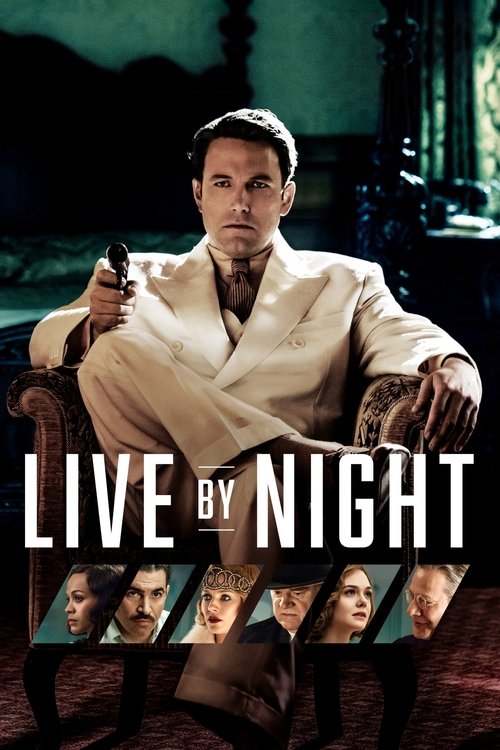
Live by Night
A group of Boston-bred gangsters set up shop in balmy Florida during the Prohibition era, facing off against the competition and the Ku Klux Klan.
The film financial setback against its considerable budget of $90.0M, earning $22.7M globally (-75% loss). While initial box office returns were modest, the film has gained appreciation for its unique voice within the crime genre.


Plot Structure
Story beats plotted across runtime


Narrative Arc
Emotional journey through the story's key moments
Story Circle
Blueprint 15-beat structure
Arcplot Score Breakdown
Weighted: Precision (70%) + Arc (15%) + Theme (15%)
Live by Night (2016) demonstrates strategically placed story structure, characteristic of Ben Affleck's storytelling approach. This structural analysis examines how the film's 15-point plot structure maps to proven narrative frameworks across 2 hours and 9 minutes. With an Arcplot score of 7.0, the film balances conventional beats with creative variation.
Characters
Cast & narrative archetypes

Joe Coughlin
Graciela Corrales
Emma Gould
Albert White
Maso Pescatore
Dion Bartolo
Loretta Figgis
Chief Irving Figgis
R.D. Pruitt
Thomas Coughlin
Main Cast & Characters
Joe Coughlin
Played by Ben Affleck
A WWI veteran turned outlaw who rises through the ranks of organized crime during Prohibition, seeking independence from traditional mob families.
Graciela Corrales
Played by Zoe Saldana
A strong-willed Cuban woman who becomes Joe's lover and business partner, running rum operations in Tampa.
Emma Gould
Played by Sienna Miller
Joe's first love, the girlfriend of Irish mob boss Albert White, whose relationship with Joe ignites a bloody gang war.
Albert White
Played by Robert Glenister
A ruthless Irish mob boss and Joe's primary antagonist, obsessed with revenge after Joe's affair with Emma.
Maso Pescatore
Played by Remo Girone
An Italian crime boss who mentors Joe and sponsors his operations in Florida, representing the old guard of organized crime.
Dion Bartolo
Played by Chris Messina
Joe's loyal best friend and second-in-command, who follows him from Boston to Florida.
Loretta Figgis
Played by Elle Fanning
The troubled daughter of a powerful Tampa police chief who becomes a Hollywood actress and descends into addiction.
Chief Irving Figgis
Played by Chris Cooper
Tampa's corrupt police chief who makes a deal with Joe but turns against him when his daughter's moral crusade threatens the casino business.
R.D. Pruitt
Played by Matthew Maher
The violent, racist leader of the Ku Klux Klan in Tampa who opposes Joe's operations.
Thomas Coughlin
Played by Brendan Gleeson
Joe's father, a Boston police captain who represents law and order, disappointed by his son's criminal path.
Structural Analysis
The Status Quo at 2 minutes (1% through the runtime) establishes Joe Coughlin narrates his philosophy: he's an outlaw, not an outlaw's son. He robs a bank in Boston, establishing his independence from his police chief father and his life in the criminal underworld of Prohibition-era Boston.. Of particular interest, this early placement immediately immerses viewers in the story world.
The inciting incident occurs at 16 minutes when Joe and Emma are ambushed by Albert White's men. Emma is killed, and Joe is severely beaten and left for dead. His world in Boston collapses, and his forbidden romance ends in tragedy.. At 12% through the film, this Disruption aligns precisely with traditional story structure. This beat shifts the emotional landscape, launching the protagonist into the central conflict.
The First Threshold at 32 minutes marks the transition into Act II, occurring at 25% of the runtime. This demonstrates the protagonist's commitment to Joe accepts Maso's offer and travels to Tampa, Florida. He actively chooses to enter the new world of the South, leaving behind Boston and committing to build a criminal empire in unfamiliar territory., moving from reaction to action.
At 64 minutes, the Midpoint arrives at 50% of the runtime—precisely centered, creating perfect narrative symmetry. Significantly, this crucial beat Joe successfully opens his casino and achieves major success. His empire is thriving, his relationship with Graciela is strong, and it appears he's won. However, this false victory comes with rising stakes: the KKK grows more dangerous, and his mentor's daughter Loretta becomes a wild card., fundamentally raising what's at risk. The emotional intensity shifts, dividing the narrative into clear before-and-after phases.
The Collapse moment at 96 minutes (74% through) represents the emotional nadir. Here, Graciela is killed in a shootout, murdered by the Ku Klux Klan in an attack on Joe's operation. Joe loses the woman he loves, his unborn child, and his dream of a legitimate life. This is his darkest moment and carries a literal "whiff of death."., demonstrates the protagonist at their lowest point. This beat's placement in the final quarter sets up the climactic reversal.
The Second Threshold at 103 minutes initiates the final act resolution at 80% of the runtime. Joe receives information about Albert White's location and decides to take final revenge. He synthesizes his grief into resolve, choosing to complete his original mission. He commits to ending the cycle of violence by eliminating White, even knowing it won't bring Graciela back., demonstrating the transformation achieved throughout the journey.
Emotional Journey
Live by Night's emotional architecture traces a deliberate progression across 15 carefully calibrated beats.
Narrative Framework
This structural analysis employs a 15-point narrative structure framework that maps key story moments. By mapping Live by Night against these established plot points, we can identify how Ben Affleck utilizes or subverts traditional narrative conventions. The plot point approach reveals not only adherence to structural principles but also creative choices that distinguish Live by Night within the crime genre.
Ben Affleck's Structural Approach
Among the 4 Ben Affleck films analyzed on Arcplot, the average structural score is 7.1, reflecting strong command of classical structure. Live by Night takes a more unconventional approach compared to the director's typical style. For comparative analysis, explore the complete Ben Affleck filmography.
Comparative Analysis
Additional crime films include The Bad Guys, Rustom and The Whole Ten Yards. For more Ben Affleck analyses, see Air, The Town and Argo.
Plot Points by Act
Act I
SetupStatus Quo
Joe Coughlin narrates his philosophy: he's an outlaw, not an outlaw's son. He robs a bank in Boston, establishing his independence from his police chief father and his life in the criminal underworld of Prohibition-era Boston.
Theme
Joe's father, Thomas Coughlin, tells him "You can't be two people at once. You have to choose who you are." This establishes the film's central theme about identity, loyalty, and the cost of living between worlds.
Worldbuilding
Joe operates as a stick-up man in 1920s Boston, in love with Emma Gould, mistress of Irish mob boss Albert White. The world of Prohibition crime, ethnic gang territories, and Joe's strained relationship with his lawman father is established.
Disruption
Joe and Emma are ambushed by Albert White's men. Emma is killed, and Joe is severely beaten and left for dead. His world in Boston collapses, and his forbidden romance ends in tragedy.
Resistance
Joe recovers from his injuries and is approached by Maso Pescatore, an Italian mob boss, who offers him a chance to run rum operations in Tampa, Florida. Joe debates leaving Boston and his old life behind, ultimately seeing this as an opportunity for revenge against Albert White.
Act II
ConfrontationFirst Threshold
Joe accepts Maso's offer and travels to Tampa, Florida. He actively chooses to enter the new world of the South, leaving behind Boston and committing to build a criminal empire in unfamiliar territory.
Mirror World
Joe meets Graciela Corrales, a Cuban woman who becomes his love interest and partner. She represents a new life and the possibility of genuine connection, contrasting with his doomed relationship with Emma and teaching him about trust and partnership.
Premise
Joe builds his rum empire in Tampa, navigating relationships with the Cuban community, KKK elements, and local power structures. He establishes casinos, gains wealth and respect, and builds a life with Graciela. This is the "gangster rising to power" promise of the premise.
Midpoint
Joe successfully opens his casino and achieves major success. His empire is thriving, his relationship with Graciela is strong, and it appears he's won. However, this false victory comes with rising stakes: the KKK grows more dangerous, and his mentor's daughter Loretta becomes a wild card.
Opposition
Forces close in on Joe from multiple directions: Loretta campaigns against his casino after a religious conversion, the KKK escalates violence, and Albert White from Boston begins encroaching on his territory. Joe's attempts to maintain control become increasingly desperate and violent.
Collapse
Graciela is killed in a shootout, murdered by the Ku Klux Klan in an attack on Joe's operation. Joe loses the woman he loves, his unborn child, and his dream of a legitimate life. This is his darkest moment and carries a literal "whiff of death."
Crisis
Joe grieves Graciela and contemplates his path. He realizes that violence and revenge have cost him everything meaningful. He faces the darkness of what he's become and what he's lost in his pursuit of power.
Act III
ResolutionSecond Threshold
Joe receives information about Albert White's location and decides to take final revenge. He synthesizes his grief into resolve, choosing to complete his original mission. He commits to ending the cycle of violence by eliminating White, even knowing it won't bring Graciela back.
Synthesis
Joe executes his plan to confront and kill Albert White. He orchestrates the assassination, faces his enemy, and completes his revenge. The finale resolves his criminal obligations and external conflicts, though at tremendous personal cost.
Transformation
Joe narrates that he lived and died in those years. Though he survives physically and continues in the criminal world, he's hollow—transformed into exactly what he swore he wouldn't become. The final image shows him alone, powerful but empty, having chosen his identity at the cost of his humanity.