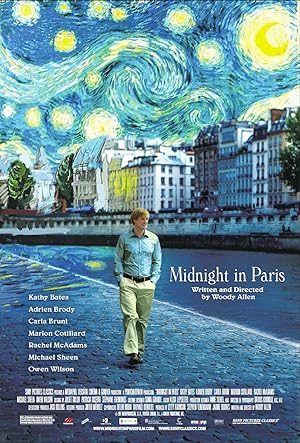
Midnight in Paris
Gil and Inez travel to Paris as a tag-along vacation on her parents' business trip. Gil is a successful Hollywood writer but is struggling on his first novel. He falls in love with the city and thinks he and Inez should move there after they get married, but Inez does not share his romantic notions of the city or the idea that the 1920s were the golden age. When Inez goes off dancing with her friends, Gil takes a walk at midnight and discovers what could be the ultimate source of inspiration for writing. Gil's daily walks at midnight in Paris could take him closer to the heart of the city but further from the woman he's about to marry.
Despite a mid-range budget of $17.0M, Midnight in Paris became a runaway success, earning $151.1M worldwide—a remarkable 789% return.
1 Oscar. 26 wins & 103 nominations
Roger Ebert
"This is Woody Allen's 41st film. He writes his films himself, and directs them with wit and grace. I consider him a treasure of the cinema. There is nothing to dislike about it. This film is sort of a daydream for American lit majors. Allen makes no attempt to explain this magic. None is needed. Nor do we have to decide if what happens is real or imaginary. Gil is swept along in their wake and finds himself plunged into the Jazz Age and all its legends."Read Full Review


Narrative Tropes
22 totalPlot Structure
Story beats plotted across runtime


Narrative Arc
Emotional journey through the story's key moments
Story Circle
Blueprint 15-beat structure
Arcplot Score Breakdown
Weighted: Precision (70%) + Arc (15%) + Theme (15%)
Midnight in Paris (2011) demonstrates deliberately positioned dramatic framework, characteristic of Woody Allen's storytelling approach. This structural analysis examines how the film's 15-point plot structure maps to proven narrative frameworks across 1 hour and 34 minutes. With an Arcplot score of 6.8, the film balances conventional beats with creative variation.
Characters
Cast & narrative archetypes

Gil Pender

Adriana

Inez

Ernest Hemingway

Gertrude Stein

Salvador Dalí

Paul Bates

Pablo Picasso
Character Screen Time
Screen time mapped to story structure
Main Cast & Characters
Gil Pender
Played by Owen Wilson
100% screen time (90 min)
A nostalgic Hollywood screenwriter visiting Paris who longs for the 1920s Golden Age. At midnight, he magically travels back in time to meet his literary heroes.
Adriana
Played by Marion Cotillard
33% screen time (30 min)
A beautiful 1920s costume designer who becomes Gil's romantic interest in the past. She dreams of the Belle Époque as her own golden age.
Inez
Played by Rachel McAdams
36% screen time (32 min)
Gil's materialistic fiancée who dismisses his romantic notions about Paris and clearly doesn't understand him.
Ernest Hemingway
Played by Corey Stoll
17% screen time (15 min)
The legendary author who befriends Gil and offers to show his manuscript to Gertrude Stein.
Gertrude Stein
Played by Kathy Bates
14% screen time (13 min)
Influential writer and art collector who critiques Gil's novel with insightful observations.
Salvador Dalí
Played by Adrien Brody
6% screen time (5 min)
Surrealist artist fascinated by Gil's stories from the future, especially the rhinoceros.
Paul Bates
Played by Michael Sheen
20% screen time (18 min)
Pseudo-intellectual friend of Inez who constantly lectures and is later revealed to be wrong about everything.
Pablo Picasso
Played by Marcial Di Fonzo Bo
9% screen time (8 min)
The revolutionary artist who is having an affair with Adriana.
Structural Analysis
The Status Quo at 0 minutes (0% through the runtime) establishes A 3.5-minute wordless montage of Paris - romantic, golden-hued shots of the city in various weather and times of day. Iconic landmarks, cafes, streets, the Seine. Set to jazz music. Paris is presented as a character, a dream, an idealized vision before any humans appear. The city is shown in rain and sunshine, establishing rain as romantic motif.. Significantly, this early placement immediately immerses viewers in the story world.
The inciting incident occurs at 17 minutes when The vintage Peugeot arrives at midnight. After leaving wine-tasting drunk, Gil gets lost and sits on steps at Rue Saint-Étienne du Mont. Church bells strike midnight. A 1920s automobile pulls up, passengers in period costume invite him in. Gil hesitates briefly, then enters. He's transported to a roaring party where he meets the Fitzgeralds and discovers he's somehow traveled to 1920s Paris.. At 18% through the film, this Disruption is delayed, allowing extended setup of the story world. This beat shifts the emotional state to -2, launching the protagonist into the central conflict.
The First Threshold at 29 minutes marks the transition into Act II, occurring at 31% of the runtime. This reveals the protagonist's commitment to Gil makes TWO active commitments that break him into Act II: (1) He gives his novel manuscript to Hemingway to pass to Gertrude Stein - this is professional/artistic commitment to the 1920s world. (2) He tries to convince Inez to come with him at midnight, actively attempting to bring his present life into his fantasy - when she refuses, he goes alone anyway. This is his definitive choice to pursue the adventure, to engage with the past, to make it part of his life. No longer passive recipient but active seeker., moving from reaction to action. The emotional journey here reflects 2.
At 43 minutes, the Midpoint arrives at 46% of the runtime—arriving early, accelerating into Act IIb complications. Significantly, this crucial beat Gil gets to one-up the insufferable Paul in the present day. At the Rodin museum, Paul is lecturing about Picasso's portrait (of Adriana), getting the interpretation completely wrong. Gil, armed with knowledge from Gertrude Stein herself, corrects Paul with authority. For a brief moment, Gil seems to have the best of both worlds - secret knowledge from the past giving him power in the present, validation from artistic legends, and growing connection with Adriana. But cracks immediately appear: hints of Inez's infidelity with Paul, Hemingway's drunkenness and philandering, Zelda's disorientation and depression, and the crushing moment when Gil lets slip to Adriana that he's engaged and she leaves abruptly. The false high peaks and begins to crumble., fundamentally raising what's at risk. The emotional state shifts to 8, dividing the narrative into clear before-and-after phases.
The Collapse moment at 67 minutes (71% through) represents the emotional nadir. Here, Gil steals Inez's earrings to give to Adriana (moral compromise, desperation). In present day, Inez's father has chest pains requiring hotel doctor. Gil is caught between worlds - stealing from fiancée to romance woman in past, lying to everyone, family medical crisis he's absent for. The "whiff of death" is both literal (father's health) and metaphorical (death of his illusions). Everything is falling apart in both timelines., illustrates the protagonist at their lowest point. This beat's placement in the final quarter sets up the climactic reversal.
The Second Threshold at 76 minutes initiates the final act resolution at 80% of the runtime. Gil and Adriana are transported to Belle Époque (1890s) when a horse-drawn carriage arrives at midnight. They meet Toulouse-Lautrec and other 1890s artists. Gil watches Adriana romanticize this earlier era, saying she wishes she could stay here forever - just as Gil romanticizes the 1920s. "That's what the present is, it's a little unsatisfying because life is a little unsatisfying... If I ever want to write something worthwhile I have to get rid of my illusions, and that I would be happier in the past is probably one of them."., demonstrating the transformation achieved throughout the journey.
Emotional Journey
Midnight in Paris's emotional architecture traces a deliberate progression from 2 to 6. The narrative's emotional pivot at the midpoint—8—divides the journey into distinct phases, with the first half building toward this moment of transformation and the second half exploring its consequences. With 5 core emotional states, the narrative maintains focused emotional clarity, allowing sustained thematic development.
Narrative Framework
This structural analysis employs a 15-point narrative structure framework that maps key story moments. By mapping Midnight in Paris against these established plot points, we can identify how Woody Allen utilizes or subverts traditional narrative conventions. The plot point approach reveals not only adherence to structural principles but also creative choices that distinguish Midnight in Paris within the comedy genre.
Woody Allen's Structural Approach
Among the 42 Woody Allen films analyzed on Arcplot, the average structural score is 7.0, demonstrating varied approaches to story architecture. Midnight in Paris takes a more unconventional approach compared to the director's typical style. For comparative analysis, explore the complete Woody Allen filmography.
Comparative Analysis
Additional comedy films include The Bad Guys, Ella Enchanted and The Evening Star. For more Woody Allen analyses, see Everyone Says I Love You, Celebrity and Interiors.
Plot Points by Act
Act I
SetupStatus Quo
A 3.5-minute wordless montage of Paris - romantic, golden-hued shots of the city in various weather and times of day. Iconic landmarks, cafes, streets, the Seine. Set to jazz music. Paris is presented as a character, a dream, an idealized vision before any humans appear. The city is shown in rain and sunshine, establishing rain as romantic motif.
Theme
Paul's pseudo-intellectual lecture at the nostalgia shop. He states explicitly: "Nostalgia is denial, denial of the painful present... the name of this fallacy is golden age thinking, a flaw in the romantic imagination of all people who find themselves unhappy in the present." This is textbook Theme Stated - another character calling out the hero's deeper flaw. Gil dismisses it, but the seed is planted.
Worldbuilding
After Paul's theme statement, we see the full setup of Gil's world. Dinner scene with Inez's parents - conservative, materialistic, dismissive of Gil's artistic ambitions. Tension builds as Paul joins them. Gil's discomfort is palpable. We see all the elements that need fixing: unfulfilling career, unfinished novel, relationship with dismissive fiancée, future in-laws who don't respect him, Paul's insufferable presence, and Gil's yearning for something more authentic. The soup discussion and building social pressure set up his need to escape.
Disruption
The vintage Peugeot arrives at midnight. After leaving wine-tasting drunk, Gil gets lost and sits on steps at Rue Saint-Étienne du Mont. Church bells strike midnight. A 1920s automobile pulls up, passengers in period costume invite him in. Gil hesitates briefly, then enters. He's transported to a roaring party where he meets the Fitzgeralds and discovers he's somehow traveled to 1920s Paris.
Resistance
Gil's internal debate happens at the Fitzgeralds' party and continues into the Hemingway café scene. The key moment is when Gil looks scared/zoned out for a moment at the party - "Is this real? Am I insane?" - before slowly warming up to the reality and dancing along. He debates: Should I believe this? Can this be happening? He meets Hemingway, who offers to show his novel to Gertrude Stein. Back in present-day bed, Gil reassures himself he saw what he saw. The debate: Should I pursue this impossible thing or dismiss it as delusion?
Act II
ConfrontationFirst Threshold
Gil makes TWO active commitments that break him into Act II: (1) He gives his novel manuscript to Hemingway to pass to Gertrude Stein - this is professional/artistic commitment to the 1920s world. (2) He tries to convince Inez to come with him at midnight, actively attempting to bring his present life into his fantasy - when she refuses, he goes alone anyway. This is his definitive choice to pursue the adventure, to engage with the past, to make it part of his life. No longer passive recipient but active seeker.
Mirror World
Hemingway's passionate monologue about love and death: "I believe that love that is true and real creates a respite from death. All cowardice comes from loving or not loving well, which is the same thing." This thematic statement occurs just minutes before Gil first sees Adriana at Gertrude Stein's salon. The B Story is about love, mentorship, and truth - Hemingway as mentor, Adriana as romantic interest, and the question of what it means to love well (not just romanticize). This is the thematic heart that will carry through to Gil's realization that his nostalgia prevents him from loving well in the present.
Premise
Gil fully living in 1920s Paris. Multiple salon visits with Gertrude Stein getting feedback on his novel, parties with the Fitzgeralds, philosophical debates with Hemingway about writing and courage, hearing Cole Porter play piano and create music in real-time, meeting T.S. Eliot, discussing art with Picasso, encountering the Surrealists (Buñuel, Man Ray, Dalí). We see the glamour, wit, creative energy of the Lost Generation. Gil is living his ultimate fantasy - meeting heroes, getting artistic validation, being part of the most celebrated artistic period in modern history.
Midpoint
Gil gets to one-up the insufferable Paul in the present day. At the Rodin museum, Paul is lecturing about Picasso's portrait (of Adriana), getting the interpretation completely wrong. Gil, armed with knowledge from Gertrude Stein herself, corrects Paul with authority. For a brief moment, Gil seems to have the best of both worlds - secret knowledge from the past giving him power in the present, validation from artistic legends, and growing connection with Adriana. But cracks immediately appear: hints of Inez's infidelity with Paul, Hemingway's drunkenness and philandering, Zelda's disorientation and depression, and the crushing moment when Gil lets slip to Adriana that he's engaged and she leaves abruptly. The false high peaks and begins to crumble.
Opposition
Multiple forces tighten the noose. EXTERNAL: In present day, Paul grows more insufferable and condescending, Inez more dismissive and distant. Inez's parents pressure Gil about wedding plans and his "career." Detective hired by Inez's father follows Gil through Paris. INTERNAL: Gil falls deeper for Adriana, creating impossible emotional situation - can't pursue romance in past without destroying present, can't abandon 1920s without losing what makes him happy. Adriana reveals she wishes she lived in Belle Époque (1890s), perfectly mirroring Gil's nostalgia and foreshadowing the theme's climax. The cracks in the fantasy widen - Fitzgerald drama, artistic egos, the impossibility of sustaining dual lives.
Collapse
Gil steals Inez's earrings to give to Adriana (moral compromise, desperation). In present day, Inez's father has chest pains requiring hotel doctor. Gil is caught between worlds - stealing from fiancée to romance woman in past, lying to everyone, family medical crisis he's absent for. The "whiff of death" is both literal (father's health) and metaphorical (death of his illusions). Everything is falling apart in both timelines.
Crisis
After finally kissing Adriana, she observes: "And yet you look so sad." Gil's response reveals his deepest pain: "Life is too mysterious... I didn't take a real shot at being a writer... I just want to let it go." This is Gil's moment of complete surrender and self-awareness. He's admitting he's been running from real life, from real creative work, from real commitment. The kiss with Adriana - the thing he thought he wanted - brings no joy, only melancholy recognition of wasted time and unrealized potential.
Act III
ResolutionSecond Threshold
Gil and Adriana are transported to Belle Époque (1890s) when a horse-drawn carriage arrives at midnight. They meet Toulouse-Lautrec and other 1890s artists. Gil watches Adriana romanticize this earlier era, saying she wishes she could stay here forever - just as Gil romanticizes the 1920s. "That's what the present is, it's a little unsatisfying because life is a little unsatisfying... If I ever want to write something worthwhile I have to get rid of my illusions, and that I would be happier in the past is probably one of them."
Synthesis
Back in present, Gil applies his new wisdom. Gertrude Stein tells him his novel reveals the truth he couldn't see: Inez is having an affair. Gil confronts Inez, she admits affair with Paul. Gil breaks off engagement definitively: "I'm not going back." To Inez's parents, he announces he's staying in Paris. In final conversation with Adriana in 1920s, he explains why he can't stay: "If you stay here, and this becomes your present, you'll soon start imagining another time was really your golden age." He says goodbye to the fantasy, to Adriana, to the 1920s. He chooses present-day Paris - alone, uncertain, but real. He walks by the Seine at midnight, accepting solitude in the present over companionship in the past.
Transformation
Gil encounters Gabrielle, the record shop girl, on a bridge at midnight in present-day Paris. It starts to rain. She says "I find Paris is most beautiful in the rain" - echoing Gil's opening sentiment about Paris in the '20s in the rain. But critically, she loves the rain in the present. They stroll together in the rain, at night, in present-day Paris