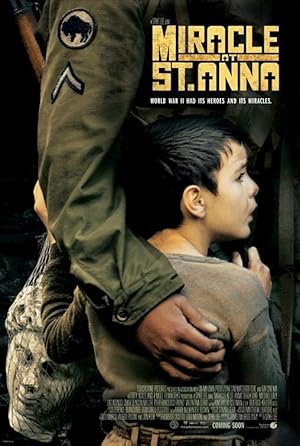
Miracle at St. Anna
Christmas, 1983. A New York postal clerk, a Buffalo Soldier in Italy in World War II, shoots a stranger. In his apartment, police find a valuable Italian marble head, missing since the war. Flashbacks tell the story of four Black soldiers who cross Tuscany's Serchio River, dodging German and friendly fire. With a shell-shocked boy in tow, they reach the village of Colognora. Orders via radio tell them to capture a German soldier for questioning about a counteroffensive. In the village, a beautiful woman, partisans that include a traitor and a local legend, the boy, and the story of a recent massacre connect to the postal worker's anguish forty years later. And the miracle?
The film financial setback against its mid-range budget of $45.0M, earning $9.3M globally (-79% loss). While initial box office returns were modest, the film has gained appreciation for its unique voice within the action genre.
1 win & 10 nominations


Plot Structure
Story beats plotted across runtime


Narrative Arc
Emotional journey through the story's key moments
Story Circle
Blueprint 15-beat structure
Arcplot Score Breakdown
Weighted: Precision (70%) + Arc (15%) + Theme (15%)
Miracle at St. Anna (2008) reveals strategically placed dramatic framework, characteristic of Spike Lee's storytelling approach. This structural analysis examines how the film's 15-point plot structure maps to proven narrative frameworks across 2 hours and 40 minutes. With an Arcplot score of 6.8, the film balances conventional beats with creative variation.
Characters
Cast & narrative archetypes

Staff Sergeant Aubrey Stamps
Corporal Hector Negron
Private First Class Sam Train
Private Bishop Cummings
Angelo Torancelli
Renata
Peppi Grotta
Main Cast & Characters
Staff Sergeant Aubrey Stamps
Played by Derek Luke
A bitter, cynical soldier haunted by betrayal and racism, seeking redemption through protecting an Italian boy.
Corporal Hector Negron
Played by Laz Alonso
A spiritual, compassionate soldier who believes the boy Angelo possesses miraculous healing powers.
Private First Class Sam Train
Played by Omar Benson Miller
A massive, gentle-giant soldier with childlike faith who bonds deeply with the Italian boy Angelo.
Private Bishop Cummings
Played by Michael Ealy
An educated, idealistic soldier who questions racism and carries the weight of moral conscience.
Angelo Torancelli
Played by Matteo Sciabordi
An 8-year-old Italian boy survivor who becomes the heart of the story and catalyst for the soldiers' humanity.
Renata
Played by Valentina Cervi
A brave Italian partisan resistance fighter who aids the soldiers and becomes romantically involved with Stamps.
Peppi Grotta
Played by Pierfrancesco Favino
An Italian partisan leader working with the resistance, torn between survival and collaboration.
Structural Analysis
The Status Quo at 1 minutes (1% through the runtime) establishes Present day 1983: Hector Negron works as a postal worker in New York, living a quiet, ordinary life decades after the war.. The analysis reveals that this early placement immediately immerses viewers in the story world.
The inciting incident occurs at 19 minutes when The squad becomes separated from their unit during a German attack at the Serchio River, leaving them stranded behind enemy lines in Tuscany.. At 12% through the film, this Disruption aligns precisely with traditional story structure. This beat shifts the emotional landscape, launching the protagonist into the central conflict.
The First Threshold at 41 minutes marks the transition into Act II, occurring at 25% of the runtime. This indicates the protagonist's commitment to The soldiers choose to take Angelo to the village of Colognora to find safety and his family, actively committing to protect him rather than simply trying to survive and return to their unit., moving from reaction to action.
At 81 minutes, the Midpoint arrives at 50% of the runtime—precisely centered, creating perfect narrative symmetry. Significantly, this crucial beat The revelation of the Sant'Anna di Stazzema massacre and the growing threat of German forces discovering the village. The stakes escalate dramatically as the soldiers realize they cannot simply wait out the war in safety., fundamentally raising what's at risk. The emotional intensity shifts, dividing the narrative into clear before-and-after phases.
The Collapse moment at 120 minutes (75% through) represents the emotional nadir. Here, The village is attacked. Multiple soldiers are killed in the devastating assault. Angelo is shot. The dream of protecting innocence dies as the violence overtakes everything., reveals the protagonist at their lowest point. This beat's placement in the final quarter sets up the climactic reversal.
The Second Threshold at 128 minutes initiates the final act resolution at 80% of the runtime. Back in 1983, Negron realizes he must act on the truth he's carried for decades. He chooses to shoot the customer who was a Nazi war criminal, breaking his silence and finally seeking justice., demonstrating the transformation achieved throughout the journey.
Emotional Journey
Miracle at St. Anna's emotional architecture traces a deliberate progression across 15 carefully calibrated beats.
Narrative Framework
This structural analysis employs systematic plot point analysis that identifies crucial turning points. By mapping Miracle at St. Anna against these established plot points, we can identify how Spike Lee utilizes or subverts traditional narrative conventions. The plot point approach reveals not only adherence to structural principles but also creative choices that distinguish Miracle at St. Anna within the action genre.
Spike Lee's Structural Approach
Among the 13 Spike Lee films analyzed on Arcplot, the average structural score is 7.0, demonstrating varied approaches to story architecture. Miracle at St. Anna takes a more unconventional approach compared to the director's typical style. For comparative analysis, explore the complete Spike Lee filmography.
Comparative Analysis
Additional action films include The Bad Guys, Puss in Boots and Venom: The Last Dance. For more Spike Lee analyses, see Summer of Sam, Inside Man and Clockers.
Plot Points by Act
Act I
SetupStatus Quo
Present day 1983: Hector Negron works as a postal worker in New York, living a quiet, ordinary life decades after the war.
Theme
In flashback to 1944, a character speaks about how Black soldiers are treated as invisible heroes, fighting for a country that doesn't see them - establishing the theme of recognition and justice.
Worldbuilding
Establishing the dual timeline: 1983 framing story and 1944 Italy where the Buffalo Soldiers of the 92nd Infantry Division face racism from their own army while fighting Nazis. The four main soldiers - Train, Bishop, Stamps, and Negron - are introduced.
Disruption
The squad becomes separated from their unit during a German attack at the Serchio River, leaving them stranded behind enemy lines in Tuscany.
Resistance
The four soldiers debate what to do while trapped behind enemy lines. They discover a traumatized Italian boy, Angelo, whom Train believes is a miracle. They must decide whether to seek safety or help the child.
Act II
ConfrontationFirst Threshold
The soldiers choose to take Angelo to the village of Colognora to find safety and his family, actively committing to protect him rather than simply trying to survive and return to their unit.
Mirror World
In the village, the soldiers meet Renata and the Italian partisans. A bond forms between Train and Angelo, and between the soldiers and the villagers - showing humanity across racial and national lines, embodying the film's theme.
Premise
The soldiers experience life in the Italian village, forming relationships with the locals. Train bonds with Angelo, romances develop, and they witness the complexities of war - partisans, collaborators, and the humanity on all sides.
Midpoint
The revelation of the Sant'Anna di Stazzema massacre and the growing threat of German forces discovering the village. The stakes escalate dramatically as the soldiers realize they cannot simply wait out the war in safety.
Opposition
Tensions rise as the Germans close in. Internal conflicts emerge among the soldiers about duty versus survival. Betrayals are revealed within the village. The soldiers' prejudices and conflicts with their own command intensify the danger.
Collapse
The village is attacked. Multiple soldiers are killed in the devastating assault. Angelo is shot. The dream of protecting innocence dies as the violence overtakes everything.
Crisis
Negron processes the loss and devastation. The survivors face the emotional weight of their failure to protect the village and Angelo. The darkness of war and the cost of their choices sink in.
Act III
ResolutionSecond Threshold
Back in 1983, Negron realizes he must act on the truth he's carried for decades. He chooses to shoot the customer who was a Nazi war criminal, breaking his silence and finally seeking justice.
Synthesis
The resolution unfolds as Negron's action in 1983 connects to the events of 1944. The truth about the Primavera statue head, the Nazi collaborator, and the Buffalo Soldiers' heroism is finally revealed. Justice is served across time.
Transformation
Negron, arrested but at peace, has transformed from a silent postal worker haunted by the past into a man who took action for justice. The invisible heroes are finally seen.