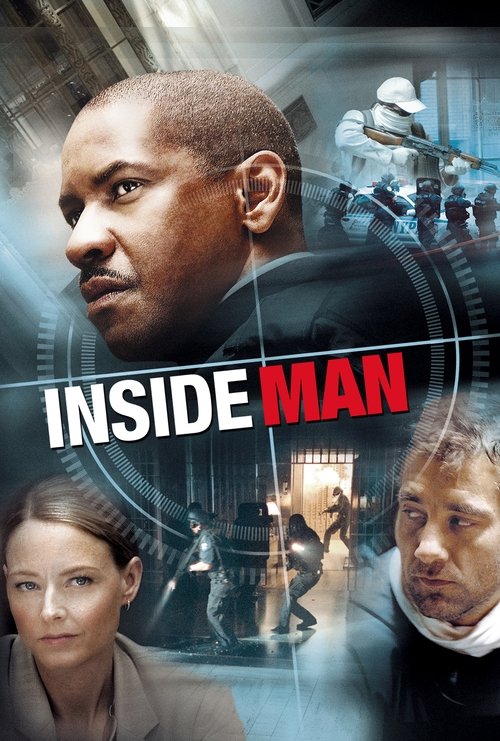
Inside Man
A police detective, a bank robber and a high-power broker enter high-stakes negotiations after the criminal's brilliant heist spirals into a hostage situation.
Despite a mid-range budget of $45.0M, Inside Man became a commercial success, earning $186.0M worldwide—a 313% return.
5 wins & 12 nominations


Plot Structure
Story beats plotted across runtime


Narrative Arc
Emotional journey through the story's key moments
Story Circle
Blueprint 15-beat structure
Characters
Cast & narrative archetypes

Keith Frazier
Dalton Russell
Madeleine White
Arthur Case
Bill Mitchell
Captain John Darius
Main Cast & Characters
Keith Frazier
Played by Denzel Washington
NYPD detective who leads the hostage negotiation, determined to outsmart the bank robbers while navigating departmental politics.
Dalton Russell
Played by Clive Owen
Brilliant and methodical bank robber who orchestrates an elaborate heist with a larger plan that unfolds over time.
Madeleine White
Played by Jodie Foster
Mysterious and powerful fixer hired by the bank's chairman to protect his dark secrets during the robbery crisis.
Arthur Case
Played by Christopher Plummer
Elderly chairman of the bank with Nazi-era secrets he desperately wants to keep hidden from authorities.
Bill Mitchell
Played by Chiwetel Ejiofor
Frazier's partner and fellow NYPD detective who assists in the hostage negotiation and investigation.
Captain John Darius
Played by Willem Dafoe
NYPD captain who oversees the hostage situation and manages the inter-agency tensions.
Structural Analysis
The Status Quo at 1 minutes (1% through the runtime) establishes Dalton Russell speaks directly to camera from a sparse cell-like room, declaring he's planned the perfect bank robbery and challenging us to figure out how. This confident, controlled opening establishes the mastermind's intellectual dominance.. Significantly, this early placement immediately immerses viewers in the story world.
The inciting incident occurs at 15 minutes when The bank robbery begins in earnest as masked gunmen take control, forcing hostages to the floor at gunpoint. The police are alerted and Frazier is called to the scene as lead hostage negotiator, disrupting his ordinary world completely.. At 12% through the film, this Disruption aligns precisely with traditional story structure. This beat shifts the emotional landscape, launching the protagonist into the central conflict.
The First Threshold at 32 minutes marks the transition into Act II, occurring at 25% of the runtime. This reveals the protagonist's commitment to Frazier commits fully to the negotiation when Russell makes his first impossible demand and threatens to execute hostages. Keith chooses to play Russell's game rather than defer to ESU for a tactical assault, crossing into an intellectual battle with an unseen opponent., moving from reaction to action.
At 65 minutes, the Midpoint arrives at 50% of the runtime—precisely centered, creating perfect narrative symmetry. Significantly, this crucial beat Russell sends out a hostage who claims someone was executed inside. The apparent murder raises stakes exponentially - this is no longer just a robbery but potentially a homicide. Frazier's approach is questioned and pressure mounts for a tactical response. False defeat: the situation appears to be spiraling beyond control., fundamentally raising what's at risk. The emotional intensity shifts, dividing the narrative into clear before-and-after phases.
The Collapse moment at 97 minutes (75% through) represents the emotional nadir. Here, The robbers announce they're coming out. Police storm the bank only to find all the hostages dressed identically to the robbers - impossible to distinguish criminal from victim. The "perfect crime" appears complete as everyone is released and no perpetrators can be identified. Frazier's investigation has seemingly failed entirely., indicates the protagonist at their lowest point. This beat's placement in the final quarter sets up the climactic reversal.
The Second Threshold at 103 minutes initiates the final act resolution at 80% of the runtime. Frazier discovers a clue that doesn't fit - a diamond hidden in one hostage's possessions. This leads him to investigate Arthur Case and uncover the truth: Case's fortune was built on Nazi collaboration, and Russell's real target was exposing this hidden evil, not stealing money., demonstrating the transformation achieved throughout the journey.
Emotional Journey
Inside Man's emotional architecture traces a deliberate progression across 15 carefully calibrated beats.
Narrative Framework
This structural analysis employs proven narrative structure principles that track dramatic progression. By mapping Inside Man against these established plot points, we can identify how Spike Lee utilizes or subverts traditional narrative conventions. The plot point approach reveals not only adherence to structural principles but also creative choices that distinguish Inside Man within the crime genre.
Spike Lee's Structural Approach
Among the 13 Spike Lee films analyzed on Arcplot, the average structural score is 7.0, demonstrating varied approaches to story architecture. Inside Man exemplifies the director's characteristic narrative technique. For comparative analysis, explore the complete Spike Lee filmography.
Comparative Analysis
Additional crime films include The Bad Guys, Rustom and The Whole Ten Yards. For more Spike Lee analyses, see Summer of Sam, Clockers and BlacKkKlansman.
Plot Points by Act
Act I
SetupStatus Quo
Dalton Russell speaks directly to camera from a sparse cell-like room, declaring he's planned the perfect bank robbery and challenging us to figure out how. This confident, controlled opening establishes the mastermind's intellectual dominance.
Theme
Dalton tells the audience: "My name is Dalton Russell. Pay strict attention to what I say because I choose my words carefully and I never repeat myself." The theme of perception versus reality, and the careful orchestration of truth, is established.
Worldbuilding
We meet Detective Keith Frazier, facing an Internal Affairs investigation over missing drug money, jeopardizing his career and relationship. The robbers arrive at Manhattan Trust Bank disguised as painters and execute their takeover with military precision, taking hostages.
Disruption
The bank robbery begins in earnest as masked gunmen take control, forcing hostages to the floor at gunpoint. The police are alerted and Frazier is called to the scene as lead hostage negotiator, disrupting his ordinary world completely.
Resistance
Frazier arrives and assesses the situation. He debates strategy with Captain Darius, establishes communication with Russell, and tries to understand what the robbers really want. Meanwhile, bank founder Arthur Case secretly contacts power broker Madeleine White to protect his hidden interests inside the vault.
Act II
ConfrontationFirst Threshold
Frazier commits fully to the negotiation when Russell makes his first impossible demand and threatens to execute hostages. Keith chooses to play Russell's game rather than defer to ESU for a tactical assault, crossing into an intellectual battle with an unseen opponent.
Mirror World
Madeleine White enters the picture as a shadowy fixer representing Arthur Case's interests. Her parallel investigation into the bank's secrets mirrors Frazier's pursuit of truth, introducing the hidden Nazi collaboration subplot that provides the film's moral dimension.
Premise
The cat-and-mouse negotiation unfolds as Frazier and Russell match wits. The robbers dress hostages in identical outfits to their own, conduct mysterious activities in the vault, and play mind games. Frazier conducts interviews, pieces together clues, while White maneuvers behind the scenes. The "perfect heist" premise delivers its promise.
Midpoint
Russell sends out a hostage who claims someone was executed inside. The apparent murder raises stakes exponentially - this is no longer just a robbery but potentially a homicide. Frazier's approach is questioned and pressure mounts for a tactical response. False defeat: the situation appears to be spiraling beyond control.
Opposition
Forces close in from all sides. The mayor pressures for resolution, ESU pushes for assault, White manipulates access to the bank for Case's interests, and Frazier struggles to maintain control. The interviews with released hostages reveal confusing contradictions. Russell's true plan remains maddeningly opaque as time runs out.
Collapse
The robbers announce they're coming out. Police storm the bank only to find all the hostages dressed identically to the robbers - impossible to distinguish criminal from victim. The "perfect crime" appears complete as everyone is released and no perpetrators can be identified. Frazier's investigation has seemingly failed entirely.
Crisis
In the aftermath, Frazier processes his apparent defeat. The bank claims nothing was stolen, the hostages are unharmed, and there's no evidence to prosecute anyone. His career remains in jeopardy, and he's been outplayed at every turn. The perfect crime seems to have succeeded.
Act III
ResolutionSecond Threshold
Frazier discovers a clue that doesn't fit - a diamond hidden in one hostage's possessions. This leads him to investigate Arthur Case and uncover the truth: Case's fortune was built on Nazi collaboration, and Russell's real target was exposing this hidden evil, not stealing money.
Synthesis
The truth emerges in layers. Russell had hidden himself inside a false wall in the storage room, waiting days to emerge and walk out undetected with documents proving Case's Nazi collaboration. Frazier confronts Case with evidence of his war crimes. Justice operates outside the law - Russell achieved moral victory while Frazier gains leverage to clear his name.
Transformation
Russell walks freely through Manhattan with his stolen evidence and a single diamond - payment for his moral work. Frazier, now cleared of suspicion and promoted, spots Russell on the street. They exchange a knowing look. Both men got what they needed: Russell exposed evil, Frazier found justice. The system's blindness enabled a deeper truth.