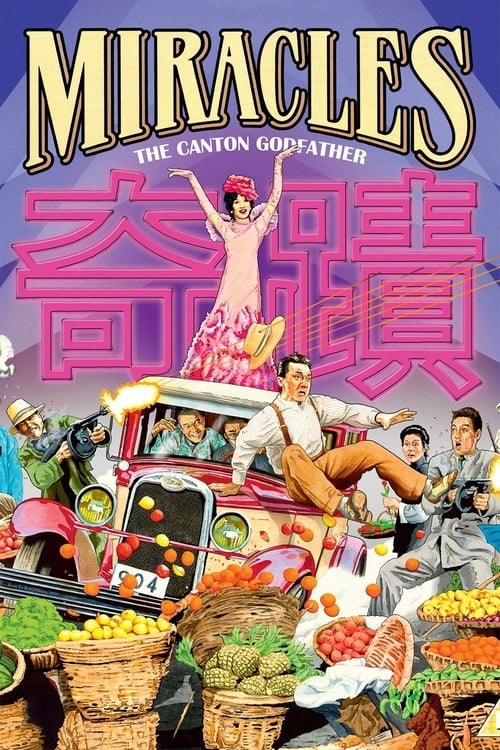
Miracles: The Canton Godfather
A country boy becomes the head of a gang through the purchase of some lucky roses from an old lady. He and a singer at the gang's nightclub try to do a good deed for the old lady when her daughter comes to visit.
The film earned $34.0M at the global box office.


Plot Structure
Story beats plotted across runtime


Narrative Arc
Emotional journey through the story's key moments
Story Circle
Blueprint 15-beat structure
Arcplot Score Breakdown
Weighted: Precision (70%) + Arc (15%) + Theme (15%)
Miracles: The Canton Godfather (1989) showcases precise dramatic framework, characteristic of Jackie Chan's storytelling approach. This structural analysis examines how the film's 15-point plot structure maps to proven narrative frameworks across 2 hours and 6 minutes. With an Arcplot score of 7.2, the film balances conventional beats with creative variation.
Characters
Cast & narrative archetypes

Kuo Cheng-Wah
Miss Yang
Bill
Little Cheung
Ying
Lui
Main Cast & Characters
Kuo Cheng-Wah
Played by Jackie Chan
A kind-hearted country bumpkin who accidentally becomes a powerful triad boss in 1930s Hong Kong through luck and circumstance.
Miss Yang
Played by Anita Mui
An aging, poor flower seller who Kuo pretends is a wealthy socialite to help her reunite with her long-lost daughter.
Bill
Played by Wu Ma
The dying former triad leader who passes his crime empire to Kuo, setting the entire story in motion.
Little Cheung
Played by Richard Ng
Kuo's loyal friend and right-hand man who helps him navigate the dangerous world of organized crime.
Ying
Played by Lowell Lo
Miss Yang's sophisticated daughter who has become a wealthy socialite, unaware of her mother's poverty.
Lui
Played by Gua Ah-leh
A rival gang leader who challenges Kuo's authority and threatens his position in the underworld.
Structural Analysis
The Status Quo at 1 minutes (1% through the runtime) establishes Country boy Kuo Cheng-Wah arrives in 1930s Hong Kong as a poor, optimistic peasant selling roses on the street, dreaming of making his fortune in the big city.. Structural examination shows that this early placement immediately immerses viewers in the story world.
The inciting incident occurs at 14 minutes when Through pure chance, Kuo buys a rose from an old woman who turns out to be the beloved "Lady Rose," and this chance encounter makes the dying gang boss believe Kuo is blessed with extraordinary luck.. At 11% through the film, this Disruption aligns precisely with traditional story structure. This beat shifts the emotional landscape, launching the protagonist into the central conflict.
The First Threshold at 31 minutes marks the transition into Act II, occurring at 25% of the runtime. This shows the protagonist's commitment to Kuo actively chooses to embrace his role as the new gang boss, deciding to use his "luck" and position to help people rather than exploit them, fundamentally transforming what it means to be a gangster., moving from reaction to action.
At 63 minutes, the Midpoint arrives at 50% of the runtime—precisely centered, creating perfect narrative symmetry. Of particular interest, this crucial beat False victory: Kuo successfully orchestrates an elaborate scheme to help Lady Rose's daughter marry into respectable society, proving his criminal empire can create genuine good. He appears to have everything - power, respect, love, and the ability to help others., fundamentally raising what's at risk. The emotional intensity shifts, dividing the narrative into clear before-and-after phases.
The Collapse moment at 93 minutes (74% through) represents the emotional nadir. Here, The wedding deception unravels catastrophically. Everything Kuo built threatens to collapse. The whiff of death: his reputation, his empire, and the happiness of those he tried to help all face destruction. His luck appears to have run out., illustrates the protagonist at their lowest point. This beat's placement in the final quarter sets up the climactic reversal.
The Second Threshold at 100 minutes initiates the final act resolution at 80% of the runtime. Kuo realizes that his true power was never luck alone, but the loyalty and love he earned through genuine kindness. He synthesizes his peasant values with his newfound capabilities to fight for what matters., demonstrating the transformation achieved throughout the journey.
Emotional Journey
Miracles: The Canton Godfather's emotional architecture traces a deliberate progression across 15 carefully calibrated beats.
Narrative Framework
This structural analysis employs proven narrative structure principles that track dramatic progression. By mapping Miracles: The Canton Godfather against these established plot points, we can identify how Jackie Chan utilizes or subverts traditional narrative conventions. The plot point approach reveals not only adherence to structural principles but also creative choices that distinguish Miracles: The Canton Godfather within the crime genre.
Jackie Chan's Structural Approach
Among the 9 Jackie Chan films analyzed on Arcplot, the average structural score is 7.2, reflecting strong command of classical structure. Miracles: The Canton Godfather represents one of the director's most structurally precise works. For comparative analysis, explore the complete Jackie Chan filmography.
Comparative Analysis
Additional crime films include The Bad Guys, Rustom and The Whole Ten Yards. For more Jackie Chan analyses, see The Young Master, Project A and Police Story 2.
Plot Points by Act
Act I
SetupStatus Quo
Country boy Kuo Cheng-Wah arrives in 1930s Hong Kong as a poor, optimistic peasant selling roses on the street, dreaming of making his fortune in the big city.
Theme
An older gangster tells Kuo that "in this world, you need luck and you need to help others" - establishing the film's theme about fortune favoring those with kind hearts.
Worldbuilding
Establishment of 1930s Hong Kong underworld: rival gangs, street poverty, colonial tensions. Kuo's innocent nature contrasts with the dangerous criminal world around him.
Disruption
Through pure chance, Kuo buys a rose from an old woman who turns out to be the beloved "Lady Rose," and this chance encounter makes the dying gang boss believe Kuo is blessed with extraordinary luck.
Resistance
The gang boss decides to hand over his criminal empire to the "lucky" Kuo. Kuo debates whether to accept this dangerous new life, receiving guidance from loyal lieutenant Yang and other gang members who are skeptical of this peasant leader.
Act II
ConfrontationFirst Threshold
Kuo actively chooses to embrace his role as the new gang boss, deciding to use his "luck" and position to help people rather than exploit them, fundamentally transforming what it means to be a gangster.
Mirror World
Kuo meets and becomes drawn to Kao, a nightclub singer, who represents the possibility of love and genuine human connection in the superficial world of crime and appearances. Their relationship will test whether kindness can survive in a corrupt world.
Premise
The "fun and games" of Kuo playing gangster: using his position for good deeds, elaborate schemes to help the poor, building a benevolent criminal empire, navigating rival gangs, and the comedy of this naive peasant outmaneuvering experienced criminals through luck and kindness.
Midpoint
False victory: Kuo successfully orchestrates an elaborate scheme to help Lady Rose's daughter marry into respectable society, proving his criminal empire can create genuine good. He appears to have everything - power, respect, love, and the ability to help others.
Opposition
Rival gang boss and corrupt forces close in, jealous of Kuo's success and goodness. The wedding scheme becomes increasingly complicated. Enemies exploit Kuo's kindness as weakness. The elaborate deception required to maintain appearances grows unsustainable.
Collapse
The wedding deception unravels catastrophically. Everything Kuo built threatens to collapse. The whiff of death: his reputation, his empire, and the happiness of those he tried to help all face destruction. His luck appears to have run out.
Crisis
Kuo faces his dark night, questioning whether kindness can survive in a world built on deception and violence. He must decide whether to abandon his principles to save everything or remain true to his good heart.
Act III
ResolutionSecond Threshold
Kuo realizes that his true power was never luck alone, but the loyalty and love he earned through genuine kindness. He synthesizes his peasant values with his newfound capabilities to fight for what matters.
Synthesis
The finale: spectacular action sequences as Kuo and his loyal followers battle rivals to protect Lady Rose's family and save the wedding. Kuo uses both his cunning and his genuine relationships to overcome seemingly impossible odds, proving kindness is strength.
Transformation
Final image mirrors the opening: Kuo with roses again, but transformed from naive peasant to confident leader who proved that luck favors the kind-hearted. He has changed the gangster world rather than being corrupted by it.