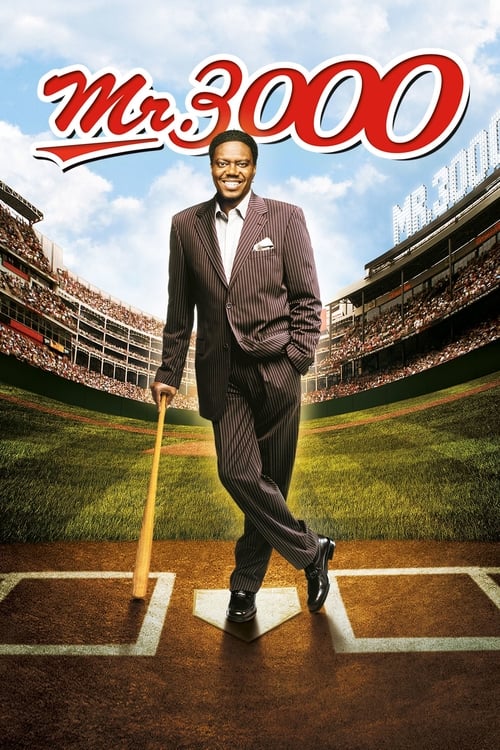
Mr. 3000
Aging baseball star who goes by the nickname, Mr. 3000, finds out many years after retirement that he didn't quite reach 3,000 hits. Now at age 47 he's back to try and reach that goal.
The film struggled financially against its respectable budget of $30.0M, earning $21.8M globally (-27% loss). While initial box office returns were modest, the film has gained appreciation for its unique voice within the comedy genre.
1 win & 5 nominations


Plot Structure
Story beats plotted across runtime


Narrative Arc
Emotional journey through the story's key moments
Story Circle
Blueprint 15-beat structure
Arcplot Score Breakdown
Weighted: Precision (70%) + Arc (15%) + Theme (15%)
Mr. 3000 (2004) reveals strategically placed story structure, characteristic of Charles Stone III's storytelling approach. This structural analysis examines how the film's 15-point plot structure maps to proven narrative frameworks across 1 hour and 44 minutes. With an Arcplot score of 7.4, the film balances conventional beats with creative variation.
Characters
Cast & narrative archetypes

Stan Ross
Mo Simmons
Boca Ken
Gus Panas
T-Rex Pennebaker
Minadeo
Main Cast & Characters
Stan Ross
Played by Bernie Mac
Egotistical retired baseball player who returns to the game to protect his legacy after discovering he's three hits short of 3,000.
Mo Simmons
Played by Angela Bassett
Sports reporter and Stan's former girlfriend who covers his comeback attempt.
Boca Ken
Played by Michael Rispoli
Stan's agent and business manager who helps orchestrate his comeback.
Gus Panas
Played by Paul Sorvino
The Brewers manager who must deal with Stan's return to the team.
T-Rex Pennebaker
Played by Brian J. White
Young star player on the Brewers who clashes with Stan over team dynamics.
Minadeo
Played by Evan Jones
Veteran Brewers player and team leader who bridges old and new school.
Structural Analysis
The Status Quo at 1 minutes (1% through the runtime) establishes Stan Ross achieves his 3000th hit in 1995, immediately retires as a celebrated baseball legend. His ego is at its peak, showing him as a self-centered star who cares only about his statistical legacy.. Notably, this early placement immediately immerses viewers in the story world.
The inciting incident occurs at 11 minutes when Stan discovers a statistical error: he only has 2,997 hits, not 3,000. His entire legacy and Hall of Fame induction are now in jeopardy, shattering his carefully constructed identity.. At 11% through the film, this Disruption aligns precisely with traditional story structure. This beat shifts the emotional landscape, launching the protagonist into the central conflict.
The First Threshold at 25 minutes marks the transition into Act II, occurring at 24% of the runtime. This demonstrates the protagonist's commitment to Stan makes the decision to come out of retirement and rejoin the Milwaukee Brewers to get his three hits back, entering the world of modern baseball as an aging player., moving from reaction to action.
At 51 minutes, the Midpoint arrives at 49% of the runtime—precisely centered, creating perfect narrative symmetry. The analysis reveals that this crucial beat Stan gets his first hit back and experiences a moment of connection with his teammates. False victory: he thinks he's on track to reclaim his glory, but he hasn't truly changed internally yet., fundamentally raising what's at risk. The emotional intensity shifts, dividing the narrative into clear before-and-after phases.
The Collapse moment at 75 minutes (72% through) represents the emotional nadir. Here, Stan is benched or faces a critical failure that exposes his selfishness has cost the team. He realizes he might not get his hits and that he's alienated everyone who could have helped him. His dream dies., illustrates the protagonist at their lowest point. This beat's placement in the final quarter sets up the climactic reversal.
The Second Threshold at 81 minutes initiates the final act resolution at 78% of the runtime. Stan realizes that being part of the team and helping them win is more important than his personal statistics. He synthesizes his experience with Mo's lessons about authentic connection and teamwork., demonstrating the transformation achieved throughout the journey.
Emotional Journey
Mr. 3000's emotional architecture traces a deliberate progression across 15 carefully calibrated beats.
Narrative Framework
This structural analysis employs a 15-point narrative structure framework that maps key story moments. By mapping Mr. 3000 against these established plot points, we can identify how Charles Stone III utilizes or subverts traditional narrative conventions. The plot point approach reveals not only adherence to structural principles but also creative choices that distinguish Mr. 3000 within the comedy genre.
Charles Stone III's Structural Approach
Among the 4 Charles Stone III films analyzed on Arcplot, the average structural score is 7.3, reflecting strong command of classical structure. Mr. 3000 represents one of the director's most structurally precise works. For comparative analysis, explore the complete Charles Stone III filmography.
Comparative Analysis
Additional comedy films include The Bad Guys, Ella Enchanted and The Evening Star. For more Charles Stone III analyses, see Uncle Drew, The Underdoggs and Drumline.
Plot Points by Act
Act I
SetupStatus Quo
Stan Ross achieves his 3000th hit in 1995, immediately retires as a celebrated baseball legend. His ego is at its peak, showing him as a self-centered star who cares only about his statistical legacy.
Theme
A character mentions that baseball is about the team, not individual glory. This establishes the central theme: true greatness comes from being part of something larger than yourself.
Worldbuilding
Nine years later, Stan lives off his legend, running a car dealership and making appearances. He's arrogant, isolated, and his former teammates resent him for abandoning the team. His relationships are superficial.
Disruption
Stan discovers a statistical error: he only has 2,997 hits, not 3,000. His entire legacy and Hall of Fame induction are now in jeopardy, shattering his carefully constructed identity.
Resistance
Stan debates whether to return to baseball at age 47. He faces resistance from everyone—management, former teammates, media. His pride and desperation clash as he considers the humiliation of a comeback.
Act II
ConfrontationFirst Threshold
Stan makes the decision to come out of retirement and rejoin the Milwaukee Brewers to get his three hits back, entering the world of modern baseball as an aging player.
Mirror World
Stan reconnects with Mo, a reporter who challenges him and represents authentic human connection versus his shallow celebrity relationships. She embodies the theme of genuine teamwork and humility.
Premise
Stan struggles as an older player among younger teammates. Fish-out-of-water comedy as he faces modern baseball, his declining skills, and teammates who resent his ego. He slowly begins learning about teamwork.
Midpoint
Stan gets his first hit back and experiences a moment of connection with his teammates. False victory: he thinks he's on track to reclaim his glory, but he hasn't truly changed internally yet.
Opposition
Stan's ego resurfaces. His stats suffer, teammates lose patience, management wants him gone. His relationship with Mo deteriorates. The gap between who he needs to be and who he is widens.
Collapse
Stan is benched or faces a critical failure that exposes his selfishness has cost the team. He realizes he might not get his hits and that he's alienated everyone who could have helped him. His dream dies.
Crisis
Stan reflects on his legacy and what truly matters. He processes the pain of isolation and confronts that his obsession with individual achievement has left him empty and alone.
Act III
ResolutionSecond Threshold
Stan realizes that being part of the team and helping them win is more important than his personal statistics. He synthesizes his experience with Mo's lessons about authentic connection and teamwork.
Synthesis
Stan plays selflessly for the team in the final games. He makes sacrifices, supports teammates, and focuses on winning rather than his personal hits. He may or may not reach 3,000, but he becomes a true teammate.
Transformation
Stan is shown in the dugout celebrating with his team or in a moment that mirrors the opening but shows he's transformed from a selfish star into a genuine team player who values relationships over statistics.