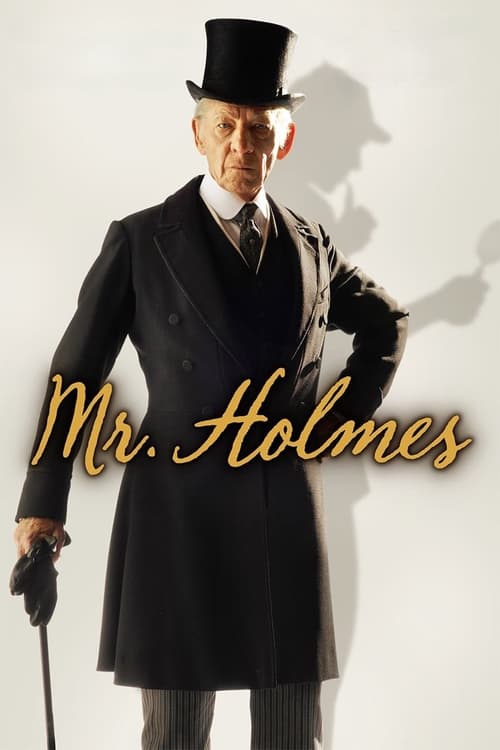
Mr. Holmes
In 1947, long-retired and near the end of his life, Sherlock Holmes grapples with an unreliable memory and must rely on his housekeeper's son as he revisits the still-unsolved case that led to his retirement.
Despite its limited budget of $11.0M, Mr. Holmes became a box office success, earning $29.4M worldwide—a 167% return.


Plot Structure
Story beats plotted across runtime


Narrative Arc
Emotional journey through the story's key moments
Story Circle
Blueprint 15-beat structure
Arcplot Score Breakdown
Weighted: Precision (70%) + Arc (15%) + Theme (15%)
Mr. Holmes (2015) exemplifies deliberately positioned story structure, characteristic of Bill Condon's storytelling approach. This structural analysis examines how the film's 15-point plot structure maps to proven narrative frameworks across 1 hour and 44 minutes. With an Arcplot score of 6.8, the film balances conventional beats with creative variation.
Characters
Cast & narrative archetypes

Sherlock Holmes
Roger Munro
Mrs. Munro
Ann Kelmot
Main Cast & Characters
Sherlock Holmes
Played by Ian McKellen
An aged, retired detective struggling with memory loss while haunted by his final unsolved case
Roger Munro
Played by Milo Parker
A curious, intelligent boy who becomes Holmes's companion and helps him reconnect with humanity
Mrs. Munro
Played by Laura Linney
Roger's widowed mother and Holmes's housekeeper, protective and weary of Holmes's influence on her son
Ann Kelmot
Played by Hattie Morahan
A troubled woman from Holmes's past case, grieving her miscarriages and seeking meaning
Structural Analysis
The Status Quo at 1 minutes (1% through the runtime) establishes An elderly Sherlock Holmes returns by train from Japan to his secluded Sussex farmhouse, carrying mysterious prickly ash plants he hopes will restore his failing memory.. Structural examination shows that this early placement immediately immerses viewers in the story world.
The inciting incident occurs at 13 minutes when Holmes reveals to Roger that Watson's published account of his final case is wrong, and he must write the true story before his memory fails completely—but he cannot remember the crucial details or why he retired.. At 12% through the film, this Disruption aligns precisely with traditional story structure. This beat shifts the emotional landscape, launching the protagonist into the central conflict.
The First Threshold at 27 minutes marks the transition into Act II, occurring at 26% of the runtime. This illustrates the protagonist's commitment to Holmes commits to writing the true account of the Ann Kelmot case, actively engaging Roger as his audience and collaborator, choosing to confront his past rather than let it fade., moving from reaction to action.
At 52 minutes, the Midpoint arrives at 50% of the runtime—precisely centered, creating perfect narrative symmetry. Of particular interest, this crucial beat Holmes remembers following Ann Kelmot to a cemetery where she played glass harmonica—he deduced she planned suicide after losing two children. This false victory of recovered memory becomes false defeat as he realizes his cold deduction failed her., fundamentally raising what's at risk. The emotional intensity shifts, dividing the narrative into clear before-and-after phases.
The Collapse moment at 77 minutes (74% through) represents the emotional nadir. Here, Roger is stung nearly to death by the bees after attempting to destroy the wasp nest threatening them. Holmes collapses from the shock, forced to confront that his emotional detachment has again led to tragedy—this time with a child he loves., reveals the protagonist at their lowest point. This beat's placement in the final quarter sets up the climactic reversal.
The Second Threshold at 84 minutes initiates the final act resolution at 81% of the runtime. Holmes finally remembers and accepts the full truth: Ann Kelmot asked him to run away with her, offering connection, and he refused. His cold rejection contributed to her death. He realizes he must not repeat this mistake with Roger and Mrs. Munro., demonstrating the transformation achieved throughout the journey.
Emotional Journey
Mr. Holmes's emotional architecture traces a deliberate progression across 15 carefully calibrated beats.
Narrative Framework
This structural analysis employs systematic plot point analysis that identifies crucial turning points. By mapping Mr. Holmes against these established plot points, we can identify how Bill Condon utilizes or subverts traditional narrative conventions. The plot point approach reveals not only adherence to structural principles but also creative choices that distinguish Mr. Holmes within the drama genre.
Bill Condon's Structural Approach
Among the 10 Bill Condon films analyzed on Arcplot, the average structural score is 7.0, reflecting strong command of classical structure. Mr. Holmes takes a more unconventional approach compared to the director's typical style. For comparative analysis, explore the complete Bill Condon filmography.
Comparative Analysis
Additional drama films include After Thomas, South Pacific and Dirty Dancing: Havana Nights. For more Bill Condon analyses, see Kinsey, The Twilight Saga: Breaking Dawn - Part 1 and Dreamgirls.
Plot Points by Act
Act I
SetupStatus Quo
An elderly Sherlock Holmes returns by train from Japan to his secluded Sussex farmhouse, carrying mysterious prickly ash plants he hopes will restore his failing memory.
Theme
Roger asks Holmes why he keeps bees if they sting him, and Holmes responds that he finds them fascinating despite the pain—echoing the film's theme that connection is worth the risk of hurt.
Worldbuilding
Holmes' solitary existence is established: his failing memory, his beekeeping, his strained relationship with housekeeper Mrs. Munro, and young Roger's eager fascination with him. We see Holmes reading Watson's fictionalized account of his last case with frustration.
Disruption
Holmes reveals to Roger that Watson's published account of his final case is wrong, and he must write the true story before his memory fails completely—but he cannot remember the crucial details or why he retired.
Resistance
Holmes begins attempting to reconstruct his final case through fragmented flashbacks, while Roger becomes increasingly invested in helping him. Mrs. Munro grows concerned about Roger's attachment to the aging detective. Holmes takes the prickly ash hoping it will restore his memory.
Act II
ConfrontationFirst Threshold
Holmes commits to writing the true account of the Ann Kelmot case, actively engaging Roger as his audience and collaborator, choosing to confront his past rather than let it fade.
Mirror World
Roger's genuine curiosity and emotional openness stands in stark contrast to Holmes' cold rationality. Their growing bond represents the human connection Holmes has always avoided—the boy becomes his unlikely teacher about the heart.
Premise
Through flashbacks, Holmes reconstructs the Ann Kelmot case—following a woman whose husband suspected her of infidelity. In the present, he mentors Roger in observation and deduction while tending bees together. The Japan storyline reveals Holmes sought Umezaki's father, who abandoned his family after meeting Holmes.
Midpoint
Holmes remembers following Ann Kelmot to a cemetery where she played glass harmonica—he deduced she planned suicide after losing two children. This false victory of recovered memory becomes false defeat as he realizes his cold deduction failed her.
Opposition
Holmes' memory continues deteriorating despite the prickly ash. Mrs. Munro announces plans to leave for a better position. Roger becomes more defiant defending Holmes. The truth of the Ann Kelmot case grows darker—Holmes offered only logic when she needed compassion, and she threw herself in front of a train.
Collapse
Roger is stung nearly to death by the bees after attempting to destroy the wasp nest threatening them. Holmes collapses from the shock, forced to confront that his emotional detachment has again led to tragedy—this time with a child he loves.
Crisis
Roger lies in hospital fighting for his life. Mrs. Munro blames Holmes and forbids him from seeing Roger. Holmes is devastated, finally feeling the weight of emotional connection he had always avoided. He faces his isolation and the cost of his rationality.
Act III
ResolutionSecond Threshold
Holmes finally remembers and accepts the full truth: Ann Kelmot asked him to run away with her, offering connection, and he refused. His cold rejection contributed to her death. He realizes he must not repeat this mistake with Roger and Mrs. Munro.
Synthesis
Holmes writes Mrs. Munro a letter taking responsibility and offering them his home and security. He writes to Umezaki, creating a comforting fiction about his father dying heroically—choosing kindness over truth. Roger recovers, and Mrs. Munro agrees to stay. Holmes destroys the bees that nearly killed Roger.
Transformation
Holmes stands in his garden with Roger, placing stones in a circle to honor the dead—including Ann Kelmot, Watson, his brother Mycroft, and Mrs. Hudson. Once isolated by intellect, Holmes has finally learned to love and be part of a family.