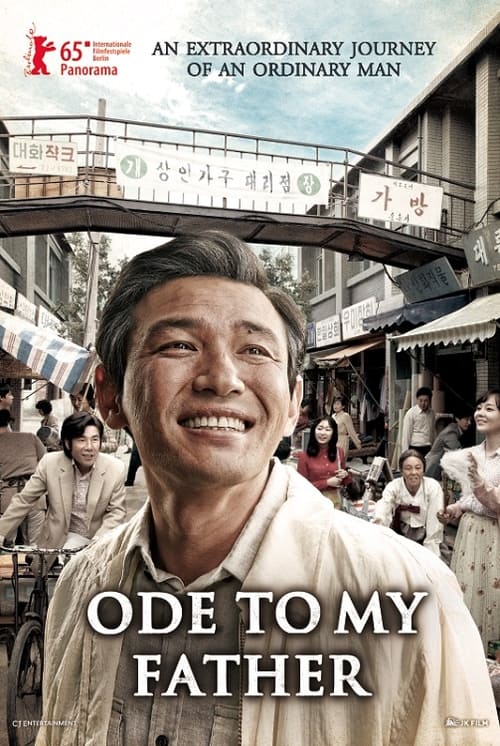
Ode to My Father
Duk-soo lost his father and younger sister while taking refuge during the Korean War. He leaves for Germany to work as a miner and enters the Vietnam War. He wishes to find his sister.
The film earned $105.4M at the global box office.
23 wins & 20 nominations
Plot Structure
Story beats plotted across runtime


Narrative Arc
Emotional journey through the story's key moments
Story Circle
Blueprint 15-beat structure
Arcplot Score Breakdown
Weighted: Precision (70%) + Arc (15%) + Theme (15%)
Ode to My Father (2014) showcases strategically placed story structure, characteristic of JK Youn's storytelling approach. This structural analysis examines how the film's 15-point plot structure maps to proven narrative frameworks across 2 hours and 6 minutes. With an Arcplot score of 7.2, the film balances conventional beats with creative variation.
Characters
Cast & narrative archetypes

Yoon Deok-soo
Young Deok-soo
Song Young-ja
Young Young-ja
Yoon Dal-goo
Yoon Deok-soo's Father
Yoon Deok-soo's Mother
Yoon Deok-soo (elderly)
Main Cast & Characters
Yoon Deok-soo
Played by Hwang Jung-min
A devoted family man who sacrifices everything for his loved ones across decades of Korean history, from the Hungnam evacuation through industrialization.
Young Deok-soo
Played by Kim Seul-gi
The young version of Deok-soo during the Korean War evacuation, who loses his sister while trying to save his family.
Song Young-ja
Played by Kim Yunjin
Deok-soo's strong-willed wife who works alongside him in Germany as a nurse and becomes his lifelong partner and anchor.
Young Young-ja
Played by Kim Seul-gi
The younger version of Young-ja who meets Deok-soo while working as a nurse in Germany.
Yoon Dal-goo
Played by Oh Dal-su
Deok-soo's loyal best friend and comedic companion who accompanies him to Germany and Vietnam, providing moral support.
Yoon Deok-soo's Father
Played by Jung Jin-young
Deok-soo's father who is separated from the family during the Hungnam evacuation, becoming the symbol of Deok-soo's lifelong hope for reunion.
Yoon Deok-soo's Mother
Played by Jang Young-nam
The resilient matriarch who holds the family together after her husband's disappearance and raises her children through hardship.
Yoon Deok-soo (elderly)
Played by Hwang Jung-min
The elderly Deok-soo reflecting on his life of sacrifice while facing the modernization of Gukje Market.
Structural Analysis
The Status Quo at 1 minutes (1% through the runtime) establishes Present-day elderly Deok-soo stands in his small store "Flower Blooms," surrounded by decades of family photographs and memorabilia. He prepares to sell the shop that has been his anchor through Korea's transformation, establishing him as a man defined by duty and sacrifice.. Of particular interest, this early placement immediately immerses viewers in the story world.
The inciting incident occurs at 13 minutes when During the chaotic Hungnam evacuation aboard the SS Meredith Victory, Deok-soo loses his grip on his younger sister Mak-soon in the crushing crowd. His father jumps off the ship to find her, shouting final instructions to Deok-soo. The family is separated, and Deok-soo becomes the unwilling head of household at age 14.. At 11% through the film, this Disruption aligns precisely with traditional story structure. This beat shifts the emotional landscape, launching the protagonist into the central conflict.
The First Threshold at 31 minutes marks the transition into Act II, occurring at 24% of the runtime. This shows the protagonist's commitment to Deok-soo makes the active decision to go to West Germany as a coal miner in the 1960s, sacrificing his own dreams and education to send money home. This choice commits him irreversibly to a life of sacrifice for his family, entering a new world of labor and hardship far from home., moving from reaction to action.
At 62 minutes, the Midpoint arrives at 50% of the runtime—precisely centered, creating perfect narrative symmetry. The analysis reveals that this crucial beat Deok-soo and Young-ja marry in Germany in a modest ceremony. This false victory represents the peak of hope—he has found love and is succeeding in supporting his family. But the wedding also raises the stakes: now he has his own family to protect, doubling his burden of responsibility., fundamentally raising what's at risk. The emotional intensity shifts, dividing the narrative into clear before-and-after phases.
The Collapse moment at 93 minutes (74% through) represents the emotional nadir. Here, At the government-organized reunion for separated families, Deok-soo desperately searches for his father and sister Mak-soon. He sees countless emotional reunions around him but finds no one from his family. The "whiff of death"—his father likely died decades ago, and Deok-soo must face that his lifelong promise was built on a ghost., reveals the protagonist at their lowest point. This beat's placement in the final quarter sets up the climactic reversal.
The Second Threshold at 101 minutes initiates the final act resolution at 80% of the runtime. At another family reunion event years later, an elderly woman approaches—it's Mak-soon, his lost sister. She survived, was raised by their father until his death, and has been searching too. This reunion gives Deok-soo the realization that his father's final wish was not a burden but a gift: family endures., demonstrating the transformation achieved throughout the journey.
Emotional Journey
Ode to My Father's emotional architecture traces a deliberate progression across 15 carefully calibrated beats.
Narrative Framework
This structural analysis employs a 15-point narrative structure framework that maps key story moments. By mapping Ode to My Father against these established plot points, we can identify how JK Youn utilizes or subverts traditional narrative conventions. The plot point approach reveals not only adherence to structural principles but also creative choices that distinguish Ode to My Father within the drama genre.
JK Youn's Structural Approach
Among the 2 JK Youn films analyzed on Arcplot, the average structural score is 7.3, reflecting strong command of classical structure. Ode to My Father takes a more unconventional approach compared to the director's typical style. For comparative analysis, explore the complete JK Youn filmography.
Comparative Analysis
Additional drama films include After Thomas, South Pacific and Dirty Dancing: Havana Nights. For more JK Youn analyses, see Tidal Wave.
Plot Points by Act
Act I
SetupStatus Quo
Present-day elderly Deok-soo stands in his small store "Flower Blooms," surrounded by decades of family photographs and memorabilia. He prepares to sell the shop that has been his anchor through Korea's transformation, establishing him as a man defined by duty and sacrifice.
Theme
Deok-soo's father, during the Hungnam evacuation, tells young Deok-soo: "You are the head of the family now. Protect your mother and siblings." This burden of responsibility and family duty becomes the thematic core of Deok-soo's entire life.
Worldbuilding
Flashback to 1950 Hungnam during the Korean War. Young Deok-soo lives with his father, mother, younger brother Jin-soo, and sisters. The family runs a small shop. We see their close-knit relationships and the innocence of Deok-soo as a child before war tears everything apart.
Disruption
During the chaotic Hungnam evacuation aboard the SS Meredith Victory, Deok-soo loses his grip on his younger sister Mak-soon in the crushing crowd. His father jumps off the ship to find her, shouting final instructions to Deok-soo. The family is separated, and Deok-soo becomes the unwilling head of household at age 14.
Resistance
Deok-soo struggles to accept his new role. The family settles in Busan as refugees. He grapples with poverty, his mother's grief, and the responsibility of caring for his siblings. He resists growing up, still hoping his father will return, but circumstances force him toward maturity.
Act II
ConfrontationFirst Threshold
Deok-soo makes the active decision to go to West Germany as a coal miner in the 1960s, sacrificing his own dreams and education to send money home. This choice commits him irreversibly to a life of sacrifice for his family, entering a new world of labor and hardship far from home.
Mirror World
In Germany, Deok-soo meets Young-ja, a Korean nurse who carries a photograph of her family everywhere. She mirrors his devotion to family but with hope and lightness. Their developing relationship introduces the possibility that duty and personal happiness might coexist.
Premise
Deok-soo's years as a miner in Germany. He endures dangerous conditions underground, sends every paycheck home, maintains hope through letters from his family, and courts Young-ja. We see the "promise of the premise"—a man honoring his father's dying wish through decades of sacrifice, sustained by love and duty.
Midpoint
Deok-soo and Young-ja marry in Germany in a modest ceremony. This false victory represents the peak of hope—he has found love and is succeeding in supporting his family. But the wedding also raises the stakes: now he has his own family to protect, doubling his burden of responsibility.
Opposition
The family returns to Korea, but financial pressures intensify. Deok-soo takes on brutal work in Vietnam to pay for his siblings' education and weddings. Young-ja silently suffers as Deok-soo repeatedly chooses extended family over their marriage. His son resents his absence. Every sacrifice creates new distance from those he's sacrificing for.
Collapse
At the government-organized reunion for separated families, Deok-soo desperately searches for his father and sister Mak-soon. He sees countless emotional reunions around him but finds no one from his family. The "whiff of death"—his father likely died decades ago, and Deok-soo must face that his lifelong promise was built on a ghost.
Crisis
Deok-soo withdraws into darkness. He questions whether his entire life of sacrifice meant anything. Young-ja reveals she gave up her nursing dreams to support him. Their son confronts him about being an absent father. Deok-soo processes the cost of his choices and the possibility that he failed everyone.
Act III
ResolutionSecond Threshold
At another family reunion event years later, an elderly woman approaches—it's Mak-soon, his lost sister. She survived, was raised by their father until his death, and has been searching too. This reunion gives Deok-soo the realization that his father's final wish was not a burden but a gift: family endures.
Synthesis
Deok-soo reconciles with his life choices. He brings the family together for a final gathering at the store before selling it. His children, now successful because of his sacrifices, honor him. Young-ja stands beside him, their partnership intact. He makes peace with his father's memory and his own legacy.
Transformation
Elderly Deok-soo stands in the empty "Flower Blooms" store, now sold. Unlike the opening, he is at peace. He looks at photographs spanning decades—Germany, Vietnam, weddings, grandchildren. He smiles, no longer burdened but proud. The final image mirrors the opening but shows transformation: duty fulfilled becomes love remembered.