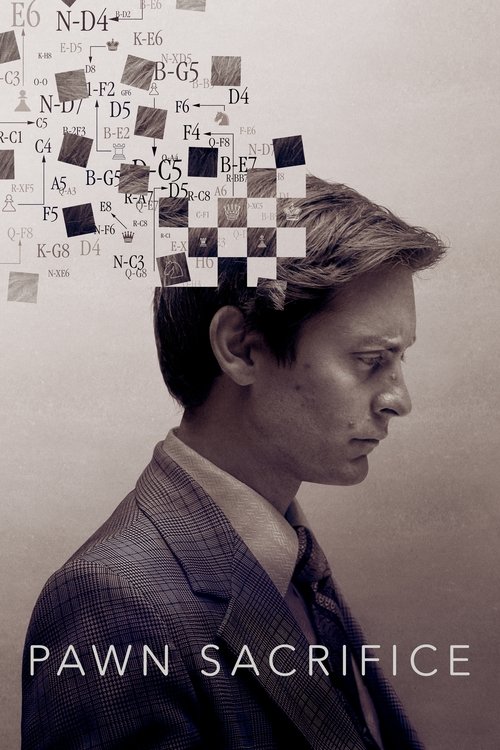
Pawn Sacrifice
American chess champion Bobby Fischer prepares for a legendary match-up against Russian Boris Spassky.
The film commercial failure against its mid-range budget of $19.0M, earning $5.6M globally (-71% loss). While initial box office returns were modest, the film has gained appreciation for its bold vision within the thriller genre.
1 win & 1 nomination


Plot Structure
Story beats plotted across runtime


Narrative Arc
Emotional journey through the story's key moments
Story Circle
Blueprint 15-beat structure
Arcplot Score Breakdown
Weighted: Precision (70%) + Arc (15%) + Theme (15%)
Pawn Sacrifice (2015) demonstrates strategically placed dramatic framework, characteristic of Edward Zwick's storytelling approach. This structural analysis examines how the film's 15-point plot structure maps to proven narrative frameworks across 1 hour and 55 minutes. With an Arcplot score of 6.3, the film takes an unconventional approach to traditional narrative frameworks.
Characters
Cast & narrative archetypes

Bobby Fischer
Father Bill Lombardy
Paul Marshall
Boris Spassky
Regina Fischer
Joan Fischer
Main Cast & Characters
Bobby Fischer
Played by Tobey Maguire
A brilliant but paranoid chess prodigy who rises to challenge the Soviet chess establishment, becoming a pawn in Cold War politics while battling his own mental demons.
Father Bill Lombardy
Played by Peter Sarsgaard
A Catholic priest and former chess champion who serves as Bobby's second and spiritual advisor, providing stability amid the chaos.
Paul Marshall
Played by Michael Stuhlbarg
A savvy entertainment lawyer who orchestrates Bobby's path to the World Championship, navigating politics and managing the volatile genius.
Boris Spassky
Played by Liev Schreiber
The reigning Soviet World Chess Champion, a noble and dignified opponent who represents the full might of the Soviet chess machine.
Regina Fischer
Played by Robin Weigert
Bobby's protective mother, a left-wing activist whose past communist sympathies and eventual abandonment deeply affect her son.
Joan Fischer
Played by Lily Rabe
Bobby's supportive older sister who tries to maintain a connection with her increasingly troubled brother.
Structural Analysis
The Status Quo at 2 minutes (1% through the runtime) establishes Young Bobby Fischer sits alone in a Brooklyn apartment, obsessively studying chess books while his mother entertains communist friends, establishing his isolation and singular focus on chess from childhood.. Of particular interest, this early placement immediately immerses viewers in the story world.
The inciting incident occurs at 14 minutes when Fischer publicly quits a major tournament, making outrageous demands and displaying erratic behavior. His reputation suffers, but this draws the attention of lawyer Paul Marshall and Father Bill Lombardy who see potential to challenge Soviet chess dominance.. At 12% through the film, this Disruption aligns precisely with traditional story structure. This beat shifts the emotional landscape, launching the protagonist into the central conflict.
The First Threshold at 30 minutes marks the transition into Act II, occurring at 26% of the runtime. This indicates the protagonist's commitment to Fischer agrees to enter the Candidates Tournament to challenge for the World Championship, committing to the grueling path toward facing Soviet champion Boris Spassky. He crosses into the world of international chess competition., moving from reaction to action.
At 58 minutes, the Midpoint arrives at 50% of the runtime—precisely centered, creating perfect narrative symmetry. Structural examination shows that this crucial beat Fischer wins the right to challenge Spassky for the World Championship in Reykjavik, Iceland. This false victory moment represents his greatest achievement, but the real battle - against Spassky and his own mind - is just beginning., fundamentally raising what's at risk. The emotional intensity shifts, dividing the narrative into clear before-and-after phases.
The Collapse moment at 87 minutes (75% through) represents the emotional nadir. Here, Fischer suffers a complete mental breakdown, convinced everyone is against him. He loses critical games due to his own behavior, and his support team (Marshall and Lombardy) reach their breaking point, questioning whether continuing is destroying him., reveals the protagonist at their lowest point. This beat's placement in the final quarter sets up the climactic reversal.
The Second Threshold at 92 minutes initiates the final act resolution at 80% of the runtime. Fischer chooses to continue, finding clarity in his purpose. He realizes he must channel his paranoia and obsession into the game itself. He returns to the board with renewed focus, using his madness as fuel rather than obstacle., demonstrating the transformation achieved throughout the journey.
Emotional Journey
Pawn Sacrifice's emotional architecture traces a deliberate progression across 15 carefully calibrated beats.
Narrative Framework
This structural analysis employs systematic plot point analysis that identifies crucial turning points. By mapping Pawn Sacrifice against these established plot points, we can identify how Edward Zwick utilizes or subverts traditional narrative conventions. The plot point approach reveals not only adherence to structural principles but also creative choices that distinguish Pawn Sacrifice within the thriller genre.
Edward Zwick's Structural Approach
Among the 10 Edward Zwick films analyzed on Arcplot, the average structural score is 6.8, demonstrating varied approaches to story architecture. Pawn Sacrifice takes a more unconventional approach compared to the director's typical style. For comparative analysis, explore the complete Edward Zwick filmography.
Comparative Analysis
Additional thriller films include The Warriors, Thunderball and Rustom. For more Edward Zwick analyses, see Courage Under Fire, Jack Reacher: Never Go Back and The Siege.
Plot Points by Act
Act I
SetupStatus Quo
Young Bobby Fischer sits alone in a Brooklyn apartment, obsessively studying chess books while his mother entertains communist friends, establishing his isolation and singular focus on chess from childhood.
Theme
Bobby's mother or mentor figure discusses how chess genius comes at a cost, warning that the game can consume a person completely - foreshadowing Fischer's eventual mental deterioration.
Worldbuilding
Fischer's rise through the chess world is established: his prodigious talent, difficult personality, paranoid tendencies, and the Cold War context where chess represents ideological warfare between America and Soviet Russia.
Disruption
Fischer publicly quits a major tournament, making outrageous demands and displaying erratic behavior. His reputation suffers, but this draws the attention of lawyer Paul Marshall and Father Bill Lombardy who see potential to challenge Soviet chess dominance.
Resistance
Marshall and Lombardy debate whether Fischer can be managed and convince him to pursue the World Championship. Fischer resists, suspicious of everyone's motives, but is gradually persuaded that defeating the Soviets would prove his superiority.
Act II
ConfrontationFirst Threshold
Fischer agrees to enter the Candidates Tournament to challenge for the World Championship, committing to the grueling path toward facing Soviet champion Boris Spassky. He crosses into the world of international chess competition.
Mirror World
Fischer develops relationships with his handlers Marshall and Lombardy, who represent stability and human connection - the life outside chess that Fischer increasingly sacrifices. Their loyalty contrasts with his paranoia.
Premise
Fischer dominates the Candidates matches, defeating top Soviet players with unprecedented scores. His genius is on full display, but so is his deteriorating mental state - making impossible demands, sensing conspiracies, becoming increasingly isolated and unstable.
Midpoint
Fischer wins the right to challenge Spassky for the World Championship in Reykjavik, Iceland. This false victory moment represents his greatest achievement, but the real battle - against Spassky and his own mind - is just beginning.
Opposition
In Iceland, Fischer's paranoia escalates dramatically. He makes outrageous demands about cameras, lighting, and playing conditions. He forfeits games, nearly withdraws entirely, and becomes convinced the Soviets are using electronic devices and psychological warfare against him.
Collapse
Fischer suffers a complete mental breakdown, convinced everyone is against him. He loses critical games due to his own behavior, and his support team (Marshall and Lombardy) reach their breaking point, questioning whether continuing is destroying him.
Crisis
Fischer isolates himself completely, wrestling with his demons alone. He must decide whether to abandon the match (and save his sanity) or push forward. His handlers debate whether they're helping or enabling his self-destruction.
Act III
ResolutionSecond Threshold
Fischer chooses to continue, finding clarity in his purpose. He realizes he must channel his paranoia and obsession into the game itself. He returns to the board with renewed focus, using his madness as fuel rather than obstacle.
Synthesis
Fischer defeats Spassky, becoming World Chess Champion and achieving his life's goal. He wins the Cold War chess battle for America. But the victory is bittersweet as the toll on his psyche is evident to everyone watching.
Transformation
Fischer stands alone after his victory, champion but isolated and damaged. Text reveals he never defended his title and descended into paranoid reclusiveness - the genius who won everything but lost himself, mirroring the opening image of isolation but now irreversibly broken.