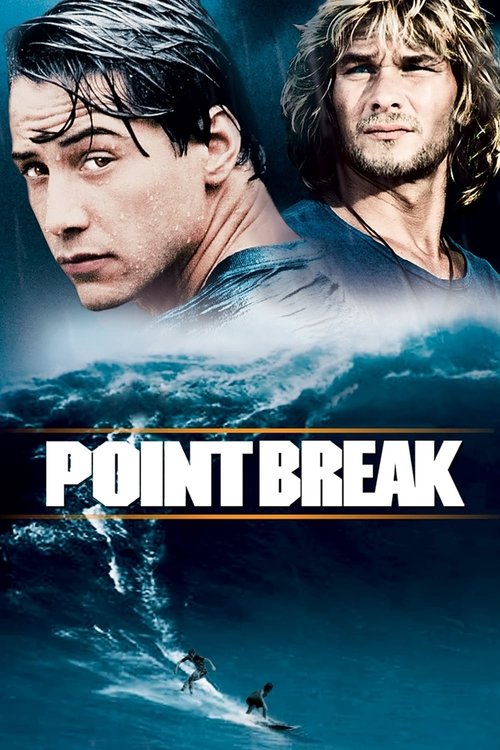
Point Break
In Los Angeles, a gang of bank robbers who call themselves The Ex-Presidents commit their crimes while wearing masks of Reagan, Carter, Nixon and Johnson. Believing that the members of the gang could be surfers, the F.B.I. sends young agent Johnny Utah to the beach undercover to mix with the surfers and gather information.
Despite a respectable budget of $24.0M, Point Break became a commercial success, earning $83.5M worldwide—a 248% return.
1 win & 2 nominations


Plot Structure
Story beats plotted across runtime


Narrative Arc
Emotional journey through the story's key moments
Story Circle
Blueprint 15-beat structure
Arcplot Score Breakdown
Weighted: Precision (70%) + Arc (15%) + Theme (15%)
Point Break (1991) exemplifies deliberately positioned story structure, characteristic of Kathryn Bigelow's storytelling approach. This structural analysis examines how the film's 15-point plot structure maps to proven narrative frameworks across 2 hours and 2 minutes. With an Arcplot score of 7.6, the film showcases strong structural fundamentals.
Characters
Cast & narrative archetypes

Johnny Utah
Bodhi
Angelo Pappas
Tyler Endicott
Ben Harp
Roach
Nathanial
Grommet
Main Cast & Characters
Johnny Utah
Played by Keanu Reeves
A young FBI agent and former Ohio State quarterback who goes undercover in the surfing community to investigate a series of bank robberies.
Bodhi
Played by Patrick Swayze
The charismatic leader of a group of surfers who secretly rob banks as the Ex-Presidents to fund their endless summer lifestyle.
Angelo Pappas
Played by Gary Busey
A veteran FBI agent partnered with Utah who developed the theory that surfers are behind the Ex-Presidents robberies.
Tyler Endicott
Played by Lori Petty
A tough, independent surfer and skydiver who becomes Utah's love interest and unknowingly connects him to Bodhi's crew.
Ben Harp
Played by John C. McGinley
Utah's rigid, by-the-book FBI supervisor who clashes with Utah's unconventional methods.
Roach
Played by Bojesse Christopher
A member of Bodhi's surf gang and one of the Ex-Presidents bank robbers known for his wild demeanor.
Nathanial
Played by John Philbin
A quiet, loyal member of Bodhi's inner circle who participates in the Ex-Presidents heists.
Grommet
Played by Julian Reyes
The youngest member of Bodhi's crew who looks up to Bodhi and participates in the bank robberies.
Structural Analysis
The Status Quo at 1 minutes (1% through the runtime) establishes Johnny Utah trains at the FBI academy, practicing with firearms. He's a former college football star turned rookie agent, disciplined but untested in the real world.. The analysis reveals that this early placement immediately immerses viewers in the story world.
The inciting incident occurs at 15 minutes when Utah convinces Pappas to let him go undercover into the surfing community to investigate the Ex-Presidents. The case becomes personal and active rather than just theory.. At 12% through the film, this Disruption aligns precisely with traditional story structure. This beat shifts the emotional landscape, launching the protagonist into the central conflict.
The First Threshold at 30 minutes marks the transition into Act II, occurring at 25% of the runtime. This demonstrates the protagonist's commitment to Utah actively chooses to fully commit to the undercover operation, joining Bodhi's crew and participating in their activities. He crosses from observer to participant in the surfer world., moving from reaction to action.
At 62 minutes, the Midpoint arrives at 50% of the runtime—precisely centered, creating perfect narrative symmetry. Of particular interest, this crucial beat Utah realizes Bodhi and his crew ARE the Ex-Presidents during a robbery. He pursues them on foot but lets Bodhi escape, unable to shoot him. False defeat - he has the truth but is compromised., fundamentally raising what's at risk. The emotional intensity shifts, dividing the narrative into clear before-and-after phases.
The Collapse moment at 92 minutes (76% through) represents the emotional nadir. Here, The final bank robbery goes catastrophically wrong. Grommet is killed, Nathanial is killed by police, and Utah is left devastated. Death is literal - his friends from the crew are dead, and his moral compass is shattered., shows the protagonist at their lowest point. This beat's placement in the final quarter sets up the climactic reversal.
The Second Threshold at 98 minutes initiates the final act resolution at 81% of the runtime. Utah realizes where Bodhi will go - Bells Beach, Australia, for the fifty-year storm. He synthesizes his understanding of Bodhi's philosophy with his duty as an agent and chooses to finish what he started., demonstrating the transformation achieved throughout the journey.
Emotional Journey
Point Break's emotional architecture traces a deliberate progression across 15 carefully calibrated beats.
Narrative Framework
This structural analysis employs systematic plot point analysis that identifies crucial turning points. By mapping Point Break against these established plot points, we can identify how Kathryn Bigelow utilizes or subverts traditional narrative conventions. The plot point approach reveals not only adherence to structural principles but also creative choices that distinguish Point Break within the action genre.
Kathryn Bigelow's Structural Approach
Among the 7 Kathryn Bigelow films analyzed on Arcplot, the average structural score is 7.1, reflecting strong command of classical structure. Point Break represents one of the director's most structurally precise works. For comparative analysis, explore the complete Kathryn Bigelow filmography.
Comparative Analysis
Additional action films include The Bad Guys, Puss in Boots and Venom: The Last Dance. For more Kathryn Bigelow analyses, see The Hurt Locker, Detroit and Zero Dark Thirty.
Plot Points by Act
Act I
SetupStatus Quo
Johnny Utah trains at the FBI academy, practicing with firearms. He's a former college football star turned rookie agent, disciplined but untested in the real world.
Theme
Angelo Pappas tells Utah, "You gotta go down there and become one of them. You've gotta learn to think like them." The theme of identity and becoming what you hunt is established.
Worldbuilding
Utah arrives in Los Angeles, meets his skeptical partner Pappas, learns about the Ex-Presidents bank robbery crew, and is introduced to the world of surfers as potential suspects. Pappas explains his theory about surfer bank robbers.
Disruption
Utah convinces Pappas to let him go undercover into the surfing community to investigate the Ex-Presidents. The case becomes personal and active rather than just theory.
Resistance
Utah learns to surf with help from Tyler, infiltrates the beach community, struggles with his new identity, and begins to understand the surfer lifestyle. He meets Bodhi for the first time and is drawn into their world.
Act II
ConfrontationFirst Threshold
Utah actively chooses to fully commit to the undercover operation, joining Bodhi's crew and participating in their activities. He crosses from observer to participant in the surfer world.
Mirror World
Utah deepens his relationship with Tyler and bonds with Bodhi's crew. Bodhi becomes the thematic mirror - the life of freedom and living on the edge that challenges Utah's FBI identity and beliefs.
Premise
Utah lives the surfer life, participates in night surfing and skydiving, bonds deeply with Bodhi and the crew, while simultaneously investigating them. The promise of the premise: cop undercover in the extreme sports world, torn between two identities.
Midpoint
Utah realizes Bodhi and his crew ARE the Ex-Presidents during a robbery. He pursues them on foot but lets Bodhi escape, unable to shoot him. False defeat - he has the truth but is compromised.
Opposition
The FBI closes in with a disastrous raid that kills the wrong suspects. Utah's loyalties are torn. Bodhi discovers Utah's true identity and kidnaps Tyler, forcing Utah to participate in robberies to save her. The stakes escalate with each confrontation.
Collapse
The final bank robbery goes catastrophically wrong. Grommet is killed, Nathanial is killed by police, and Utah is left devastated. Death is literal - his friends from the crew are dead, and his moral compass is shattered.
Crisis
Utah sits in darkness, processing the deaths and his complete failure. He has lost Tyler, lost Bodhi, lost his case, and lost himself. Pappas tries to console him but Utah is alone with his choices.
Act III
ResolutionSecond Threshold
Utah realizes where Bodhi will go - Bells Beach, Australia, for the fifty-year storm. He synthesizes his understanding of Bodhi's philosophy with his duty as an agent and chooses to finish what he started.
Synthesis
Utah travels to Australia, confronts Bodhi in the surf during the storm, captures him, but ultimately lets him go for one last ride - knowing it will kill him. Utah completes his transformation by choosing honor over duty.
Transformation
Utah throws his FBI badge into the ocean, watching Bodhi paddle out to his death. He is no longer the rigid agent from the opening - he has internalized the philosophy of freedom and living fully, even as it destroys what it touches.