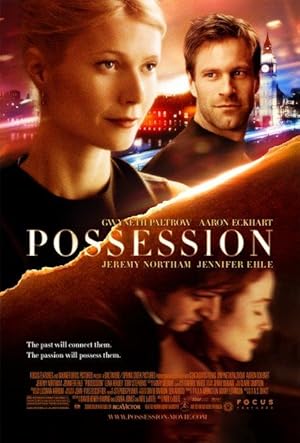
Possession
Roland Michell is an American scholar trying to make it in the difficult world of British Academia. He has yet to break out from under his mentor's shadow until he finds a pair of love letters that once belonged to one of his idols, a famous Victorian poet. Michell, after some sleuthing, narrows down the suspects to a woman not his wife, another well known Victorian poet. Roland enlists the aid of a Dr. Maud Bailey, an expert on the life of the woman in question. Together they piece together the story of a forbidden love affair, and discover one of their own. They also find themselves in a battle to hold on to their discovery before it falls into the hands of their rival, Fergus Wolfe.
The film commercial failure against its mid-range budget of $25.0M, earning $10.1M globally (-60% loss). While initial box office returns were modest, the film has gained appreciation for its compelling narrative within the drama genre.


Plot Structure
Story beats plotted across runtime


Narrative Arc
Emotional journey through the story's key moments
Story Circle
Blueprint 15-beat structure
Arcplot Score Breakdown
Weighted: Precision (70%) + Arc (15%) + Theme (15%)
Possession (2002) showcases precise dramatic framework, characteristic of Neil LaBute's storytelling approach. This structural analysis examines how the film's 15-point plot structure maps to proven narrative frameworks across 1 hour and 42 minutes. With an Arcplot score of 7.6, the film showcases strong structural fundamentals.
Characters
Cast & narrative archetypes

Roland Michell
Maud Bailey
Randolph Henry Ash
Christabel LaMotte
Fergus Wolff
Blanche Glover
Ellen Ash
Euan MacIntyre
Mortimer Cropper
Main Cast & Characters
Roland Michell
Played by Aaron Eckhart
An American literary scholar researching Victorian poet Randolph Henry Ash who discovers letters suggesting a secret affair. His investigation parallels his own developing romance with Maud Bailey.
Maud Bailey
Played by Gwyneth Paltrow
A British academic and expert on the reclusive Victorian poet Christabel LaMotte. Guarded and intellectually rigorous, she reluctantly partners with Roland to uncover the truth about their subjects' relationship.
Randolph Henry Ash
Played by Jeremy Northam
A celebrated Victorian poet whose posthumous reputation as a devoted husband is threatened by newly discovered letters revealing a passionate affair with Christabel LaMotte.
Christabel LaMotte
Played by Jennifer Ehle
A reclusive Victorian poet who lived with her companion Blanche Glover. Her secret passionate affair with Ash produced consequences that rippled through generations.
Fergus Wolff
Played by Toby Stephens
A charming but opportunistic academic rival who previously dated Maud and seeks to exploit the discovered letters for his own scholarly advancement.
Blanche Glover
Played by Lena Headey
Christabel's devoted companion and housemate whose jealousy over Christabel's affair with Ash leads to tragic consequences.
Ellen Ash
Played by Holly Aird
Randolph Ash's devoted wife who maintains appearances despite suspecting her husband's infidelity. Her diary entries reveal her awareness and silent suffering.
Euan MacIntyre
Played by Tom Hollander
A Scottish academic who assists Roland and Maud in their research while navigating the competitive world of literary scholarship.
Mortimer Cropper
Played by Trevor Eve
An American collector obsessed with acquiring Ash memorabilia, willing to use unethical means to obtain literary artifacts for his collection.
Structural Analysis
The Status Quo at 1 minutes (1% through the runtime) establishes Roland Michell works as a research assistant in the British Library, struggling financially and professionally, stuck in an unfulfilling relationship, studying the revered Victorian poet Randolph Henry Ash.. Of particular interest, this early placement immediately immerses viewers in the story world.
The inciting incident occurs at 12 minutes when Roland discovers hidden love letters in a book, revealing that the supposedly faithful Randolph Henry Ash had a secret romantic correspondence, potentially rewriting literary history.. At 12% through the film, this Disruption aligns precisely with traditional story structure. This beat shifts the emotional landscape, launching the protagonist into the central conflict.
The First Threshold at 26 minutes marks the transition into Act II, occurring at 25% of the runtime. This reveals the protagonist's commitment to Roland and Maud decide to work together to uncover the truth about Ash and LaMotte's relationship, embarking on a literary treasure hunt that takes them away from London., moving from reaction to action.
At 51 minutes, the Midpoint arrives at 50% of the runtime—precisely centered, creating perfect narrative symmetry. The analysis reveals that this crucial beat Roland and Maud make a major breakthrough in their research and share an intimate moment, but rival scholars led by Cropper learn of their discovery, raising the stakes and creating urgency., fundamentally raising what's at risk. The emotional intensity shifts, dividing the narrative into clear before-and-after phases.
The Collapse moment at 77 minutes (75% through) represents the emotional nadir. Here, The Victorian timeline reveals that LaMotte's baby died (or was believed to have died), destroying the lovers' hopes. In the present, it seems the rival scholars will claim the discovery and credit., demonstrates the protagonist at their lowest point. This beat's placement in the final quarter sets up the climactic reversal.
The Second Threshold at 82 minutes initiates the final act resolution at 80% of the runtime. Roland and Maud discover the final piece of the puzzle—evidence that reveals the complete truth about Ash and LaMotte, giving them both the scholarly proof they need and the courage to act on their own feelings., demonstrating the transformation achieved throughout the journey.
Emotional Journey
Possession's emotional architecture traces a deliberate progression across 15 carefully calibrated beats.
Narrative Framework
This structural analysis employs systematic plot point analysis that identifies crucial turning points. By mapping Possession against these established plot points, we can identify how Neil LaBute utilizes or subverts traditional narrative conventions. The plot point approach reveals not only adherence to structural principles but also creative choices that distinguish Possession within the drama genre.
Neil LaBute's Structural Approach
Among the 6 Neil LaBute films analyzed on Arcplot, the average structural score is 7.2, reflecting strong command of classical structure. Possession represents one of the director's most structurally precise works. For comparative analysis, explore the complete Neil LaBute filmography.
Comparative Analysis
Additional drama films include After Thomas, South Pacific and Dirty Dancing: Havana Nights. For more Neil LaBute analyses, see The Wicker Man, Death at a Funeral and Lakeview Terrace.
Plot Points by Act
Act I
SetupStatus Quo
Roland Michell works as a research assistant in the British Library, struggling financially and professionally, stuck in an unfulfilling relationship, studying the revered Victorian poet Randolph Henry Ash.
Theme
A colleague or mentor discusses how the past can illuminate the present, and how great passions transcend time—suggesting the film's exploration of parallel love stories across centuries.
Worldbuilding
Introduction to Roland's mundane academic life, the London literary world, established scholarship on Ash as a devoted husband, and the competitive nature of academic discovery.
Disruption
Roland discovers hidden love letters in a book, revealing that the supposedly faithful Randolph Henry Ash had a secret romantic correspondence, potentially rewriting literary history.
Resistance
Roland secretly keeps the letters and debates what to do. He begins investigating the mysterious recipient, leading him to Christabel LaMotte. He meets Maud Bailey, a LaMotte scholar who is initially suspicious and territorial.
Act II
ConfrontationFirst Threshold
Roland and Maud decide to work together to uncover the truth about Ash and LaMotte's relationship, embarking on a literary treasure hunt that takes them away from London.
Mirror World
The first substantial flashback to Ash and LaMotte's Victorian romance begins, establishing the parallel love story that will mirror Roland and Maud's developing relationship.
Premise
The detective story unfolds as Roland and Maud follow clues across England, uncovering letters, visiting historical sites, and piecing together the forbidden Victorian love affair while their own attraction grows.
Midpoint
Roland and Maud make a major breakthrough in their research and share an intimate moment, but rival scholars led by Cropper learn of their discovery, raising the stakes and creating urgency.
Opposition
Competing academics close in, threatening to steal their discovery. Roland's ethical compromises catch up with him. The Victorian story reveals complications and tragedy as LaMotte becomes pregnant and faces social ruin.
Collapse
The Victorian timeline reveals that LaMotte's baby died (or was believed to have died), destroying the lovers' hopes. In the present, it seems the rival scholars will claim the discovery and credit.
Crisis
Roland and Maud face the darkness of the tragic Victorian romance and contemplate whether their own relationship can avoid similar fate, questioning whether love and truth are worth the professional and personal costs.
Act III
ResolutionSecond Threshold
Roland and Maud discover the final piece of the puzzle—evidence that reveals the complete truth about Ash and LaMotte, giving them both the scholarly proof they need and the courage to act on their own feelings.
Synthesis
The full Victorian story is revealed through flashback, showing a final meeting between Ash and LaMotte. Roland and Maud claim their discovery, defeat the rival scholars, and openly acknowledge their love for each other.
Transformation
Roland and Maud together, having found both professional success and personal connection—transformed from isolated, emotionally guarded academics into partners in love and work, having learned from the past rather than being trapped by it.