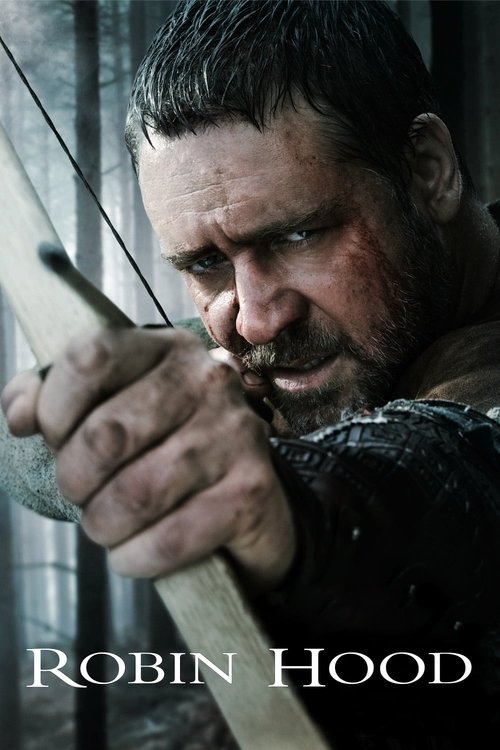
Robin Hood
When soldier Robin happens upon the dying Robert of Loxley, he promises to return the man's sword to his family in Nottingham. There, he assumes Robert's identity; romances his widow, Marion; and draws the ire of the town's sheriff and King John's henchman, Godfrey.
Working with a major studio investment of $200.0M, the film achieved a respectable showing with $321.7M in global revenue (+61% profit margin).
1 win & 14 nominations


Plot Structure
Story beats plotted across runtime


Narrative Arc
Emotional journey through the story's key moments
Story Circle
Blueprint 15-beat structure
Arcplot Score Breakdown
Weighted: Precision (70%) + Arc (15%) + Theme (15%)
Robin Hood (2010) exhibits carefully calibrated plot construction, characteristic of Ridley Scott's storytelling approach. This structural analysis examines how the film's 15-point plot structure maps to proven narrative frameworks across 2 hours and 20 minutes. With an Arcplot score of 6.7, the film balances conventional beats with creative variation.
Characters
Cast & narrative archetypes

Robin Longstride
Marion Loxley
Godfrey
King John
William Marshal
Little John
Will Scarlet
Allan A'Dayle
Friar Tuck
Sir Walter Loxley
Main Cast & Characters
Robin Longstride
Played by Russell Crowe
A common archer returning from the Crusades who assumes the identity of a nobleman and becomes the legendary outlaw Robin Hood.
Marion Loxley
Played by Cate Blanchett
A strong-willed widow who manages her late husband's estate and becomes Robin's ally and love interest.
Godfrey
Played by Mark Strong
A treacherous English knight secretly working for the French, serving as the primary antagonist orchestrating chaos in England.
King John
Played by Oscar Isaac
The weak and petulant new King of England, easily manipulated and prone to tyrannical decisions.
William Marshal
Played by William Hurt
A loyal advisor and military leader who counsels King John and represents England's noble ideals.
Little John
Played by Kevin Durand
Robin's loyal friend and companion, a massive and good-hearted warrior from the Crusades.
Will Scarlet
Played by Scott Grimes
One of Robin's fellow archers and trusted companions who joins him in returning from the Crusades.
Allan A'Dayle
Played by Alan Doyle
A cheerful companion and skilled fighter who travels with Robin's group from the Holy Land.
Friar Tuck
Played by Mark Addy
A jovial and skilled beekeeper who becomes part of Robin's band and provides both spiritual and combat support.
Sir Walter Loxley
Played by Max von Sydow
Marion's blind father-in-law who asks Robin to assume his dead son's identity to protect the family lands.
Structural Analysis
The Status Quo at 1 minutes (1% through the runtime) establishes Robin Longstride is an archer in King Richard's army during the Crusades, a common soldier longing to return home to England after years of war.. Notably, this early placement immediately immerses viewers in the story world.
The inciting incident occurs at 17 minutes when Robin witnesses Sir Robert Loxley's ambush and death. As Loxley dies, he extracts a promise from Robin to return his sword to his father in Nottingham.. At 12% through the film, this Disruption aligns precisely with traditional story structure. This beat shifts the emotional landscape, launching the protagonist into the central conflict.
The First Threshold at 36 minutes marks the transition into Act II, occurring at 26% of the runtime. This reveals the protagonist's commitment to Robin chooses to assume Robert Loxley's identity permanently and marry Marion to save the Loxley estate, committing to a new life and identity in Nottingham., moving from reaction to action.
At 71 minutes, the Midpoint arrives at 50% of the runtime—precisely centered, creating perfect narrative symmetry. Significantly, this crucial beat Robin discovers Godfrey's betrayal and the French invasion plan. King John refuses to listen to Robin's warning, revealing the depth of corruption and the impossibility of working within the system., fundamentally raising what's at risk. The emotional intensity shifts, dividing the narrative into clear before-and-after phases.
The Collapse moment at 105 minutes (75% through) represents the emotional nadir. Here, Walter Loxley dies after revealing Robin's true parentage and legacy, representing the death of the old order and Robin's last connection to his assumed identity., reveals the protagonist at their lowest point. This beat's placement in the final quarter sets up the climactic reversal.
The Second Threshold at 112 minutes initiates the final act resolution at 80% of the runtime. Robin rallies the barons and common people with the Magna Carta principles, uniting England against the French invasion and accepting his role as champion of liberty., demonstrating the transformation achieved throughout the journey.
Emotional Journey
Robin Hood's emotional architecture traces a deliberate progression across 15 carefully calibrated beats.
Narrative Framework
This structural analysis employs structural analysis methodology used to understand storytelling architecture. By mapping Robin Hood against these established plot points, we can identify how Ridley Scott utilizes or subverts traditional narrative conventions. The plot point approach reveals not only adherence to structural principles but also creative choices that distinguish Robin Hood within the action genre.
Ridley Scott's Structural Approach
Among the 24 Ridley Scott films analyzed on Arcplot, the average structural score is 6.5, demonstrating varied approaches to story architecture. Robin Hood represents one of the director's most structurally precise works. For comparative analysis, explore the complete Ridley Scott filmography.
Comparative Analysis
Additional action films include The Bad Guys, Puss in Boots and Venom: The Last Dance. For more Ridley Scott analyses, see Alien, White Squall and American Gangster.
Plot Points by Act
Act I
SetupStatus Quo
Robin Longstride is an archer in King Richard's army during the Crusades, a common soldier longing to return home to England after years of war.
Theme
King Richard speaks about liberty and the rights of Englishmen before his death, foreshadowing the film's central theme of freedom versus tyranny.
Worldbuilding
Establishment of the Crusades' end, King Richard's death, Robin and his men's journey home, and introduction to Prince John's corrupt reign and Marion's struggling estate in Nottingham.
Disruption
Robin witnesses Sir Robert Loxley's ambush and death. As Loxley dies, he extracts a promise from Robin to return his sword to his father in Nottingham.
Resistance
Robin assumes Robert Loxley's identity to return the sword, travels to Nottingham, meets Walter Loxley and Marion, and grapples with whether to maintain the deception or return to his simple life.
Act II
ConfrontationFirst Threshold
Robin chooses to assume Robert Loxley's identity permanently and marry Marion to save the Loxley estate, committing to a new life and identity in Nottingham.
Mirror World
Robin and Marion begin to form a genuine partnership as they work together to save the estate and protect the village, representing the theme of unity and shared purpose.
Premise
Robin becomes the defender of Nottingham, standing up to corrupt tax collectors, uniting the villagers, discovering his own father's legacy as a philosopher of liberty, and growing closer to Marion while preparing for conflict with King John.
Midpoint
Robin discovers Godfrey's betrayal and the French invasion plan. King John refuses to listen to Robin's warning, revealing the depth of corruption and the impossibility of working within the system.
Opposition
Godfrey's forces terrorize the north, King John demands more taxes, the barons revolt, and Robin must unite the fractured kingdom while the French invasion fleet approaches England's shores.
Collapse
Walter Loxley dies after revealing Robin's true parentage and legacy, representing the death of the old order and Robin's last connection to his assumed identity.
Crisis
Robin mourns Walter and contemplates his true identity and destiny. He must choose between fleeing or embracing his role as a leader of the common people against tyranny.
Act III
ResolutionSecond Threshold
Robin rallies the barons and common people with the Magna Carta principles, uniting England against the French invasion and accepting his role as champion of liberty.
Synthesis
The Battle of the Beach: Robin leads the unified English forces against the French invasion, defeats Godfrey, saves England, but is declared an outlaw by King John who reneges on his promises of liberty.
Transformation
Robin, now an outlaw with Marion and his band in Sherwood Forest, has transformed from a cynical soldier into Robin Hood, legendary champion of the common people and symbol of resistance against tyranny.