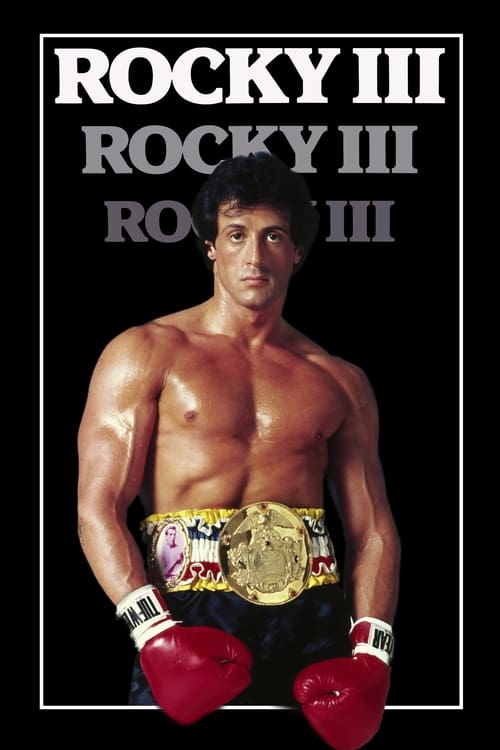
Rocky III
Following Rocky Balboa's intense battle with his most powerful adversary yet – the ferocious Clubber Lang – Rocky joins forces with former rival Apollo Creed in an effort to get back his fighting spirit.
Despite a respectable budget of $17.0M, Rocky III became a box office phenomenon, earning $270.0M worldwide—a remarkable 1488% return.
Nominated for 1 Oscar. 3 wins & 9 nominations


Plot Structure
Story beats plotted across runtime


Narrative Arc
Emotional journey through the story's key moments
Story Circle
Blueprint 15-beat structure
Arcplot Score Breakdown
Weighted: Precision (70%) + Arc (15%) + Theme (15%)
Rocky III (1982) showcases precise plot construction, characteristic of Sylvester Stallone's storytelling approach. This structural analysis examines how the film's 15-point plot structure maps to proven narrative frameworks across 1 hour and 40 minutes. With an Arcplot score of 7.4, the film balances conventional beats with creative variation.
Characters
Cast & narrative archetypes

Rocky Balboa
Clubber Lang
Apollo Creed
Adrian Balboa
Mickey Goldmill
Paulie Pennino
Main Cast & Characters
Rocky Balboa
Played by Sylvester Stallone
The heavyweight champion who has become comfortable and complacent, losing his edge after years of easy defenses until a brutal challenger forces him to rediscover his hunger.
Clubber Lang
Played by Mr. T
The vicious, hungry challenger who brutally defeats Rocky and represents everything Rocky has lost: raw hunger, aggression, and the eye of the tiger.
Apollo Creed
Played by Carl Weathers
Rocky's former rival turned mentor who helps him regain his fire by training him in his old style, teaching him to fight with speed and heart again.
Adrian Balboa
Played by Talia Shire
Rocky's wife who provides emotional support and the crucial breakthrough moment, telling Rocky she's not afraid anymore, giving him permission to fight again.
Mickey Goldmill
Played by Burgess Meredith
Rocky's longtime trainer who tries to protect him from Clubber Lang, revealing he's been hand-picking easy opponents, then dies after the first Clubber fight.
Paulie Pennino
Played by Burt Young
Adrian's brother and Rocky's friend who struggles with Rocky's success and his own insecurities, serving as comic relief and blue-collar reality check.
Structural Analysis
The Status Quo at 1 minutes (1% through the runtime) establishes Rocky is at the height of his success - montage shows him as champion defending his title multiple times, living in luxury with Adrian and their son, beloved by Philadelphia. He has everything he wanted externally.. Of particular interest, this early placement immediately immerses viewers in the story world.
The inciting incident occurs at 11 minutes when At the statue unveiling, Clubber Lang publicly challenges and humiliates Rocky, calling him a coward and questioning his legitimacy as champion. Rocky's pride is wounded and his peaceful world is disrupted by this aggressive threat.. At 11% through the film, this Disruption aligns precisely with traditional story structure. This beat shifts the emotional landscape, launching the protagonist into the central conflict.
The First Threshold at 24 minutes marks the transition into Act II, occurring at 24% of the runtime. This shows the protagonist's commitment to Rocky enters the ring to fight Clubber Lang for the first time. This is his choice to defend his title and prove himself, entering a new world where his old approach won't work against this raw, hungry opponent., moving from reaction to action.
At 51 minutes, the Midpoint arrives at 51% of the runtime—precisely centered, creating perfect narrative symmetry. Notably, this crucial beat Adrian confronts Rocky on the beach, calling out his fear. Rocky admits the truth: "I'm afraid... After Mickey died, I found out how bad he got hurt in the first fight. He didn't want me to know. Now I don't know if I can beat this guy." The façade breaks - this is about overcoming fear, not just winning., fundamentally raising what's at risk. The emotional intensity shifts, dividing the narrative into clear before-and-after phases.
The Collapse moment at 75 minutes (75% through) represents the emotional nadir. Here, This is inverted - rather than a low point, Rocky reaches his peak readiness. The "death" was Mickey earlier; here Rocky has symbolically killed his old fearful self. He's ready for the rematch, fully transformed, embodying both his old heart and Apollo's new technique. "No pain" moment with Apollo., illustrates the protagonist at their lowest point. This beat's placement in the final quarter sets up the climactic reversal.
The Second Threshold at 79 minutes initiates the final act resolution at 79% of the runtime. Rocky enters the ring for the rematch with Clubber Lang. This time he's a different fighter - combining his warrior heart with Apollo's speed and strategy. He has the eye of the tiger back. The fight begins and Rocky implements his new approach., demonstrating the transformation achieved throughout the journey.
Emotional Journey
Rocky III's emotional architecture traces a deliberate progression across 15 carefully calibrated beats.
Narrative Framework
This structural analysis employs systematic plot point analysis that identifies crucial turning points. By mapping Rocky III against these established plot points, we can identify how Sylvester Stallone utilizes or subverts traditional narrative conventions. The plot point approach reveals not only adherence to structural principles but also creative choices that distinguish Rocky III within the drama genre.
Sylvester Stallone's Structural Approach
Among the 7 Sylvester Stallone films analyzed on Arcplot, the average structural score is 7.4, reflecting strong command of classical structure. Rocky III exemplifies the director's characteristic narrative technique. For comparative analysis, explore the complete Sylvester Stallone filmography.
Comparative Analysis
Additional drama films include After Thomas, South Pacific and Dirty Dancing: Havana Nights. For more Sylvester Stallone analyses, see Paradise Alley, Rambo and Staying Alive.
Plot Points by Act
Act I
SetupStatus Quo
Rocky is at the height of his success - montage shows him as champion defending his title multiple times, living in luxury with Adrian and their son, beloved by Philadelphia. He has everything he wanted externally.
Theme
Mickey warns Rocky: "The worst thing that happened to you, that can happen to any fighter: you got civilized." The theme is stated - success and comfort have made Rocky soft, and he's lost his edge, his hunger.
Worldbuilding
Rocky's life as celebrity champion: commercials, endorsements, charity events, statue unveiling. Mickey manages him carefully, arranging easy fights. Clubber Lang emerges as hungry challenger, calling Rocky out publicly. Rocky enjoys comfortable life with Adrian and Paulie.
Disruption
At the statue unveiling, Clubber Lang publicly challenges and humiliates Rocky, calling him a coward and questioning his legitimacy as champion. Rocky's pride is wounded and his peaceful world is disrupted by this aggressive threat.
Resistance
Mickey tries to talk Rocky out of fighting Clubber, revealing he's protected Rocky by arranging easier opponents. Rocky insists on accepting the challenge despite Mickey's warnings. Preparations for the fight are troubled - Rocky is distracted, unfocused, while Clubber is fierce and hungry.
Act II
ConfrontationFirst Threshold
Rocky enters the ring to fight Clubber Lang for the first time. This is his choice to defend his title and prove himself, entering a new world where his old approach won't work against this raw, hungry opponent.
Mirror World
Mickey dies after suffering a heart attack before the fight. Rocky, devastated and unfocused, fights Clubber and is brutally knocked out. He loses both his trainer/father figure and his championship. Apollo Creed appears, offering to help - introducing the relationship that will teach Rocky what he needs.
Premise
Rocky spirals into depression and self-doubt after losing Mickey and the title. Apollo Creed offers to train him for a rematch, but Rocky must rediscover his purpose. They go to Apollo's old gym in Los Angeles. Rocky struggles with fear and lack of motivation, while Adrian tries to support him through his crisis.
Midpoint
Adrian confronts Rocky on the beach, calling out his fear. Rocky admits the truth: "I'm afraid... After Mickey died, I found out how bad he got hurt in the first fight. He didn't want me to know. Now I don't know if I can beat this guy." The façade breaks - this is about overcoming fear, not just winning.
Opposition
With Adrian's support, Rocky commits fully to Apollo's training. Apollo teaches him a new style - speed, finesse, the "eye of the tiger" - combining it with Rocky's heart. Rocky transforms physically and mentally, regaining his hunger. The montage shows Rocky training with intensity, running on the beach with Apollo, finding his fire again.
Collapse
This is inverted - rather than a low point, Rocky reaches his peak readiness. The "death" was Mickey earlier; here Rocky has symbolically killed his old fearful self. He's ready for the rematch, fully transformed, embodying both his old heart and Apollo's new technique. "No pain" moment with Apollo.
Crisis
Final moments before the rematch. Rocky and Apollo share quiet confidence. Rocky is calm, focused, no longer afraid. He has internalized the lesson - it's not about fame or comfort, but about proving to himself he still has the fire.
Act III
ResolutionSecond Threshold
Rocky enters the ring for the rematch with Clubber Lang. This time he's a different fighter - combining his warrior heart with Apollo's speed and strategy. He has the eye of the tiger back. The fight begins and Rocky implements his new approach.
Synthesis
The rematch fight: Rocky uses Apollo's rope-a-dope strategy, letting Clubber exhaust himself while taunting him ("You ain't so bad!"). Rocky then unleashes his combination of technique and heart, demonstrating his transformation. He defeats Clubber Lang, reclaiming the championship.
Transformation
Rocky and Apollo, now true friends and equals, agree to a private fight "just you and me, no cameras" in Apollo's gym. The freeze-frame captures them mid-fight - Rocky has transformed from complacent champion to warrior with purpose, having found his hunger again through friendship and facing his fear.