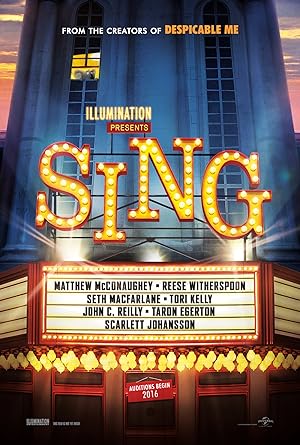
Sing
In a world of anthropomorphic animals, koala Buster Moon owns a theater, having been interested in show business since his father took him to his first music show as a child. Following financial problems brought up by the bank representative Judith, he tells his wealthy friend Eddie that he will host a singing competition with a prize of $1,000. But Buster's assistant, Miss Crawly, accidentally appends two extra zeroes, and the promotional fliers showing $100,000 are blown out of Buster's office into the city streets.
Despite a significant budget of $75.0M, Sing became a box office phenomenon, earning $634.2M worldwide—a remarkable 746% return.
3 wins & 25 nominations


Plot Structure
Story beats plotted across runtime


Narrative Arc
Emotional journey through the story's key moments
Story Circle
Blueprint 15-beat structure
Arcplot Score Breakdown
Weighted: Precision (70%) + Arc (15%) + Theme (15%)
Sing (2016) exemplifies strategically placed dramatic framework, characteristic of Garth Jennings's storytelling approach. This structural analysis examines how the film's 15-point plot structure maps to proven narrative frameworks across 1 hour and 48 minutes. With an Arcplot score of 7.5, the film showcases strong structural fundamentals.
Characters
Cast & narrative archetypes

Buster Moon
Rosita
Ash
Johnny
Meena
Mike
Gunter
Main Cast & Characters
Buster Moon
Played by Matthew McConaughey
An optimistic koala theater owner determined to save his failing theater by hosting a singing competition.
Rosita
Played by Reese Witherspoon
A devoted pig mother of 25 piglets with unfulfilled dreams of performing on stage.
Ash
Played by Scarlett Johansson
A teenage porcupine punk rocker struggling to break free from her boyfriend's shadow and find her own voice.
Johnny
Played by Taron Egerton
A young gorilla torn between his father's criminal expectations and his passion for singing and piano.
Meena
Played by Tori Kelly
A shy teenage elephant with a powerful voice who struggles with severe stage fright.
Mike
Played by Seth MacFarlane
An arrogant street-performing mouse with a big voice and a gambling problem.
Gunter
Played by Nick Kroll
An enthusiastic pig dancer and Rosita's performance partner who brings energy and flair to their act.
Structural Analysis
The Status Quo at 1 minutes (1% through the runtime) establishes Young Buster Moon watches a spectacular theater performance with his father, igniting his lifelong dream of running his own theater. We see his current reality: the Moon Theater is failing, empty seats, and mounting debts.. Structural examination shows that this early placement immediately immerses viewers in the story world.
The inciting incident occurs at 14 minutes when Buster Moon decides to hold a singing competition to save his theater. Miss Crawly accidentally prints flyers advertising $100,000 prize money instead of $1,000, and the flyers spread throughout the city, creating massive interest and changing everything.. At 13% through the film, this Disruption is delayed, allowing extended setup of the story world. This beat shifts the emotional landscape, launching the protagonist into the central conflict.
The First Threshold at 27 minutes marks the transition into Act II, occurring at 25% of the runtime. This reveals the protagonist's commitment to The contestants are selected and commit to the competition. Each character makes an active choice to pursue this opportunity despite obstacles: Rosita partners with Gunter, Johnny defies his father, Ash enters solo after boyfriend drama, Meena accepts a stagehand role, Mike schemes. They enter the "new world" of preparation., moving from reaction to action.
At 54 minutes, the Midpoint arrives at 50% of the runtime—precisely centered, creating perfect narrative symmetry. Significantly, this crucial beat The truth about the prize money is revealed - Buster doesn't actually have $100,000. This false defeat raises the stakes enormously. The contestants feel betrayed, Buster's deception is exposed, and everything he's built begins to crumble. The fun and games are over., fundamentally raising what's at risk. The emotional intensity shifts, dividing the narrative into clear before-and-after phases.
The Collapse moment at 81 minutes (75% through) represents the emotional nadir. Here, The theater is destroyed. During a confrontation, the glass tank breaks and floods the theater, literally bringing down Buster's dream. The Moon Theater collapses in ruins. This is the "death" moment - the death of the dream, the death of hope, the death of Buster's lifelong vision., reveals the protagonist at their lowest point. This beat's placement in the final quarter sets up the climactic reversal.
The Second Threshold at 87 minutes initiates the final act resolution at 81% of the runtime. Meena finds Buster and sings for him, finally overcoming her fear. Her authentic performance reminds Buster why he started - it was never about money or fame, but about giving people a chance to find their voice. He has the breakthrough: the show must go on, for its own sake., demonstrating the transformation achieved throughout the journey.
Emotional Journey
Sing's emotional architecture traces a deliberate progression across 15 carefully calibrated beats.
Narrative Framework
This structural analysis employs a 15-point narrative structure framework that maps key story moments. By mapping Sing against these established plot points, we can identify how Garth Jennings utilizes or subverts traditional narrative conventions. The plot point approach reveals not only adherence to structural principles but also creative choices that distinguish Sing within the animation genre.
Garth Jennings's Structural Approach
Among the 4 Garth Jennings films analyzed on Arcplot, the average structural score is 7.4, reflecting strong command of classical structure. Sing represents one of the director's most structurally precise works. For comparative analysis, explore the complete Garth Jennings filmography.
Comparative Analysis
Additional animation films include The Bad Guys, Puss in Boots and Violet Evergarden: Eternity and the Auto Memory Doll. For more Garth Jennings analyses, see Sing 2, Son of Rambow and The Hitchhiker's Guide to the Galaxy.
Plot Points by Act
Act I
SetupStatus Quo
Young Buster Moon watches a spectacular theater performance with his father, igniting his lifelong dream of running his own theater. We see his current reality: the Moon Theater is failing, empty seats, and mounting debts.
Theme
Miss Crawly or another character mentions "following your dreams" or "believing in yourself" - the core theme that everyone has a song inside them waiting to be sung, regardless of their current circumstances.
Worldbuilding
Introduction to all main characters in their ordinary worlds: Rosita the overwhelmed housewife pig, Johnny the gorilla in a criminal family, Ash the punk rocker overshadowed by her boyfriend, Meena the shy elephant with stage fright, and Mike the arrogant mouse. Each is stuck in their status quo.
Disruption
Buster Moon decides to hold a singing competition to save his theater. Miss Crawly accidentally prints flyers advertising $100,000 prize money instead of $1,000, and the flyers spread throughout the city, creating massive interest and changing everything.
Resistance
Auditions take place. Each character debates whether to enter: Rosita questions leaving her domestic duties, Johnny must hide it from his criminal father, Meena battles her stage fright, Ash deals with her boyfriend's ego, Mike sees it as easy money. Buster evaluates talent and makes selections.
Act II
ConfrontationFirst Threshold
The contestants are selected and commit to the competition. Each character makes an active choice to pursue this opportunity despite obstacles: Rosita partners with Gunter, Johnny defies his father, Ash enters solo after boyfriend drama, Meena accepts a stagehand role, Mike schemes. They enter the "new world" of preparation.
Mirror World
The rehearsal process begins, and relationships form that will teach the theme. Gunter becomes Rosita's liberating partner, Buster becomes a mentor figure to all, and each contestant finds people who believe in them - the supportive community they've been missing.
Premise
The "fun and games" of rehearsals and preparation. Rosita builds an elaborate contraption to manage home duties, Johnny sneaks away from crime jobs to practice piano, Ash finds her authentic voice after her boyfriend leaves, Meena struggles with confidence, Mike gets involved with dangerous bears. Each explores their potential.
Midpoint
The truth about the prize money is revealed - Buster doesn't actually have $100,000. This false defeat raises the stakes enormously. The contestants feel betrayed, Buster's deception is exposed, and everything he's built begins to crumble. The fun and games are over.
Opposition
Everything falls apart. Buster desperately tries to secure funding from his friend Eddie's grandmother. The contestants lose faith - some quit, others are torn between dreams and obligations. Johnny's father discovers his betrayal and the gang is arrested. External and internal pressures mount from all sides.
Collapse
The theater is destroyed. During a confrontation, the glass tank breaks and floods the theater, literally bringing down Buster's dream. The Moon Theater collapses in ruins. This is the "death" moment - the death of the dream, the death of hope, the death of Buster's lifelong vision.
Crisis
Buster retreats to his friend Eddie's place, completely defeated and ready to give up. He washes cars to survive, abandoning his dream. The contestants return to their old lives, equally devastated. This is the dark night where all seems lost and the dream appears truly dead.
Act III
ResolutionSecond Threshold
Meena finds Buster and sings for him, finally overcoming her fear. Her authentic performance reminds Buster why he started - it was never about money or fame, but about giving people a chance to find their voice. He has the breakthrough: the show must go on, for its own sake.
Synthesis
Buster reunites the contestants for a free show in the theater ruins. Each performer synthesizes their journey - Rosita embraces her bold self, Johnny reconciles passion with family, Ash owns her authenticity, Meena conquers her fear, even Mike returns. The performance is triumphant, attracting a huge crowd and media attention. The show succeeds beyond money.
Transformation
The final image shows the grand reopening of the rebuilt Moon Theater, now funded by Eddie's grandmother who was moved by their performance. The theater is packed, vibrant, successful - but more importantly, each character has found their authentic voice. The dream lives, transformed and genuine.