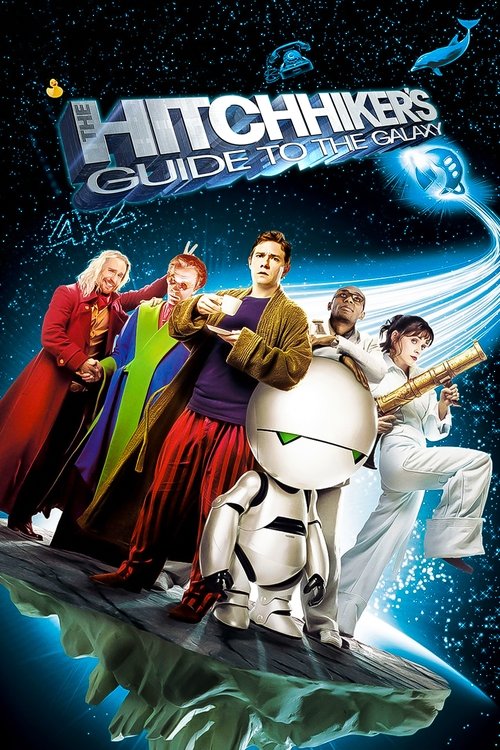
The Hitchhiker's Guide to the Galaxy
Mere seconds before the Earth is to be demolished by an alien construction crew, Arthur Dent is swept off the planet by his friend Ford Prefect, a researcher penning a new edition of "The Hitchhiker's Guide to the Galaxy."
Despite a respectable budget of $50.0M, The Hitchhiker's Guide to the Galaxy became a financial success, earning $104.5M worldwide—a 109% return.
1 win & 10 nominations


Plot Structure
Story beats plotted across runtime


Narrative Arc
Emotional journey through the story's key moments
Story Circle
Blueprint 15-beat structure
Arcplot Score Breakdown
Weighted: Precision (70%) + Arc (15%) + Theme (15%)
The Hitchhiker's Guide to the Galaxy (2005) reveals meticulously timed plot construction, characteristic of Garth Jennings's storytelling approach. This structural analysis examines how the film's 15-point plot structure maps to proven narrative frameworks across 1 hour and 49 minutes. With an Arcplot score of 7.2, the film balances conventional beats with creative variation.
Structural Analysis
The Status Quo at 1 minutes (1% through the runtime) establishes Arthur Dent lies in front of a bulldozer to save his house from demolition, establishing his ordinary suburban life and stubborn attachment to the familiar.. Significantly, this early placement immediately immerses viewers in the story world.
The inciting incident occurs at 12 minutes when The Vogon destructor fleet arrives and announces Earth's demolition to make way for a hyperspace bypass, destroying Arthur's entire world.. At 11% through the film, this Disruption aligns precisely with traditional story structure. This beat shifts the emotional landscape, launching the protagonist into the central conflict.
The First Threshold at 28 minutes marks the transition into Act II, occurring at 26% of the runtime. This indicates the protagonist's commitment to Arthur chooses to stay aboard the Heart of Gold with Ford, Trillian, Zaphod, and Marvin, actively accepting his new life in the galaxy rather than seeking death or denial., moving from reaction to action.
At 54 minutes, the Midpoint arrives at 50% of the runtime—precisely centered, creating perfect narrative symmetry. The analysis reveals that this crucial beat The crew lands on Magrathea and discovers it's the legendary planet that built custom worlds, including Earth. Arthur learns Earth was a giant computer designed to find the Ultimate Question - false victory of finding "meaning."., fundamentally raising what's at risk. The emotional intensity shifts, dividing the narrative into clear before-and-after phases.
The Collapse moment at 81 minutes (74% through) represents the emotional nadir. Here, The Vogons capture the crew. Arthur faces the futility of existence - Earth was destroyed moments before completing its 10-million-year program, and Trillian is about to be killed. Total despair and meaninglessness., illustrates the protagonist at their lowest point. This beat's placement in the final quarter sets up the climactic reversal.
The Second Threshold at 86 minutes initiates the final act resolution at 79% of the runtime. Arthur realizes the Ultimate Question is unknowable, but that doesn't matter - what matters is choosing to live and act anyway. He uses the Point of View Gun to make Vogons see their own cruelty, saving the crew., demonstrating the transformation achieved throughout the journey.
Emotional Journey
The Hitchhiker's Guide to the Galaxy's emotional architecture traces a deliberate progression across 15 carefully calibrated beats.
Narrative Framework
This structural analysis employs structural analysis methodology used to understand storytelling architecture. By mapping The Hitchhiker's Guide to the Galaxy against these established plot points, we can identify how Garth Jennings utilizes or subverts traditional narrative conventions. The plot point approach reveals not only adherence to structural principles but also creative choices that distinguish The Hitchhiker's Guide to the Galaxy within the adventure genre.
Garth Jennings's Structural Approach
Among the 4 Garth Jennings films analyzed on Arcplot, the average structural score is 7.4, reflecting strong command of classical structure. The Hitchhiker's Guide to the Galaxy takes a more unconventional approach compared to the director's typical style. For comparative analysis, explore the complete Garth Jennings filmography.
Comparative Analysis
Additional adventure films include The Black Stallion, The Bad Guys and Puss in Boots. For more Garth Jennings analyses, see Sing 2, Sing and Son of Rambow.
Plot Points by Act
Act I
SetupStatus Quo
Arthur Dent lies in front of a bulldozer to save his house from demolition, establishing his ordinary suburban life and stubborn attachment to the familiar.
Theme
Ford Prefect tells Arthur "You've got to learn to roll with things" - the thematic statement about accepting change and the absurdity of existence.
Worldbuilding
Introduction to Arthur's mundane Earth life, his unrequited feelings for Trillian, Ford's strange behavior, and the impending demolition of Arthur's house.
Disruption
The Vogon destructor fleet arrives and announces Earth's demolition to make way for a hyperspace bypass, destroying Arthur's entire world.
Resistance
Ford rescues Arthur by hitchhiking onto the Vogon ship. Arthur struggles to comprehend the reality of aliens and space travel. They survive Vogon poetry torture and are rescued by the Heart of Gold.
Act II
ConfrontationFirst Threshold
Arthur chooses to stay aboard the Heart of Gold with Ford, Trillian, Zaphod, and Marvin, actively accepting his new life in the galaxy rather than seeking death or denial.
Mirror World
Arthur reconnects with Trillian, who represents adaptability and wonder. Their relationship subplot carries the theme of openness to experience versus clinging to the past.
Premise
The crew explores absurd galactic adventures: the Infinite Improbability Drive, Viltvodle VI and the Point of View Gun, seeking the Ultimate Question on Magrathea, encountering bizarre alien civilizations.
Midpoint
The crew lands on Magrathea and discovers it's the legendary planet that built custom worlds, including Earth. Arthur learns Earth was a giant computer designed to find the Ultimate Question - false victory of finding "meaning."
Opposition
Slartibartfast reveals Earth's true purpose. The Vogons pursue them to prevent the Ultimate Question from being discovered. Arthur realizes his insignificance in the cosmos. Tensions rise between Arthur and Trillian.
Collapse
The Vogons capture the crew. Arthur faces the futility of existence - Earth was destroyed moments before completing its 10-million-year program, and Trillian is about to be killed. Total despair and meaninglessness.
Crisis
Arthur confronts his paralyzing fear and depression. He must find inner resolve without cosmic meaning or guarantees. Dark night of accepting absurdity.
Act III
ResolutionSecond Threshold
Arthur realizes the Ultimate Question is unknowable, but that doesn't matter - what matters is choosing to live and act anyway. He uses the Point of View Gun to make Vogons see their own cruelty, saving the crew.
Synthesis
Arthur defeats the Vogons through empathy (the POV Gun). The crew escapes and chooses to continue exploring together. Arthur accepts uncertainty and embraces adventure with Trillian.
Transformation
Arthur and Trillian fly through space together, Arthur now relaxed and smiling, having transformed from a rigid, house-obsessed everyman into someone who embraces cosmic absurdity and possibility.