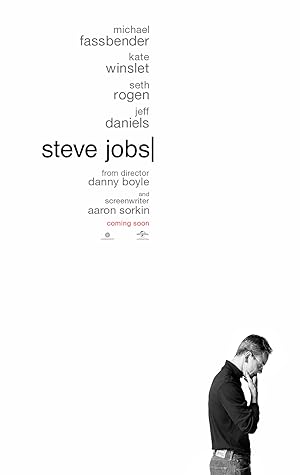
Steve Jobs
His passion and ingenuity have been the driving force behind the digital age. However his drive to revolutionize technology was sacrificial. Ultimately it affected his family life and possibly his health. In this revealing film we explore the trials and triumphs of a modern day genius, the late CEO of Apple inc. Steven Paul Jobs.
Working with a mid-range budget of $30.0M, the film achieved a modest success with $34.4M in global revenue (+15% profit margin).
Nominated for 2 Oscars. 28 wins & 117 nominations


Plot Structure
Story beats plotted across runtime


Narrative Arc
Emotional journey through the story's key moments
Story Circle
Blueprint 15-beat structure
Arcplot Score Breakdown
Weighted: Precision (70%) + Arc (15%) + Theme (15%)
Steve Jobs (2015) showcases deliberately positioned narrative architecture, characteristic of Danny Boyle's storytelling approach. This structural analysis examines how the film's 15-point plot structure maps to proven narrative frameworks across 2 hours and 2 minutes. With an Arcplot score of 7.6, the film showcases strong structural fundamentals.
Characters
Cast & narrative archetypes

Steve Jobs
Joanna Hoffman
Steve Wozniak
John Sculley
Lisa Brennan-Jobs
Chrisann Brennan
Andy Hertzfeld
Main Cast & Characters
Steve Jobs
Played by Michael Fassbender
Visionary Apple co-founder driven by perfectionism and need for control. A genius who struggles with personal relationships while revolutionizing technology.
Joanna Hoffman
Played by Kate Winslet
Jobs' marketing executive and closest confidant. The only person who can consistently challenge him and speak truth to power.
Steve Wozniak
Played by Seth Rogen
Apple co-founder and engineering genius. Loyal friend who desires recognition for the Apple II team and represents collaborative values Jobs rejects.
John Sculley
Played by Jeff Daniels
Former Apple CEO and father figure to Jobs. Their relationship evolves from mentor-protégé to bitter rivals after Jobs' ousting from Apple.
Lisa Brennan-Jobs
Played by Perla Haney-Jardine
Jobs' daughter whose paternity he initially denies. Her presence forces Jobs to confront his humanity and capacity for connection.
Chrisann Brennan
Played by Katherine Waterston
Lisa's mother and Jobs' former girlfriend. She fights for support and acknowledgment while raising their daughter largely alone.
Andy Hertzfeld
Played by Michael Stuhlbarg
Original Macintosh team member and software engineer. Represents the creative engineers Jobs both inspires and exploits.
Structural Analysis
The Status Quo at 1 minutes (1% through the runtime) establishes Jobs backstage at the 1984 Macintosh launch, obsessively controlling every detail, showing his perfectionism and difficult personality that defines his world.. Significantly, this early placement immediately immerses viewers in the story world.
The inciting incident occurs at 15 minutes when Jobs learns the Macintosh won't say "hello" due to insufficient memory, and the computer magazine exposé about his daughter Lisa threatens to overshadow the launch.. At 12% through the film, this Disruption aligns precisely with traditional story structure. This beat shifts the emotional landscape, launching the protagonist into the central conflict.
The First Threshold at 31 minutes marks the transition into Act II, occurring at 25% of the runtime. This indicates the protagonist's commitment to Jobs steps on stage to present the Macintosh to the world, committing fully to his vision despite all the conflicts and unresolved personal issues., moving from reaction to action.
At 61 minutes, the Midpoint arrives at 50% of the runtime—precisely centered, creating perfect narrative symmetry. Structural examination shows that this crucial beat Jobs has a devastating confrontation with Sculley, who reveals the board chose him over Jobs, and Wozniak publicly calls him out for taking credit and not acknowledging the people who built things., fundamentally raising what's at risk. The emotional intensity shifts, dividing the narrative into clear before-and-after phases.
The Collapse moment at 92 minutes (75% through) represents the emotional nadir. Here, Lisa tells Jobs "I don't want your money" and walks away, rejecting him completely. Jobs faces the death of his relationship with his daughter and the cost of his inability to connect., indicates the protagonist at their lowest point. This beat's placement in the final quarter sets up the climactic reversal.
The Second Threshold at 98 minutes initiates the final act resolution at 80% of the runtime. Jobs finds Lisa and genuinely apologizes, admitting "I'm poorly made" and offering to put her name on the Lisa computer in the credits, finally acknowledging her and his failures., demonstrating the transformation achieved throughout the journey.
Emotional Journey
Steve Jobs's emotional architecture traces a deliberate progression across 15 carefully calibrated beats.
Narrative Framework
This structural analysis employs a 15-point narrative structure framework that maps key story moments. By mapping Steve Jobs against these established plot points, we can identify how Danny Boyle utilizes or subverts traditional narrative conventions. The plot point approach reveals not only adherence to structural principles but also creative choices that distinguish Steve Jobs within the biography genre.
Danny Boyle's Structural Approach
Among the 12 Danny Boyle films analyzed on Arcplot, the average structural score is 6.6, demonstrating varied approaches to story architecture. Steve Jobs represents one of the director's most structurally precise works. For comparative analysis, explore the complete Danny Boyle filmography.
Comparative Analysis
Additional biography films include After Thomas, Taking Woodstock and The Fire Inside. For more Danny Boyle analyses, see Yesterday, Millions and T2 Trainspotting.
Plot Points by Act
Act I
SetupStatus Quo
Jobs backstage at the 1984 Macintosh launch, obsessively controlling every detail, showing his perfectionism and difficult personality that defines his world.
Theme
Joanna Hoffman tells Jobs "You can't write code, you're not an engineer" - establishing the central question of what makes someone valuable beyond technical ability.
Worldbuilding
The 1984 Macintosh launch preparation reveals Jobs' relationships: his controlling nature with Joanna, conflict with Wozniak over Apple II recognition, denial of his daughter Lisa, and tension with CEO John Sculley.
Disruption
Jobs learns the Macintosh won't say "hello" due to insufficient memory, and the computer magazine exposé about his daughter Lisa threatens to overshadow the launch.
Resistance
Jobs debates with his team about fixing the demo, confronts Chrisann and Lisa backstage, reflects on being adopted, and argues with Sculley about marketing versus product vision before the Mac launch.
Act II
ConfrontationFirst Threshold
Jobs steps on stage to present the Macintosh to the world, committing fully to his vision despite all the conflicts and unresolved personal issues.
Mirror World
1988 - Jobs at NeXT, now exiled from Apple, first appears with Joanna Hoffman who remains his conscience and truth-teller, representing the relationship subplot that carries his potential for growth.
Premise
The NeXT launch sequence explores Jobs' exile from Apple, his ongoing denial about Lisa, conflict with Wozniak about acknowledgment, and the power struggle with Sculley who ousted him from his own company.
Midpoint
Jobs has a devastating confrontation with Sculley, who reveals the board chose him over Jobs, and Wozniak publicly calls him out for taking credit and not acknowledging the people who built things.
Opposition
1998 iMac launch: Jobs is back at Apple but pressure mounts as Lisa (now older) confronts him, Wozniak threatens to tell the press Jobs denied his daughter, and the weight of his relationship failures intensifies.
Collapse
Lisa tells Jobs "I don't want your money" and walks away, rejecting him completely. Jobs faces the death of his relationship with his daughter and the cost of his inability to connect.
Crisis
Jobs sits alone with the weight of Lisa's rejection, processes Joanna's words about his cruelty, and confronts what he's lost by refusing to acknowledge his humanity and connections.
Act III
ResolutionSecond Threshold
Jobs finds Lisa and genuinely apologizes, admitting "I'm poorly made" and offering to put her name on the Lisa computer in the credits, finally acknowledging her and his failures.
Synthesis
Jobs reconciles with Lisa, acknowledges Wozniak's contributions from stage, makes peace with his legacy, and prepares for the iMac launch with genuine human connection finally integrated into his life.
Transformation
Jobs walks to the stage with Lisa by his side, having finally connected with his daughter - transformed from someone who denied human bonds to someone who embraces them.