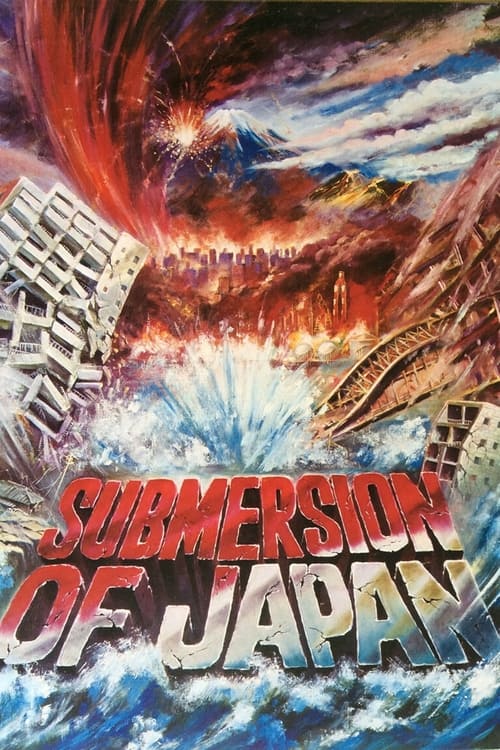
Submersion of Japan
A team of geophysicists investigating seismic activity on the seafloor discover that the islands of Japan, after suffering from massive volcanic eruptions and earthquakes, will be pulled into the ocean, killing millions.
Despite a moderate budget of $18.6M, Submersion of Japan became a solid performer, earning $49.7M worldwide—a 167% return.
Plot Structure
Story beats plotted across runtime


Narrative Arc
Emotional journey through the story's key moments
Story Circle
Blueprint 15-beat structure
Arcplot Score Breakdown
Weighted: Precision (70%) + Arc (15%) + Theme (15%)
Submersion of Japan (1973) exhibits carefully calibrated narrative design, characteristic of Shirō Moritani's storytelling approach. This structural analysis examines how the film's 15-point plot structure maps to proven narrative frameworks across 2 hours and 23 minutes. With an Arcplot score of 7.4, the film balances conventional beats with creative variation.
Characters
Cast & narrative archetypes

Dr. Toshio Onodera
Reiko Abe
Prime Minister Yamamoto
Hajime Toge
Professor Tadokoro
Main Cast & Characters
Dr. Toshio Onodera
Played by Keiju Kobayashi
A geologist who discovers Japan is sinking and works desperately to warn the government and save lives.
Reiko Abe
Played by Ayumi Ishida
A diving assistant who helps Dr. Onodera with underwater research and becomes personally invested in the crisis.
Prime Minister Yamamoto
Played by Tetsuro Tamba
The Japanese Prime Minister who must make impossible decisions about evacuating millions as the nation sinks.
Hajime Toge
Played by Hiroshi Fujioka
A submarine pilot who assists in underwater investigations and evacuation efforts.
Professor Tadokoro
Played by Kobayashi Keiju
An elder scientist and mentor who predicts the catastrophe and guides the research team.
Structural Analysis
The Status Quo at 2 minutes (1% through the runtime) establishes A submarine pilot conducts routine deep-sea exploration in calm Japanese waters, establishing the protagonist's professional world and normal scientific operations.. Significantly, this early placement immediately immerses viewers in the story world.
The inciting incident occurs at 17 minutes when A massive earthquake strikes, causing widespread destruction and leading Dr. Tadokoro to discover terrifying seismic data suggesting something catastrophic is happening beneath Japan.. At 12% through the film, this Disruption aligns precisely with traditional story structure. This beat shifts the emotional landscape, launching the protagonist into the central conflict.
The First Threshold at 35 minutes marks the transition into Act II, occurring at 25% of the runtime. This demonstrates the protagonist's commitment to Dr. Tadokoro presents irrefutable evidence to the government that Japan will sink into the ocean within a year, and the Prime Minister commits to emergency action, launching the nation into crisis mode., moving from reaction to action.
At 71 minutes, the Midpoint arrives at 50% of the runtime—precisely centered, creating perfect narrative symmetry. Of particular interest, this crucial beat A major volcanic eruption and earthquake devastate Tokyo, making it clear that time is running out faster than predicted and the scale of destruction will be total—this is no longer theoretical., fundamentally raising what's at risk. The emotional intensity shifts, dividing the narrative into clear before-and-after phases.
The Collapse moment at 106 minutes (74% through) represents the emotional nadir. Here, Dr. Tadokoro dies during a final submarine mission attempting to study the mantle, sacrificing himself to gather data. His death represents the futility of fighting geological inevitability., shows the protagonist at their lowest point. This beat's placement in the final quarter sets up the climactic reversal.
The Second Threshold at 114 minutes initiates the final act resolution at 80% of the runtime. Onodera and the remaining survivors accept that survival means leaving Japan behind and carrying forward its culture and spirit in their hearts rather than its physical land., demonstrating the transformation achieved throughout the journey.
Emotional Journey
Submersion of Japan's emotional architecture traces a deliberate progression across 15 carefully calibrated beats.
Narrative Framework
This structural analysis employs systematic plot point analysis that identifies crucial turning points. By mapping Submersion of Japan against these established plot points, we can identify how Shirō Moritani utilizes or subverts traditional narrative conventions. The plot point approach reveals not only adherence to structural principles but also creative choices that distinguish Submersion of Japan within the thriller genre.
Comparative Analysis
Additional thriller films include The Warriors, Thunderball and Rustom.
Plot Points by Act
Act I
SetupStatus Quo
A submarine pilot conducts routine deep-sea exploration in calm Japanese waters, establishing the protagonist's professional world and normal scientific operations.
Theme
A scientist states that when nature decides to act, human civilization is powerless to stop it—introducing the theme of humanity's vulnerability before geological forces.
Worldbuilding
Introduction of key characters including geologist Dr. Tadokoro, submarine pilot Onodera, and government officials. Establishes Japan's scientific infrastructure and the political landscape before disaster strikes.
Disruption
A massive earthquake strikes, causing widespread destruction and leading Dr. Tadokoro to discover terrifying seismic data suggesting something catastrophic is happening beneath Japan.
Resistance
Scientists debate the evidence and conduct more research expeditions. Government officials resist believing the findings. Dr. Tadokoro and his team work to convince authorities of the impending danger while gathering more proof.
Act II
ConfrontationFirst Threshold
Dr. Tadokoro presents irrefutable evidence to the government that Japan will sink into the ocean within a year, and the Prime Minister commits to emergency action, launching the nation into crisis mode.
Mirror World
Onodera's relationship with Reiko deepens as they face the crisis together, representing the human connection and love that gives meaning in the face of unstoppable catastrophe.
Premise
The promise of the premise unfolds: watching Japan attempt to save itself through massive evacuation plans, international diplomacy, and desperate scientific efforts to slow the geological process.
Midpoint
A major volcanic eruption and earthquake devastate Tokyo, making it clear that time is running out faster than predicted and the scale of destruction will be total—this is no longer theoretical.
Opposition
Chaos intensifies as evacuation efforts struggle against time and logistics. International politics complicate refugee acceptance. Nature's assault accelerates with continuous earthquakes, tsunamis, and volcanic activity overwhelming all countermeasures.
Collapse
Dr. Tadokoro dies during a final submarine mission attempting to study the mantle, sacrificing himself to gather data. His death represents the futility of fighting geological inevitability.
Crisis
Survivors process the loss of their mentor and the reality that Japan cannot be saved. Evacuations become desperate as the archipelago literally tears apart. Characters confront losing their homeland forever.
Act III
ResolutionSecond Threshold
Onodera and the remaining survivors accept that survival means leaving Japan behind and carrying forward its culture and spirit in their hearts rather than its physical land.
Synthesis
Final evacuations proceed as Japan sinks beneath the waves. Survivors board ships and aircraft, watching their homeland disappear. The Japanese people scatter across the world, carrying their identity beyond geography.
Transformation
Onodera stands on a ship watching the last remnants of Japan slip beneath the ocean, transformed from a man defined by his nation to one who must carry its memory forward into an uncertain future.