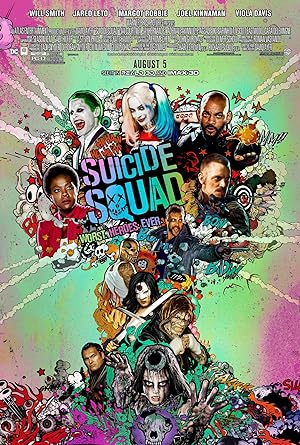
Suicide Squad
It feels good to be bad...Assemble a team of the world's most dangerous, incarcerated Super Villains, provide them with the most powerful arsenal at the government's disposal, and send them off on a mission to defeat an enigmatic, insuperable entity. U.S. intelligence officer Amanda Waller has determined only a secretly convened group of disparate, despicable individuals with next to nothing to lose will do. However, once they realize they weren't picked to succeed but chosen for their patent culpability when they inevitably fail, will the Suicide Squad resolve to die trying, or decide it's every man for himself?
Despite a enormous budget of $175.0M, Suicide Squad became a commercial success, earning $749.2M worldwide—a 328% return. This commercial performance validated the ambitious narrative scope, confirming that audiences embrace unique voice even at blockbuster scale.
1 Oscar. 18 wins & 41 nominations


Plot Structure
Story beats plotted across runtime


Narrative Arc
Emotional journey through the story's key moments
Story Circle
Blueprint 15-beat structure
Arcplot Score Breakdown
Weighted: Precision (70%) + Arc (15%) + Theme (15%)
Suicide Squad (2016) reveals strategically placed story structure, characteristic of David Ayer's storytelling approach. This structural analysis examines how the film's 15-point plot structure maps to proven narrative frameworks across 2 hours and 2 minutes. With an Arcplot score of 6.4, the film takes an unconventional approach to traditional narrative frameworks.
Characters
Cast & narrative archetypes

Deadshot
Harley Quinn
Rick Flag
Amanda Waller
The Joker
Enchantress
Diablo
Captain Boomerang
Killer Croc
Katana
Main Cast & Characters
Deadshot
Played by Will Smith
Elite assassin and marksman who never misses, reluctantly joins the squad to reduce his prison sentence and reconnect with his daughter.
Harley Quinn
Played by Margot Robbie
Former psychiatrist turned criminally insane accomplice of the Joker, brings chaotic energy and unpredictability to the team.
Rick Flag
Played by Joel Kinnaman
Military officer tasked with leading and controlling the Suicide Squad, torn between duty and protecting June Moone.
Amanda Waller
Played by Viola Davis
Ruthless government intelligence officer who assembles the Suicide Squad, willing to sacrifice anyone to protect national security.
The Joker
Played by Jared Leto
Psychopathic crime lord obsessed with reclaiming Harley Quinn, operates outside the squad's mission.
Enchantress
Played by Cara Delevingne
Ancient witch possessing archaeologist June Moone, becomes the primary antagonist seeking to destroy humanity.
Diablo
Played by Jay Hernandez
Former gang member with pyrokinetic powers, haunted by accidentally killing his family and reluctant to use his abilities.
Captain Boomerang
Played by Jai Courtney
Australian thief and bank robber who uses specialized boomerangs, primarily motivated by self-interest.
Killer Croc
Played by Adewale Akinnuoye-Agbaje
Metahuman with reptilian features and enhanced strength, ostracized by society and finding acceptance within the squad.
Katana
Played by Karen Fukuhara
Japanese vigilante wielding a mystical sword that traps souls, serves as Rick Flag's bodyguard and enforcer.
Structural Analysis
The Status Quo at 1 minutes (1% through the runtime) establishes Deadshot and Harley Quinn are shown imprisoned in Belle Reve, enduring brutal conditions. Deadshot does push-ups in isolation while Harley hangs from her cage bars—trapped villains with no hope of redemption.. Notably, this early placement immediately immerses viewers in the story world.
The inciting incident occurs at 15 minutes when Dr. June Moone transforms into Enchantress and escapes Waller's control, teleporting to retrieve her brother's spirit. The metahuman weapon Waller created becomes the threat—her contingency plan has catastrophically backfired.. At 12% through the film, this Disruption aligns precisely with traditional story structure. This beat shifts the emotional landscape, launching the protagonist into the central conflict.
The First Threshold at 31 minutes marks the transition into Act II, occurring at 25% of the runtime. This reveals the protagonist's commitment to The Squad deploys into Midway City via helicopter, descending into the war zone. Slipknot attempts escape and is immediately killed by his implant—proving the stakes are real. The villains have crossed into the mission with no way back., moving from reaction to action.
At 61 minutes, the Midpoint arrives at 50% of the runtime—precisely centered, creating perfect narrative symmetry. Significantly, this crucial beat The Squad extracts their target from the building—revealed to be Amanda Waller herself. The mission was never about saving civilians; they're just cleaning up Waller's mess. The false victory curdles as they realize they've been manipulated., fundamentally raising what's at risk. The emotional intensity shifts, dividing the narrative into clear before-and-after phases.
The Collapse moment at 92 minutes (75% through) represents the emotional nadir. Here, In a bar, Flag reveals the full truth: June is Enchantress, and Waller forced his compliance. He destroys the detonator, freeing them. El Diablo confesses he killed his family. The Squad faces their darkest selves—broken people with nothing left to lose., reveals the protagonist at their lowest point. This beat's placement in the final quarter sets up the climactic reversal.
The Second Threshold at 98 minutes initiates the final act resolution at 80% of the runtime. Deadshot stands and walks toward Enchantress's lair. One by one, the others follow—not because they must, but because they choose to. For the first time, villains become heroes by their own decision. They're no longer a suicide squad; they're a team., demonstrating the transformation achieved throughout the journey.
Emotional Journey
Suicide Squad's emotional architecture traces a deliberate progression across 15 carefully calibrated beats.
Narrative Framework
This structural analysis employs a 15-point narrative structure framework that maps key story moments. By mapping Suicide Squad against these established plot points, we can identify how David Ayer utilizes or subverts traditional narrative conventions. The plot point approach reveals not only adherence to structural principles but also creative choices that distinguish Suicide Squad within the action genre.
David Ayer's Structural Approach
Among the 7 David Ayer films analyzed on Arcplot, the average structural score is 6.9, demonstrating varied approaches to story architecture. Suicide Squad takes a more unconventional approach compared to the director's typical style. For comparative analysis, explore the complete David Ayer filmography.
Comparative Analysis
Additional action films include The Bad Guys, Puss in Boots and Venom: The Last Dance. For more David Ayer analyses, see Fury, Street Kings and Sabotage.
Plot Points by Act
Act I
SetupStatus Quo
Deadshot and Harley Quinn are shown imprisoned in Belle Reve, enduring brutal conditions. Deadshot does push-ups in isolation while Harley hangs from her cage bars—trapped villains with no hope of redemption.
Theme
Amanda Waller pitches Task Force X to Pentagon officials: "Getting people to act against their own self-interest for the national security of the United States is what I do for a living." The theme emerges—can forced service transform villains into something more?
Worldbuilding
Extended dossier sequences introduce each Squad member through flashbacks: Deadshot's assassination skills and daughter; Harley's origin with the Joker; El Diablo's tragic past; Killer Croc, Captain Boomerang, and others. Waller's ruthless control is established.
Disruption
Dr. June Moone transforms into Enchantress and escapes Waller's control, teleporting to retrieve her brother's spirit. The metahuman weapon Waller created becomes the threat—her contingency plan has catastrophically backfired.
Resistance
Enchantress resurrects Incubus and begins building her machine in Midway City. Waller activates Task Force X, and Rick Flag briefs the reluctant villains. Explosive implants are demonstrated on Slipknot. The Squad debates whether to cooperate or resist.
Act II
ConfrontationFirst Threshold
The Squad deploys into Midway City via helicopter, descending into the war zone. Slipknot attempts escape and is immediately killed by his implant—proving the stakes are real. The villains have crossed into the mission with no way back.
Mirror World
Rick Flag's love for June Moone is revealed as the Squad fights through the city. His vulnerability humanizes the mission—he's not just their handler but a man trying to save the woman he loves from the monster inside her.
Premise
The Squad battles through Midway City's streets against Enchantress's eyeball soldiers. Their unique abilities shine in combat. Banter and dark humor develop camaraderie. The Joker orchestrates Harley's rescue attempt. They're becoming a dysfunctional family.
Midpoint
The Squad extracts their target from the building—revealed to be Amanda Waller herself. The mission was never about saving civilians; they're just cleaning up Waller's mess. The false victory curdles as they realize they've been manipulated.
Opposition
Waller's helicopter is shot down by the Joker. The Squad must rescue her again. Enchantress's machine grows stronger, transforming humans into her army. Joker's helicopter explodes with Harley seemingly aboard. Internal conflicts rise as trust fractures.
Collapse
In a bar, Flag reveals the full truth: June is Enchantress, and Waller forced his compliance. He destroys the detonator, freeing them. El Diablo confesses he killed his family. The Squad faces their darkest selves—broken people with nothing left to lose.
Crisis
The Squad sits in defeated silence. They could walk away—the bombs are deactivated. Deadshot thinks of his daughter, Harley of her twisted love. Each confronts what they're fighting for when there's no compulsion left.
Act III
ResolutionSecond Threshold
Deadshot stands and walks toward Enchantress's lair. One by one, the others follow—not because they must, but because they choose to. For the first time, villains become heroes by their own decision. They're no longer a suicide squad; they're a team.
Synthesis
The Squad confronts Enchantress and Incubus. El Diablo embraces his full power, sacrificing himself to destroy Incubus. Harley tricks Enchantress with false allegiance. Deadshot destroys the machine. Flag crushes Enchantress's heart, saving June.
Transformation
The Squad returns to Belle Reve as heroes—granted privileges and reduced sentences. Deadshot gets supervised visits with his daughter. They're still prisoners, but transformed: villains who proved they could choose good when it mattered most.