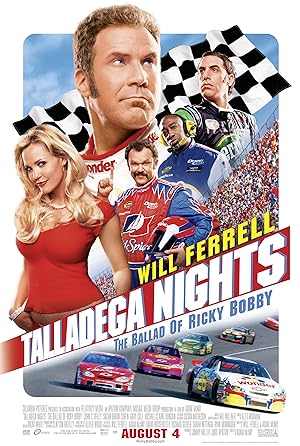
Talladega Nights: The Ballad of Ricky Bobby
NASCAR stock car racing sensation Ricky Bobby is a national hero because of his "win at all costs" approach. He and his loyal racing partner, childhood friend Cal Naughton Jr., are a fearless duo -- "Shake" and "Bake" by their fans for their ability to finish so many races in the #1 and #2 positions, with Cal always in second place. When flamboyant French Formula One driver Jean Girard challenges "Shake" and "Bake" for the supremacy of NASCAR, Ricky Bobby must face his own demons and fight Girard for the right to be known as racing's top driver.
Despite a moderate budget of $72.5M, Talladega Nights: The Ballad of Ricky Bobby became a box office success, earning $163.0M worldwide—a 125% return.
8 wins & 9 nominations


Plot Structure
Story beats plotted across runtime


Narrative Arc
Emotional journey through the story's key moments
Story Circle
Blueprint 15-beat structure
Arcplot Score Breakdown
Weighted: Precision (70%) + Arc (15%) + Theme (15%)
Talladega Nights: The Ballad of Ricky Bobby (2006) demonstrates precise narrative architecture, characteristic of Adam McKay's storytelling approach. This structural analysis examines how the film's 15-point plot structure maps to proven narrative frameworks across 1 hour and 48 minutes. With an Arcplot score of 6.9, the film balances conventional beats with creative variation.
Characters
Cast & narrative archetypes

Ricky Bobby
Cal Naughton Jr.
Jean Girard
Carley Bobby
Reese Bobby
Lucius Washington
Susan
Lucy Bobby
Main Cast & Characters
Ricky Bobby
Played by Will Ferrell
A NASCAR driver who rises to fame with his "if you ain't first, you're last" philosophy, then must rebuild himself after a career-ending crash scare.
Cal Naughton Jr.
Played by John C. Reilly
Ricky's loyal best friend and teammate who struggles with the conflict between friendship and his own ambitions.
Jean Girard
Played by Sacha Baron Cohen
A French Formula One driver who comes to NASCAR to prove himself, embodying sophistication and challenging Ricky's worldview.
Carley Bobby
Played by Leslie Bibb
Ricky's ambitious wife who leaves him when his success evaporates, revealing her materialistic nature.
Reese Bobby
Played by Gary Cole
Ricky's absentee father who returns to teach him the harsh lessons needed to overcome his psychological paralysis.
Lucius Washington
Played by Michael Clarke Duncan
Ricky's assistant who provides comic relief and remains loyal through Ricky's downfall and recovery.
Susan
Played by Amy Adams
Ricky's assistant and eventual love interest who sees his true worth beyond his fame and success.
Lucy Bobby
Played by Jane Lynch
Ricky's mother who enabled his immaturity and must deal with his regression after his crash.
Structural Analysis
The Status Quo at 1 minutes (1% through the runtime) establishes Young Ricky Bobby in class, father Reese arrives drunk telling him "If you're not first, you're last." Establishes Ricky's lifelong obsession with winning and speed.. Structural examination shows that this early placement immediately immerses viewers in the story world.
The inciting incident occurs at 12 minutes when Driver Terry Cheveaux is too intoxicated to race. Ricky volunteers to take the wheel, despite never having driven in a race. His chance at glory arrives unexpectedly.. At 12% through the film, this Disruption aligns precisely with traditional story structure. This beat shifts the emotional landscape, launching the protagonist into the central conflict.
The First Threshold at 27 minutes marks the transition into Act II, occurring at 25% of the runtime. This reveals the protagonist's commitment to Ricky fully commits to being "#1" and makes a deal with Cal: they'll work together with Ricky always winning first place and Cal taking second ("Shake and Bake"). Enters the celebrity NASCAR world completely., moving from reaction to action.
At 54 minutes, the Midpoint arrives at 50% of the runtime—precisely centered, creating perfect narrative symmetry. Significantly, this crucial beat During a race with Girard, Ricky crashes violently and catches fire. He runs around the track in his underwear thinking he's on fire (he's not). Public humiliation and psychological break. False defeat that changes everything., fundamentally raising what's at risk. The emotional intensity shifts, dividing the narrative into clear before-and-after phases.
The Collapse moment at 79 minutes (73% through) represents the emotional nadir. Here, Ricky's pizza delivery job interview ends in disaster when he has a panic attack in the car. He's hit absolute rock bottom - no career, no family, no identity, living with his mother, can't even deliver pizza., indicates the protagonist at their lowest point. This beat's placement in the final quarter sets up the climactic reversal.
The Second Threshold at 85 minutes initiates the final act resolution at 79% of the runtime. Ricky realizes his father's motto was nonsense and that he can race for the love of racing, not just to be first. He synthesizes his natural talent with newfound wisdom: it's okay to be second, third, or last., demonstrating the transformation achieved throughout the journey.
Emotional Journey
Talladega Nights: The Ballad of Ricky Bobby's emotional architecture traces a deliberate progression across 15 carefully calibrated beats.
Narrative Framework
This structural analysis employs a 15-point narrative structure framework that maps key story moments. By mapping Talladega Nights: The Ballad of Ricky Bobby against these established plot points, we can identify how Adam McKay utilizes or subverts traditional narrative conventions. The plot point approach reveals not only adherence to structural principles but also creative choices that distinguish Talladega Nights: The Ballad of Ricky Bobby within the comedy genre.
Adam McKay's Structural Approach
Among the 7 Adam McKay films analyzed on Arcplot, the average structural score is 7.2, reflecting strong command of classical structure. Talladega Nights: The Ballad of Ricky Bobby takes a more unconventional approach compared to the director's typical style. For comparative analysis, explore the complete Adam McKay filmography.
Comparative Analysis
Additional comedy films include The Bad Guys, Ella Enchanted and The Evening Star. For more Adam McKay analyses, see The Big Short, Vice and Anchorman: The Legend of Ron Burgundy.
Plot Points by Act
Act I
SetupStatus Quo
Young Ricky Bobby in class, father Reese arrives drunk telling him "If you're not first, you're last." Establishes Ricky's lifelong obsession with winning and speed.
Theme
Reese Bobby tells young Ricky: "If you're not first, you're last" - the warped philosophy that will drive and eventually destroy Ricky, until he learns winning isn't everything.
Worldbuilding
Adult Ricky is a pit crew member for Dennit Racing, married to Carly with two wild sons. Best friends with Cal Naughton Jr. Shows Ricky's world before stardom: working class, loyal, but unfulfilled.
Disruption
Driver Terry Cheveaux is too intoxicated to race. Ricky volunteers to take the wheel, despite never having driven in a race. His chance at glory arrives unexpectedly.
Resistance
Ricky debates whether to drive conservatively or go for the win. He chooses to race aggressively, wins, and becomes an overnight NASCAR sensation. Gets corporate sponsors, mansion, fame. Cal becomes his teammate.
Act II
ConfrontationFirst Threshold
Ricky fully commits to being "#1" and makes a deal with Cal: they'll work together with Ricky always winning first place and Cal taking second ("Shake and Bake"). Enters the celebrity NASCAR world completely.
Mirror World
French Formula One driver Jean Girard arrives as Ricky's antagonist and thematic opposite: cultured, intellectual, secure in himself. Represents everything Ricky isn't but needs to learn.
Premise
The promise of the premise: Ricky Bobby as unstoppable NASCAR champion. Absurd sponsorships, ridiculous press conferences, luxurious lifestyle, hilarious family dinners. The comedy of unchecked ego and success.
Midpoint
During a race with Girard, Ricky crashes violently and catches fire. He runs around the track in his underwear thinking he's on fire (he's not). Public humiliation and psychological break. False defeat that changes everything.
Opposition
Ricky develops psychosomatic paralysis and fear of driving. Loses everything: sponsorships, wife Carly (who starts dating Cal), house, career. Moves in with his mother. Attempts comeback fail miserably. His flaws and fears consume him.
Collapse
Ricky's pizza delivery job interview ends in disaster when he has a panic attack in the car. He's hit absolute rock bottom - no career, no family, no identity, living with his mother, can't even deliver pizza.
Crisis
Ricky wallows in defeat until his estranged father Reese returns. Through unorthodox and dangerous "therapy," Reese forces Ricky to confront his fears and reveals the truth: "If you're not first, you're last" was meaningless drunk talk.
Act III
ResolutionSecond Threshold
Ricky realizes his father's motto was nonsense and that he can race for the love of racing, not just to be first. He synthesizes his natural talent with newfound wisdom: it's okay to be second, third, or last.
Synthesis
Ricky returns to NASCAR, confronts Girard and Cal in the final race. Intense three-way battle where Ricky races fearlessly but without ego. He and Cal reconcile. Ricky crosses finish line on foot after crash, making peace with not winning.
Transformation
Ricky and Cal race go-karts with Ricky's sons, laughing and enjoying the pure fun of racing. No sponsors, no glory, just joy. Mirrors opening but shows transformation: he's learned winning isn't everything, relationships and passion matter more.