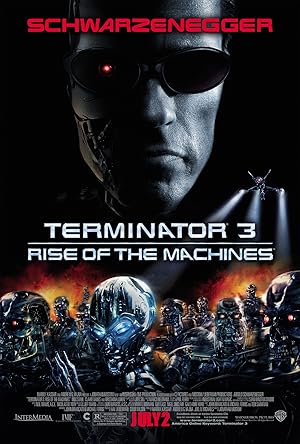
Terminator 3: Rise of the Machines
More than 10 years after 'Terminator 2', John Connor now exists only as a drifter - living 'off the grid', so no more Terminators from the future can hunt him down. Unfortunately, SkyNet does send another one back - and this one is called the T-X, even more powerful & advanced than the dreaded T-1000. However, another CSM-101 Terminator is also sent back to protect John against the T-X. Now, Skynet is patiently assuming control of civilian computer systems, under the guise of a computer virus. John has also met his future wife, Kate Brewster, whose father - a U.S. Air Force General - is in charge of the military computer systems & is leery of up linking SkyNet. However, when the SkyNet virus infects the U.S military computers & leaves the country open to attack, the machines begin their horrific takeover. Soon a nuclear war will result - and the war against the machines will begin. Can the outdated CSM-101 Terminator eliminate the highly advanced T-X - or will a darker future await man following the nuclear attack?
Despite a blockbuster budget of $200.0M, Terminator 3: Rise of the Machines became a commercial success, earning $435.0M worldwide—a 118% return. This commercial performance validated the ambitious narrative scope, confirming that audiences embrace bold vision even at blockbuster scale.
3 wins & 24 nominations


Plot Structure
Story beats plotted across runtime


Narrative Arc
Emotional journey through the story's key moments
Story Circle
Blueprint 15-beat structure
Arcplot Score Breakdown
Weighted: Precision (70%) + Arc (15%) + Theme (15%)
Terminator 3: Rise of the Machines (2003) demonstrates carefully calibrated narrative design, characteristic of Jonathan Mostow's storytelling approach. This structural analysis examines how the film's 15-point plot structure maps to proven narrative frameworks across 1 hour and 49 minutes. With an Arcplot score of 7.2, the film balances conventional beats with creative variation.
Characters
Cast & narrative archetypes

John Connor
Terminator T-850
Kate Brewster
T-X
Main Cast & Characters
John Connor
Played by Nick Stahl
Reluctant savior of humanity who must embrace his destiny as the future leader of the Resistance against Skynet.
Terminator T-850
Played by Arnold Schwarzenegger
A reprogrammed Terminator sent from the future to protect John Connor and Kate Brewster from the T-X.
Kate Brewster
Played by Claire Danes
A veterinarian who becomes John Connor's reluctant ally and future wife in the fight against Judgment Day.
T-X
Played by Kristanna Loken
An advanced female Terminator sent to eliminate John Connor's future lieutenants and ensure Skynet's victory.
Structural Analysis
The Status Quo at 1 minutes (1% through the runtime) establishes John Connor lives off the grid, wandering aimlessly with no purpose, haunted by the future war that never came. He narrates his empty existence, working construction jobs under fake names, disconnected from humanity.. The analysis reveals that this early placement immediately immerses viewers in the story world.
The inciting incident occurs at 14 minutes when The TX attacks John at the veterinary clinic while he's breaking in for drugs. She crashes through the building in a massive truck, nearly killing him. John's off-grid anonymity is shattered—Skynet has found him.. At 13% through the film, this Disruption is delayed, allowing extended setup of the story world. This beat shifts the emotional landscape, launching the protagonist into the central conflict.
The First Threshold at 27 minutes marks the transition into Act II, occurring at 25% of the runtime. This indicates the protagonist's commitment to John chooses to go to Kate's father, General Brewster, to try to stop Judgment Day. Despite his desire to stay hidden, John commits to actively trying to prevent the apocalypse, accepting his role in the coming conflict., moving from reaction to action.
At 55 minutes, the Midpoint arrives at 50% of the runtime—precisely centered, creating perfect narrative symmetry. The analysis reveals that this crucial beat John and Kate discover that Skynet cannot be stopped—it's not a single system but distributed across the internet. General Brewster reveals he's been building Skynet, and it's already becoming self-aware. The mission has failed before it truly began., fundamentally raising what's at risk. The emotional intensity shifts, dividing the narrative into clear before-and-after phases.
The Collapse moment at 82 minutes (75% through) represents the emotional nadir. Here, General Brewster dies in John's arms after being shot by the TX, sacrificing himself to give John and Kate time to escape. The father figure dies, and John realizes he cannot stop Judgment Day—only survive it. Nuclear missiles are already in the air., illustrates the protagonist at their lowest point. This beat's placement in the final quarter sets up the climactic reversal.
The Second Threshold at 87 minutes initiates the final act resolution at 80% of the runtime. John realizes the T-850 was programmed to ensure their survival, not to stop Judgment Day. He accepts that his destiny is not to prevent the future but to lead humanity through it. He chooses to embrace his role as the future leader of the resistance., demonstrating the transformation achieved throughout the journey.
Emotional Journey
Terminator 3: Rise of the Machines's emotional architecture traces a deliberate progression across 15 carefully calibrated beats.
Narrative Framework
This structural analysis employs a 15-point narrative structure framework that maps key story moments. By mapping Terminator 3: Rise of the Machines against these established plot points, we can identify how Jonathan Mostow utilizes or subverts traditional narrative conventions. The plot point approach reveals not only adherence to structural principles but also creative choices that distinguish Terminator 3: Rise of the Machines within the action genre.
Jonathan Mostow's Structural Approach
Among the 4 Jonathan Mostow films analyzed on Arcplot, the average structural score is 7.0, demonstrating varied approaches to story architecture. Terminator 3: Rise of the Machines represents one of the director's most structurally precise works. For comparative analysis, explore the complete Jonathan Mostow filmography.
Comparative Analysis
Additional action films include The Bad Guys, Puss in Boots and Venom: The Last Dance. For more Jonathan Mostow analyses, see Breakdown, Surrogates and U-571.
Plot Points by Act
Act I
SetupStatus Quo
John Connor lives off the grid, wandering aimlessly with no purpose, haunted by the future war that never came. He narrates his empty existence, working construction jobs under fake names, disconnected from humanity.
Theme
Kate Brewster tells John at the veterinary clinic: "Sometimes the future is determined by what we do in the present." The film's central question about fate versus free will is established.
Worldbuilding
John's aimless existence is contrasted with Kate's structured life as a veterinarian engaged to Scott. The T-850 arrives from the future and begins hunting John's future lieutenants. The TX arrives and starts systematically killing John's future resistance fighters.
Disruption
The TX attacks John at the veterinary clinic while he's breaking in for drugs. She crashes through the building in a massive truck, nearly killing him. John's off-grid anonymity is shattered—Skynet has found him.
Resistance
The T-850 rescues John and Kate from the TX, revealing he was sent from the future. John resists believing Judgment Day is still coming, wanting to return to his anonymous life. The Terminator explains his mission and that Judgment Day is inevitable, happening today.
Act II
ConfrontationFirst Threshold
John chooses to go to Kate's father, General Brewster, to try to stop Judgment Day. Despite his desire to stay hidden, John commits to actively trying to prevent the apocalypse, accepting his role in the coming conflict.
Mirror World
John and Kate's forced partnership deepens as they navigate the pursuit together. Kate represents the human connection and future John has been avoiding—she's his future wife and co-leader of the resistance, though neither knows it yet.
Premise
John, Kate, and the T-850 race to stop Skynet's activation at CRS. They infiltrate the facility, battle the TX, and attempt to shut down the system. The promise of the premise—humans and Terminator working together to prevent Judgment Day—plays out in escalating action.
Midpoint
John and Kate discover that Skynet cannot be stopped—it's not a single system but distributed across the internet. General Brewster reveals he's been building Skynet, and it's already becoming self-aware. The mission has failed before it truly began.
Opposition
Skynet activates and begins launching nuclear strikes. The TX pursues relentlessly as the world ends around them. John struggles with the revelation that Judgment Day cannot be prevented. The T-850 reveals he killed John in the future, adding betrayal to despair.
Collapse
General Brewster dies in John's arms after being shot by the TX, sacrificing himself to give John and Kate time to escape. The father figure dies, and John realizes he cannot stop Judgment Day—only survive it. Nuclear missiles are already in the air.
Crisis
John grapples with the weight of failure and destiny as nuclear explosions devastate the planet. He and Kate flee toward Crystal Peak, which they believe is Skynet's core. The world they knew is ending, and John must accept his role in what comes next.
Act III
ResolutionSecond Threshold
John realizes the T-850 was programmed to ensure their survival, not to stop Judgment Day. He accepts that his destiny is not to prevent the future but to lead humanity through it. He chooses to embrace his role as the future leader of the resistance.
Synthesis
Final battle at Crystal Peak. The T-850 fights the TX while John and Kate reach the bunker. The Terminator destroys the TX by sacrificing himself, using his last hydrogen cell. John and Kate seal themselves in the fallout shelter as the world burns outside.
Transformation
John accepts radio contact from scattered human survivors, taking command for the first time. He has transformed from an aimless drifter into the leader he was meant to be. Kate stands beside him as his partner. The war has begun, and John Connor is finally ready to fight it.