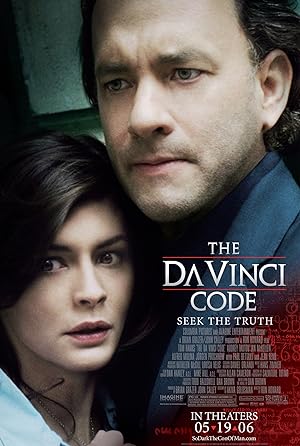
The Da Vinci Code
Dan Brown's controversial best-selling novel about a powerful secret that's been kept under wraps for thousands of years comes to the screen in this suspense thriller from Director Ron Howard. The stately silence of Paris' Louvre museum is broken when one of the gallery's leading curators is found dead on the grounds, with strange symbols carved into his body and left around the spot where he died. Hoping to learn the significance of the symbols, police bring in Sophie Neveu (Audrey Tautou), a gifted cryptographer who is also the victim's granddaughter. Needing help, Sophie calls on Robert Langdon (Tom Hanks), a leading symbologist from the United States. As Sophie and Robert dig deeper into the case, they discover the victim's involvement in the Priory of Sion, a secret society whose members have been privy to forbidden knowledge dating back to the birth of Christianity. In their search, Sophie and Robert happen upon evidence that could lead to the final resting place of the Holy Grail, while members of the priory and an underground Catholic society known as Opus Dei give chase, determined to prevent them from sharing their greatest secrets with the world.
Despite a substantial budget of $125.0M, The Da Vinci Code became a massive hit, earning $760.0M worldwide—a remarkable 508% return.
8 wins & 21 nominations


Plot Structure
Story beats plotted across runtime


Narrative Arc
Emotional journey through the story's key moments
Story Circle
Blueprint 15-beat structure
Arcplot Score Breakdown
Weighted: Precision (70%) + Arc (15%) + Theme (15%)
The Da Vinci Code (2006) reveals deliberately positioned dramatic framework, characteristic of Ron Howard's storytelling approach. This structural analysis examines how the film's 15-point plot structure maps to proven narrative frameworks across 2 hours and 29 minutes. With an Arcplot score of 7.1, the film balances conventional beats with creative variation.
Characters
Cast & narrative archetypes

Robert Langdon
Sophie Neveu
Leigh Teabing
Silas
Bishop Aringarosa
Captain Bezu Fache
Main Cast & Characters
Robert Langdon
Played by Tom Hanks
Harvard symbologist drawn into a murder mystery at the Louvre that leads to discoveries about the Holy Grail and early Christianity.
Sophie Neveu
Played by Audrey Tautou
French cryptologist and granddaughter of Jacques Saunière who teams with Langdon to uncover her grandfather's secrets.
Leigh Teabing
Played by Ian McKellen
Wealthy British Royal Historian and Grail scholar who aids Langdon and Sophie in their quest for the truth.
Silas
Played by Paul Bettany
Albino monk and assassin working for Opus Dei, driven by faith and a desire for redemption through violence.
Bishop Aringarosa
Played by Alfred Molina
Leader of Opus Dei who orchestrates the conspiracy to protect the Church's secrets.
Captain Bezu Fache
Played by Jean Reno
Tenacious French police captain convinced Langdon is guilty of murder at the Louvre.
Structural Analysis
The Status Quo at 1 minutes (1% through the runtime) establishes Robert Langdon gives a lecture on symbols at the American University of Paris, establishing his expertise in religious symbology and his comfortable academic life.. The analysis reveals that this early placement immediately immerses viewers in the story world.
The inciting incident occurs at 17 minutes when Captain Fache summons Langdon to the Louvre crime scene, revealing that Saunière left a dying message naming Langdon - making him the prime suspect in a murder investigation.. At 12% through the film, this Disruption aligns precisely with traditional story structure. This beat shifts the emotional landscape, launching the protagonist into the central conflict.
The First Threshold at 34 minutes marks the transition into Act II, occurring at 23% of the runtime. This reveals the protagonist's commitment to Langdon makes the active choice to flee with Sophie from the Louvre, evading Fache's surveillance. He commits to helping her solve her grandfather's puzzle, becoming a fugitive and crossing into the world of conspiracy., moving from reaction to action.
At 73 minutes, the Midpoint arrives at 49% of the runtime—precisely centered, creating perfect narrative symmetry. Of particular interest, this crucial beat Langdon and Sophie arrive at Château Villette and meet Sir Leigh Teabing, who reveals the central conspiracy: the Holy Grail is not a cup but Mary Magdalene, who carried Christ's bloodline. This false victory gives them a powerful ally and seemingly crucial knowledge, but Teabing has his own agenda., fundamentally raising what's at risk. The emotional intensity shifts, dividing the narrative into clear before-and-after phases.
The Collapse moment at 111 minutes (75% through) represents the emotional nadir. Here, The devastating betrayal: Sir Leigh Teabing is revealed as the Teacher, the mastermind behind everything including Saunière's murder. He holds Langdon and Sophie at gunpoint, willing to kill to possess the Grail. Their trusted ally becomes their greatest threat - a whiff of death as friendship dies and Langdon faces execution., demonstrates the protagonist at their lowest point. This beat's placement in the final quarter sets up the climactic reversal.
The Second Threshold at 119 minutes initiates the final act resolution at 80% of the runtime. Langdon synthesizes his knowledge and makes a crucial realization. He seemingly solves the cryptex but throws it into the air, causing Teabing to lunge for it. The cryptex shatters - but Langdon had already removed and memorized the true clue. His intellectual mastery defeats brute force., demonstrating the transformation achieved throughout the journey.
Emotional Journey
The Da Vinci Code's emotional architecture traces a deliberate progression across 15 carefully calibrated beats.
Narrative Framework
This structural analysis employs systematic plot point analysis that identifies crucial turning points. By mapping The Da Vinci Code against these established plot points, we can identify how Ron Howard utilizes or subverts traditional narrative conventions. The plot point approach reveals not only adherence to structural principles but also creative choices that distinguish The Da Vinci Code within the mystery genre.
Ron Howard's Structural Approach
Among the 24 Ron Howard films analyzed on Arcplot, the average structural score is 7.0, demonstrating varied approaches to story architecture. The Da Vinci Code represents one of the director's most structurally precise works. For comparative analysis, explore the complete Ron Howard filmography.
Comparative Analysis
Additional mystery films include Lone Star, The Wicker Man and A Soldier's Story. For more Ron Howard analyses, see Apollo 13, Solo: A Star Wars Story and Cinderella Man.
Plot Points by Act
Act I
SetupStatus Quo
Robert Langdon gives a lecture on symbols at the American University of Paris, establishing his expertise in religious symbology and his comfortable academic life.
Theme
The dying Jacques Saunière arranges his body in the pose of Da Vinci's Vitruvian Man and writes cryptic messages, establishing the theme: sacred truths are hidden in plain sight, and faith requires questioning established narratives.
Worldbuilding
We establish Langdon's world as a respected symbologist, the Louvre's grandeur, the mysterious murder of Jacques Saunière, and the introduction of the DCPJ investigation led by Captain Fache who suspects Langdon.
Disruption
Captain Fache summons Langdon to the Louvre crime scene, revealing that Saunière left a dying message naming Langdon - making him the prime suspect in a murder investigation.
Resistance
Langdon examines the crime scene clues. Sophie Neveu, DCPJ cryptologist and Saunière's estranged granddaughter, arrives and secretly warns Langdon that Fache believes he is guilty. She reveals she can prove his innocence if he helps her decode her grandfather's message.
Act II
ConfrontationFirst Threshold
Langdon makes the active choice to flee with Sophie from the Louvre, evading Fache's surveillance. He commits to helping her solve her grandfather's puzzle, becoming a fugitive and crossing into the world of conspiracy.
Mirror World
Sophie reveals her estrangement from her grandfather after witnessing a secret ritual, and shares her personal stake in the mystery. Her relationship with Langdon becomes the emotional throughline - she seeks understanding while he provides intellectual analysis, together embodying faith and reason.
Premise
The promise of the premise unfolds: Langdon and Sophie decode clue after clue - the cryptex, the Fibonacci sequence, anagrams. They visit the Swiss bank, retrieve the keystone, and discover the Priory of Sion's secrets. Meanwhile, Silas the albino monk pursues them under orders from the Teacher.
Midpoint
Langdon and Sophie arrive at Château Villette and meet Sir Leigh Teabing, who reveals the central conspiracy: the Holy Grail is not a cup but Mary Magdalene, who carried Christ's bloodline. This false victory gives them a powerful ally and seemingly crucial knowledge, but Teabing has his own agenda.
Opposition
The stakes escalate as multiple forces close in. Silas attacks Teabing's estate. The trio escapes to London by private plane. Bishop Aringarosa coordinates with the Teacher. Fache pursues them across borders. They investigate Temple Church and Westminster Abbey, decoding more clues while evading capture.
Collapse
The devastating betrayal: Sir Leigh Teabing is revealed as the Teacher, the mastermind behind everything including Saunière's murder. He holds Langdon and Sophie at gunpoint, willing to kill to possess the Grail. Their trusted ally becomes their greatest threat - a whiff of death as friendship dies and Langdon faces execution.
Crisis
Teabing forces Langdon to solve the final cryptex puzzle at gunpoint. Sophie is held hostage. Langdon must process the betrayal while buying time. The emotional darkness of facing mortality and having trusted the wrong person weighs on both protagonists.
Act III
ResolutionSecond Threshold
Langdon synthesizes his knowledge and makes a crucial realization. He seemingly solves the cryptex but throws it into the air, causing Teabing to lunge for it. The cryptex shatters - but Langdon had already removed and memorized the true clue. His intellectual mastery defeats brute force.
Synthesis
Teabing is arrested by Fache, who now knows Langdon is innocent. Silas dies in Aringarosa's arms, a victim of manipulation. Langdon follows the final clue to Rosslyn Chapel in Scotland, where Sophie discovers she is a living descendant of Christ's bloodline. The mystery resolves as Sophie finds living family and her heritage.
Transformation
Langdon returns to Paris and realizes the final truth: the Grail rests beneath the Louvre pyramid. He kneels in reverence at the hidden tomb of Mary Magdalene. The academic skeptic has transformed into a man of faith - not in doctrine, but in the sacred mystery itself. The symbol-reader now believes in what symbols protect.