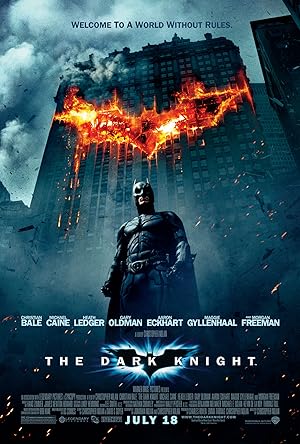
The Dark Knight
Set within a year after the events of Batman Begins (2005), Batman, Lieutenant James Gordon, and new District Attorney Harvey Dent successfully begin to round up the criminals that plague Gotham City, until a mysterious and sadistic criminal mastermind known only as "The Joker" appears in Gotham, creating a new wave of chaos. Batman's struggle against The Joker becomes deeply personal, forcing him to "confront everything he believes" and improve his technology to stop him. A love triangle develops between Bruce Wayne, Dent, and Rachel Dawes.
Despite a blockbuster budget of $185.0M, The Dark Knight became a box office success, earning $1004.6M worldwide—a 443% return. This commercial performance validated the ambitious narrative scope, illustrating how audiences embrace distinctive approach even at blockbuster scale.
2 Oscars. 163 wins & 165 nominations
Roger Ebert
"The Dark Knight creates a haunted world of desperation, in which Bruce Wayne seems to see his city sliding into anarchy, and must become Batman to save it."Read Full Review


Plot Structure
Story beats plotted across runtime


Narrative Arc
Emotional journey through the story's key moments
Story Circle
Blueprint 15-beat structure
Arcplot Score Breakdown
Weighted: Precision (70%) + Arc (15%) + Theme (15%)
The Dark Knight (2008) exemplifies precise dramatic framework, characteristic of Christopher Nolan's storytelling approach. This structural analysis examines how the film's 15-point plot structure maps to proven narrative frameworks across 2 hours and 32 minutes. With an Arcplot score of 7.4, the film balances conventional beats with creative variation.
Characters
Cast & narrative archetypes

Bruce Wayne / Batman
The Joker
Harvey Dent / Two-Face
Rachel Dawes
Alfred Pennyworth
Lucius Fox
James Gordon
Main Cast & Characters
Bruce Wayne / Batman
Played by Christian Bale
Gotham's vigilante hero struggling to maintain order while facing his greatest moral challenge from the Joker.
The Joker
Played by Heath Ledger
Anarchic criminal mastermind who seeks to prove that anyone can be corrupted and that civilization is a thin veneer over chaos.
Harvey Dent / Two-Face
Played by Aaron Eckhart
Gotham's idealistic district attorney whose fall from grace becomes the Joker's ultimate proof of corruption.
Rachel Dawes
Played by Maggie Gyllenhaal
Assistant DA and Bruce's childhood love, caught between Bruce and Harvey while fighting for Gotham's soul.
Alfred Pennyworth
Played by Michael Caine
Bruce's loyal butler and moral compass, offering wisdom and challenging Bruce's methods.
Lucius Fox
Played by Morgan Freeman
Wayne Enterprises executive who provides Batman with technology while maintaining ethical boundaries.
James Gordon
Played by Gary Oldman
Gotham's principled police lieutenant who allies with Batman to fight corruption and the Joker.
Structural Analysis
The Status Quo at 1 minutes (1% through the runtime) establishes The Joker's bank heist reveals Gotham's new criminal landscape. Masked clowns systematically eliminate each other while robbing a mob bank, establishing a city where even criminals fear a new kind of chaos.. Of particular interest, this early placement immediately immerses viewers in the story world.
The inciting incident occurs at 17 minutes when The Joker crashes the mob meeting and offers to kill Batman for half their money. His chaotic philosophy directly challenges the organized crime structure and forces both criminals and heroes to respond to an unprecedented threat.. At 11% through the film, this Disruption aligns precisely with traditional story structure. This beat shifts the emotional landscape, launching the protagonist into the central conflict.
The First Threshold at 33 minutes marks the transition into Act II, occurring at 22% of the runtime. This demonstrates the protagonist's commitment to Batman makes the active choice to go to Hong Kong and extract Lau, the mob's accountant, bringing him back to Gotham for prosecution. This aggressive move outside his jurisdiction commits him fully to dismantling the criminal empire., moving from reaction to action.
At 67 minutes, the Midpoint arrives at 44% of the runtime—arriving early, accelerating into Act IIb complications. Of particular interest, this crucial beat The Joker's ultimatum forces Harvey to publicly claim he is Batman, sacrificing himself to draw out the Joker. This false victory creates the conditions for tragedy—Harvey is captured, and Rachel is taken, setting up the impossible choice., fundamentally raising what's at risk. The emotional intensity shifts, dividing the narrative into clear before-and-after phases.
The Collapse moment at 100 minutes (66% through) represents the emotional nadir. Here, Harvey Dent completes his transformation into Two-Face, killing the corrupt cops responsible for Rachel's death. Gotham's white knight has fallen. The Joker visits Harvey in the hospital and convinces him to embrace chaos and revenge., indicates the protagonist at their lowest point. This beat's placement in the final quarter sets up the climactic reversal.
The Second Threshold at 108 minutes initiates the final act resolution at 71% of the runtime. Batman realizes the Joker's endgame involves the ferries and deploys his controversial sonar surveillance system to find him. Despite Lucius Fox's moral objections, Batman commits to using any means necessary to stop the Joker's final attack., demonstrating the transformation achieved throughout the journey.
Emotional Journey
The Dark Knight's emotional architecture traces a deliberate progression across 15 carefully calibrated beats.
Narrative Framework
This structural analysis employs systematic plot point analysis that identifies crucial turning points. By mapping The Dark Knight against these established plot points, we can identify how Christopher Nolan utilizes or subverts traditional narrative conventions. The plot point approach reveals not only adherence to structural principles but also creative choices that distinguish The Dark Knight within the action genre.
Christopher Nolan's Structural Approach
Among the 11 Christopher Nolan films analyzed on Arcplot, the average structural score is 7.3, reflecting strong command of classical structure. The Dark Knight represents one of the director's most structurally precise works. For comparative analysis, explore the complete Christopher Nolan filmography.
Comparative Analysis
Additional action films include The Bad Guys, Puss in Boots and Venom: The Last Dance. For more Christopher Nolan analyses, see Oppenheimer, Interstellar and Dunkirk.
Plot Points by Act
Act I
SetupStatus Quo
The Joker's bank heist reveals Gotham's new criminal landscape. Masked clowns systematically eliminate each other while robbing a mob bank, establishing a city where even criminals fear a new kind of chaos.
Theme
Alfred tells Bruce about the Burmese bandit who couldn't be bought or reasoned with: "Some men just want to watch the world burn." This establishes the central question of how a hero with rules defeats an enemy without them.
Worldbuilding
Gotham's power structure is established: Batman disrupts mob operations, Gordon leads the Major Crimes Unit, and Harvey Dent emerges as the crusading DA. Bruce sees Harvey as Gotham's potential savior who could allow Batman to retire.
Disruption
The Joker crashes the mob meeting and offers to kill Batman for half their money. His chaotic philosophy directly challenges the organized crime structure and forces both criminals and heroes to respond to an unprecedented threat.
Resistance
Batman, Gordon, and Dent form an uneasy alliance. Bruce debates whether Harvey could be the hero Gotham needs, potentially freeing him to pursue a normal life with Rachel. The Joker begins targeting officials who won't be corrupted.
Act II
ConfrontationFirst Threshold
Batman makes the active choice to go to Hong Kong and extract Lau, the mob's accountant, bringing him back to Gotham for prosecution. This aggressive move outside his jurisdiction commits him fully to dismantling the criminal empire.
Mirror World
Harvey Dent's dual nature is revealed through his lucky coin and his relationship with Rachel. He represents the public hero Bruce wishes he could be—operating in daylight, with a face and a name, beloved by Gotham.
Premise
The trinity of Batman, Gordon, and Dent systematically dismantles the mob. Simultaneously, the Joker escalates his campaign of chaos—assassinating officials, threatening the mayor, and forcing Batman into impossible choices with escalating ultimatums.
Midpoint
The Joker's ultimatum forces Harvey to publicly claim he is Batman, sacrificing himself to draw out the Joker. This false victory creates the conditions for tragedy—Harvey is captured, and Rachel is taken, setting up the impossible choice.
Opposition
The Joker's trap forces Batman to choose between saving Harvey or Rachel. Batman goes for Rachel but finds Harvey instead—the Joker switched the addresses. Rachel dies, Harvey is disfigured, and the Joker escapes from custody after corrupting cops.
Collapse
Harvey Dent completes his transformation into Two-Face, killing the corrupt cops responsible for Rachel's death. Gotham's white knight has fallen. The Joker visits Harvey in the hospital and convinces him to embrace chaos and revenge.
Crisis
Batman grapples with his failure to save Rachel and protect Harvey. The Joker threatens to blow up a hospital unless Coleman Reese is killed, demonstrating how easily Gotham's citizens can be turned against each other.
Act III
ResolutionSecond Threshold
Batman realizes the Joker's endgame involves the ferries and deploys his controversial sonar surveillance system to find him. Despite Lucius Fox's moral objections, Batman commits to using any means necessary to stop the Joker's final attack.
Synthesis
The ferry experiment fails—neither civilians nor prisoners choose to kill the other, proving the Joker wrong about human nature. Batman defeats the Joker but must confront Two-Face, who has taken Gordon's family hostage to make him feel his loss.
Transformation
Batman kills Two-Face to save Gordon's son and chooses to take the blame for Harvey's crimes. He becomes the Dark Knight—a villain in the eyes of Gotham—so that Harvey Dent can remain a symbol of hope. The hero Gotham deserves, not the one it needs.