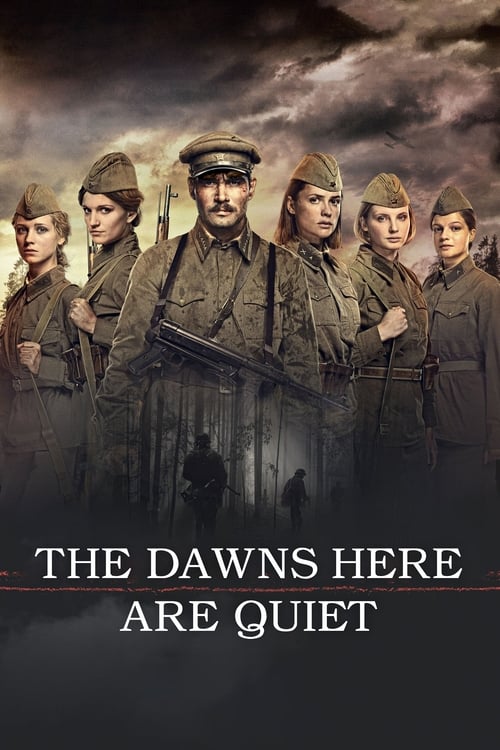
The Dawns Here Are Quiet
It is late spring of 1942, and the Great Patriotic War is in full swing. A long way off from the front-line, at some God-forgotten junction, the Germans make an air landing operation in an attempt to get through to the Kirov railway and the White Sea - the Baltic Sea Canal. These aren't just ordinary paratroopers. This is a team of seasoned and highly trained infiltrators, the elite of the Waffen-SS, superhumans. The only thing in their way is an anti-aircraft artillery unit of corporal Vaskov and five young women in training. It may seem like a fight of local significance, but the countrys main strategic transportation artery is at stake. Can the corporal and his 'petite newbies' prevent Nazi sabotage and at what cost? Television version: An extended version made out of four 45 minute episodes was released on Channel One Russia, on 9 May 2016. Available on PrimeVideo.
Working with a small-scale budget of $3.3M, the film achieved a modest success with $5.2M in global revenue (+59% profit margin).

Plot Structure
Story beats plotted across runtime


Narrative Arc
Emotional journey through the story's key moments
Story Circle
Blueprint 15-beat structure
Arcplot Score Breakdown
Weighted: Precision (70%) + Arc (15%) + Theme (15%)
The Dawns Here Are Quiet (2015) demonstrates precise dramatic framework, characteristic of Renat Davletyarov's storytelling approach. This structural analysis examines how the film's 15-point plot structure maps to proven narrative frameworks across 1 hour and 51 minutes. With an Arcplot score of 7.3, the film balances conventional beats with creative variation.
Characters
Cast & narrative archetypes

Fedot Vaskov
Rita Osyanina
Zhenya Komelkova
Sonya Gurvich
Galya Chetvertak
Lisa Brichkina
Main Cast & Characters
Fedot Vaskov
Played by Pyotr Fyodorov
A gruff senior sergeant who leads five young women on a mission against German paratroopers in the Karelian forests during WWII.
Rita Osyanina
Played by Anastasiya Mikulchina
A young widow and sniper, fiercely determined and protective of her young son. The most experienced soldier among the women.
Zhenya Komelkova
Played by Sofya Lebedeva
A beautiful, vivacious girl with a tragic past who uses humor and charm to mask her pain. Acts as the group's morale booster.
Sonya Gurvich
Played by Kristina Asmus
An intellectual, bookish girl from Moscow who quotes poetry and dreams of peacetime. The most idealistic of the group.
Galya Chetvertak
Played by Agniya Kuznetsova
A naive, innocent country girl who longs for her mother and struggles with the harsh realities of war.
Lisa Brichkina
Played by Evgeniya Malakhova
A shy, nature-loving girl raised in the forest who serves as the group's best scout and tracker.
Structural Analysis
The Status Quo at 2 minutes (2% through the runtime) establishes The remote anti-aircraft post in the Karelian forests, 1942. Sergeant Vaskov's garrison of rowdy male soldiers is shown before his request for replacements, establishing the isolation and mundane routine of this backwater posting far from the front lines.. Of particular interest, this early placement immediately immerses viewers in the story world.
The inciting incident occurs at 14 minutes when Liza spots two German paratroopers in the forest during her morning routine. She reports to Vaskov, shattering the illusion that their remote post is safely removed from real combat. The enemy has arrived at their doorstep.. At 12% through the film, this Disruption aligns precisely with traditional story structure. This beat shifts the emotional landscape, launching the protagonist into the central conflict.
The First Threshold at 28 minutes marks the transition into Act II, occurring at 25% of the runtime. This reveals the protagonist's commitment to Vaskov and his five soldiers depart the relative safety of the garrison and venture into the forest to intercept the Germans. The decision to pursue with such a small force—especially untested women soldiers—is Vaskov's irreversible choice that launches them into deadly territory., moving from reaction to action.
At 56 minutes, the Midpoint arrives at 50% of the runtime—precisely centered, creating perfect narrative symmetry. Of particular interest, this crucial beat Vaskov discovers the Germans number sixteen, not two—a full sabotage squad, not scouts. They are massively outgunned. This false defeat transforms an interception mission into a desperate last stand. Vaskov realizes he may have led these women to their deaths, but retreat is no longer possible; they must hold the enemy or die trying., fundamentally raising what's at risk. The emotional intensity shifts, dividing the narrative into clear before-and-after phases.
The Collapse moment at 83 minutes (75% through) represents the emotional nadir. Here, Zhenya, the fierce and beautiful fighter who seemed invincible, makes a last stand to draw fire from Vaskov. She walks out singing, drawing German fire, and is cut down by multiple bullets. Her death—the most vibrant and vengeful of them all, silenced—represents the complete collapse of hope. Only Vaskov and the wounded Rita remain., indicates the protagonist at their lowest point. This beat's placement in the final quarter sets up the climactic reversal.
The Second Threshold at 90 minutes initiates the final act resolution at 81% of the runtime. Vaskov, wounded and grief-stricken, finds renewed purpose in the women's sacrifice. He realizes their deaths cannot be in vain—he must complete the mission alone. Armed with their memory and fueled by rage, he transforms from protector to avenger, determined to stop every last German., demonstrating the transformation achieved throughout the journey.
Emotional Journey
The Dawns Here Are Quiet's emotional architecture traces a deliberate progression across 15 carefully calibrated beats.
Narrative Framework
This structural analysis employs proven narrative structure principles that track dramatic progression. By mapping The Dawns Here Are Quiet against these established plot points, we can identify how Renat Davletyarov utilizes or subverts traditional narrative conventions. The plot point approach reveals not only adherence to structural principles but also creative choices that distinguish The Dawns Here Are Quiet within the drama genre.
Comparative Analysis
Additional drama films include After Thomas, South Pacific and Dirty Dancing: Havana Nights.
Plot Points by Act
Act I
SetupStatus Quo
The remote anti-aircraft post in the Karelian forests, 1942. Sergeant Vaskov's garrison of rowdy male soldiers is shown before his request for replacements, establishing the isolation and mundane routine of this backwater posting far from the front lines.
Theme
Vaskov remarks to headquarters that he needs soldiers who will follow orders, not cause trouble—he gets women instead. The underlying theme emerges: the brutal cost of war falls on everyone, especially the young and innocent, and heroism is found in the most unexpected places.
Worldbuilding
Introduction of the five female anti-aircraft gunners: Zhenya Komelkova, the beautiful redhead with a personal vendetta; Rita Osyanina, the serious widow and secret mother; Galya Chetvertak, the timid orphan; Sonya Gurvich, the Jewish intellectual; and Liza Brichkina, the country girl dreaming of education. Their backstories, personalities, and wartime traumas are established through flashbacks and camp interactions.
Disruption
Liza spots two German paratroopers in the forest during her morning routine. She reports to Vaskov, shattering the illusion that their remote post is safely removed from real combat. The enemy has arrived at their doorstep.
Resistance
Vaskov debates how to respond to the threat. He considers sending for reinforcements but realizes the Germans may escape by then. He selects five of his best soldiers—Zhenya, Rita, Liza, Sonya, and Galya—to intercept the enemy. The women prepare for the mission, unaware of the danger ahead. Vaskov struggles with leading women into potential combat.
Act II
ConfrontationFirst Threshold
Vaskov and his five soldiers depart the relative safety of the garrison and venture into the forest to intercept the Germans. The decision to pursue with such a small force—especially untested women soldiers—is Vaskov's irreversible choice that launches them into deadly territory.
Mirror World
During their forest journey, the women share stories and dreams around a brief rest. Rita reveals she has a young son she's protecting by fighting; Zhenya shares her burning hatred for Germans who killed her family. These intimate moments forge bonds between the characters and Vaskov, transforming them from soldiers into family—humanizing those who will soon be sacrificed.
Premise
The cat-and-mouse pursuit through the Karelian wilderness. Vaskov leads his small unit to cut off the German saboteurs, using his knowledge of the terrain. The women prove capable and brave, tracking the enemy, setting up ambush positions. Initial encounters suggest they may succeed—the Germans seem unaware they're being followed. The promise of the premise: ordinary women becoming warriors.
Midpoint
Vaskov discovers the Germans number sixteen, not two—a full sabotage squad, not scouts. They are massively outgunned. This false defeat transforms an interception mission into a desperate last stand. Vaskov realizes he may have led these women to their deaths, but retreat is no longer possible; they must hold the enemy or die trying.
Opposition
The Germans close in as Vaskov's unit fights to delay them. Liza is sent back for reinforcements but drowns in a bog, her last thoughts of the education she'll never receive. Sonya is killed by a German knife when discovered during reconnaissance. Galya, the most frightened, panics and gives away her position, shot dead. Each death is preceded by a flashback showing the life and dreams being extinguished. The women fall one by one.
Collapse
Zhenya, the fierce and beautiful fighter who seemed invincible, makes a last stand to draw fire from Vaskov. She walks out singing, drawing German fire, and is cut down by multiple bullets. Her death—the most vibrant and vengeful of them all, silenced—represents the complete collapse of hope. Only Vaskov and the wounded Rita remain.
Crisis
Rita, mortally wounded and knowing she's dying, shares final words with Vaskov about her son Albert. She asks him to care for the boy, then shoots herself to avoid capture and to free Vaskov to continue fighting. Vaskov is now completely alone against the remaining Germans, every woman dead, bearing the weight of their sacrifice.
Act III
ResolutionSecond Threshold
Vaskov, wounded and grief-stricken, finds renewed purpose in the women's sacrifice. He realizes their deaths cannot be in vain—he must complete the mission alone. Armed with their memory and fueled by rage, he transforms from protector to avenger, determined to stop every last German.
Synthesis
Vaskov single-handedly hunts down and kills the remaining Germans. In a climactic confrontation, he captures the last survivors, forcing them to carry their wounded at gunpoint. When Soviet reinforcements finally arrive, they find the bloodied sergeant with his prisoners—one man who held off sixteen saboteurs. The mission is complete, but at unbearable cost.
Transformation
Epilogue: Years after the war, an elderly Vaskov returns to the forest with Albert—Rita's son, now grown, whom Vaskov raised as his own. They visit a memorial to the five fallen women. The dawns here are quiet now because of their sacrifice. The transformation: Vaskov kept his promise, honoring their memory not just with a monument but with a life—the son Rita died protecting now stands beside the man who survived to tell their story.