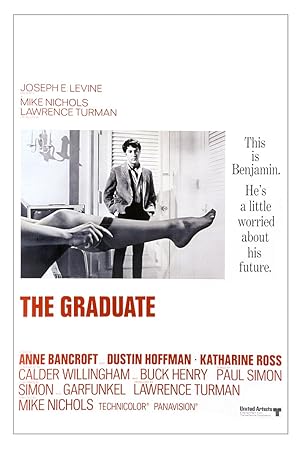
The Graduate
Benjamin Braddock returns home to California after successfully completing college. He gets a hero's welcome from his parents but Ben isn't quite sure what to do with the rest of his life. He is soon seduced by Mrs. Robinson, the wife of his father's partner, who methodically pursues the inexperienced young man. Soon, they are meeting regularly in hotel rooms. Warned by her to stay away from her daughter Elaine, his father goads him into taking her out on a date. He finds he quite likes Elaine but when she learns he's been having an affair with her own mother, she'll have nothing to do with him. He's smitten however and pursues her.
Despite its modest budget of $3.0M, The Graduate became a massive hit, earning $104.9M worldwide—a remarkable 3398% return. The film's unique voice attracted moviegoers, illustrating how strong storytelling can transcend budget limitations.
1 Oscar. 22 wins & 17 nominations


Plot Structure
Story beats plotted across runtime


Narrative Arc
Emotional journey through the story's key moments
Story Circle
Blueprint 15-beat structure
Arcplot Score Breakdown
Weighted: Precision (70%) + Arc (15%) + Theme (15%)
The Graduate (1967) exemplifies strategically placed dramatic framework, characteristic of Mike Nichols's storytelling approach. This structural analysis examines how the film's 15-point plot structure maps to proven narrative frameworks across 1 hour and 46 minutes. With an Arcplot score of 6.6, the film balances conventional beats with creative variation.
Characters
Cast & narrative archetypes

Benjamin Braddock
Mrs. Robinson
Elaine Robinson
Mr. Braddock
Mrs. Braddock
Mr. Robinson
Main Cast & Characters
Benjamin Braddock
Played by Dustin Hoffman
Recent college graduate drifting aimlessly, seduced by Mrs. Robinson, then falls for her daughter Elaine.
Mrs. Robinson
Played by Anne Bancroft
Cynical, alcoholic older woman who seduces Benjamin and tries to keep him from her daughter.
Elaine Robinson
Played by Katharine Ross
Mrs. Robinson's daughter who becomes the object of Benjamin's genuine affection and pursuit.
Mr. Braddock
Played by William Daniels
Benjamin's successful, conventional father who pressures him about his future.
Mrs. Braddock
Played by Elizabeth Wilson
Benjamin's doting but clueless mother, proud of his achievements.
Mr. Robinson
Played by Murray Hamilton
Elaine's father and Benjamin's father's law partner, unaware of his wife's affair.
Structural Analysis
The Status Quo at 1 minutes (1% through the runtime) establishes Benjamin Braddock arrives home from college, riding the airport walkway with a blank, disconnected expression—a young man adrift, uncertain about his future despite his accomplishments.. Structural examination shows that this early placement immediately immerses viewers in the story world.
The inciting incident occurs at 13 minutes when Mrs. Robinson corners Benjamin and asks him to drive her home, beginning her seduction. This older woman's advances disrupt Benjamin's passive drift, forcing him into unfamiliar territory.. At 12% through the film, this Disruption aligns precisely with traditional story structure. This beat shifts the emotional landscape, launching the protagonist into the central conflict.
The First Threshold at 27 minutes marks the transition into Act II, occurring at 25% of the runtime. This demonstrates the protagonist's commitment to Benjamin actively chooses to call Mrs. Robinson and meet her at the Taft Hotel. He crosses into the affair, entering a secret, morally ambiguous world of his own making., moving from reaction to action.
At 53 minutes, the Midpoint arrives at 50% of the runtime—precisely centered, creating perfect narrative symmetry. The analysis reveals that this crucial beat Mrs. Robinson forbids Benjamin from seeing Elaine and threatens to tell her about the affair. The stakes escalate dramatically—Benjamin's pursuit of genuine love is now in direct conflict with his past transgression., fundamentally raising what's at risk. The emotional intensity shifts, dividing the narrative into clear before-and-after phases.
The Collapse moment at 80 minutes (75% through) represents the emotional nadir. Here, Benjamin learns that Elaine is getting married to Carl Smith. His chance at redemption and real love appears dead. He has lost everything that matters., illustrates the protagonist at their lowest point. This beat's placement in the final quarter sets up the climactic reversal.
The Second Threshold at 85 minutes initiates the final act resolution at 80% of the runtime. Benjamin discovers the wedding location and races to the church. He synthesizes his earlier passivity with newfound determination—he will fight for what he wants, consequences be damned., demonstrating the transformation achieved throughout the journey.
Emotional Journey
The Graduate's emotional architecture traces a deliberate progression across 15 carefully calibrated beats.
Narrative Framework
This structural analysis employs proven narrative structure principles that track dramatic progression. By mapping The Graduate against these established plot points, we can identify how Mike Nichols utilizes or subverts traditional narrative conventions. The plot point approach reveals not only adherence to structural principles but also creative choices that distinguish The Graduate within the comedy genre.
Mike Nichols's Structural Approach
Among the 16 Mike Nichols films analyzed on Arcplot, the average structural score is 7.0, demonstrating varied approaches to story architecture. The Graduate takes a more unconventional approach compared to the director's typical style. For comparative analysis, explore the complete Mike Nichols filmography.
Comparative Analysis
Additional comedy films include The Bad Guys, Ella Enchanted and The Evening Star. For more Mike Nichols analyses, see Closer, Primary Colors and Charlie Wilson's War.
Plot Points by Act
Act I
SetupStatus Quo
Benjamin Braddock arrives home from college, riding the airport walkway with a blank, disconnected expression—a young man adrift, uncertain about his future despite his accomplishments.
Theme
Mr. McGuire offers Benjamin unsolicited advice at the party: "Plastics." This word embodies the shallow, artificial world of his parents' generation that Benjamin must either accept or reject.
Worldbuilding
Benjamin's graduation party showcases his privileged but suffocating world—successful parents, their materialistic friends, expectations of achievement. Benjamin floats aimlessly in the pool, underwater, trying to escape.
Disruption
Mrs. Robinson corners Benjamin and asks him to drive her home, beginning her seduction. This older woman's advances disrupt Benjamin's passive drift, forcing him into unfamiliar territory.
Resistance
Benjamin resists Mrs. Robinson's advances but is drawn into the affair. He debates with himself, alternating between temptation and moral hesitation, culminating in his phone call to arrange their first hotel meeting.
Act II
ConfrontationFirst Threshold
Benjamin actively chooses to call Mrs. Robinson and meet her at the Taft Hotel. He crosses into the affair, entering a secret, morally ambiguous world of his own making.
Mirror World
Benjamin meets Elaine Robinson for the first time (as an adult). She represents genuine connection, authenticity, and the possibility of real love—everything the affair with her mother is not.
Premise
Benjamin pursues Elaine while continuing the affair with Mrs. Robinson. He falls in love with Elaine, taking her on dates, but his secret threatens to destroy everything. This is the "fun" of the premise—the romantic pursuit.
Midpoint
Mrs. Robinson forbids Benjamin from seeing Elaine and threatens to tell her about the affair. The stakes escalate dramatically—Benjamin's pursuit of genuine love is now in direct conflict with his past transgression.
Opposition
Benjamin confesses the affair to Elaine (without naming her mother). Elaine is devastated and returns to Berkeley. Benjamin follows her, but Mrs. Robinson has poisoned Elaine against him. The Robinsons and Braddocks close ranks against Benjamin.
Collapse
Benjamin learns that Elaine is getting married to Carl Smith. His chance at redemption and real love appears dead. He has lost everything that matters.
Crisis
Benjamin drives frantically to Santa Barbara, nearly out of gas, desperate and determined. This is his dark night—alone, rejected, but refusing to give up on Elaine.
Act III
ResolutionSecond Threshold
Benjamin discovers the wedding location and races to the church. He synthesizes his earlier passivity with newfound determination—he will fight for what he wants, consequences be damned.
Synthesis
Benjamin arrives at the church just as the ceremony ends. He pounds on the glass, screaming "Elaine!" She responds, and together they fight off both families, using a cross to bar the church doors. They escape on a city bus.
Transformation
Benjamin and Elaine sit on the bus, initial euphoria fading to uncertain expressions. They've escaped the plastic world of their parents, but their smiles fade as they face an ambiguous future—transformed, but uncertain.