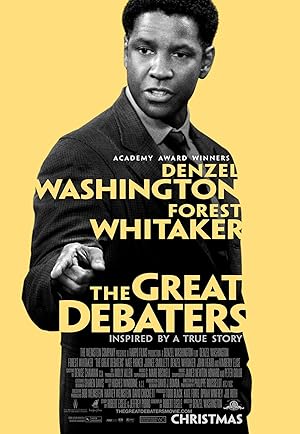
The Great Debaters
Marshall, Texas, described by James Farmer, Jr. as "the last city to surrender after the Civil War," is home to Wiley College, where, in 1935-36, inspired by the Harlem Renaissance and his clandestine work as a union organizer, Professor Melvin Tolson coaches the debate team to a nearly-undefeated season that sees the first debate between U.S. students from white and Negro colleges and ends with an invitation to face Harvard University's national champions. The team of four, which includes a female student and a very young James Farmer, is tested in a crucible heated by Jim Crow, sexism, a lynch mob, an arrest and near riot, a love affair, jealousy, and a national radio audience.
Despite a respectable budget of $15.0M, The Great Debaters became a box office success, earning $30.2M worldwide—a 102% return.


Plot Structure
Story beats plotted across runtime


Narrative Arc
Emotional journey through the story's key moments
Story Circle
Blueprint 15-beat structure
Arcplot Score Breakdown
Weighted: Precision (70%) + Arc (15%) + Theme (15%)
The Great Debaters (2007) exemplifies deliberately positioned narrative architecture, characteristic of Denzel Washington's storytelling approach. This structural analysis examines how the film's 15-point plot structure maps to proven narrative frameworks across 2 hours and 6 minutes. With an Arcplot score of 7.7, the film showcases strong structural fundamentals.
Characters
Cast & narrative archetypes

Melvin B. Tolson
Henry Lowe
Samantha Booke
James Farmer Jr.
James Farmer Sr.
Main Cast & Characters
Melvin B. Tolson
Played by Denzel Washington
A brilliant poetry professor and debate coach at Wiley College who inspires his students to fight injustice through words and challenges the Jim Crow South.
Henry Lowe
Played by Nate Parker
A charismatic but troubled debate team member with a sharp intellect and fiery temperament, battling personal demons while finding purpose in the team.
Samantha Booke
Played by Jurnee Smollett
The only female member of the debate team, a determined and intelligent young woman who breaks gender barriers while proving her intellectual prowess.
James Farmer Jr.
Played by Denzel Whitaker
The youngest member of the debate team, a 14-year-old prodigy who grows from sheltered idealism to mature understanding of social justice through direct confrontation with racism.
James Farmer Sr.
Played by Forest Whitaker
A conservative college administrator and minister, father to James Jr., who values stability and caution over activism, creating tension with his son's evolving worldview.
Structural Analysis
The Status Quo at 1 minutes (1% through the runtime) establishes Opening scene at Wiley College, East Texas, 1935. Professor Melvin Tolson teaches poetry to his students, establishing the segregated world of Black education in the Jim Crow South. Young Henry Lowe, Samantha Booke, and James Farmer Jr. Are introduced as students hungry for knowledge but living within strict racial boundaries.. Of particular interest, this early placement immediately immerses viewers in the story world.
The inciting incident occurs at 14 minutes when Tolson announces tryouts for the debate team with the audacious goal of competing against white colleges. This disrupts the status quo by offering a path to challenge racial barriers through intellectual prowess. The students must now decide whether to risk everything for this opportunity.. At 11% through the film, this Disruption aligns precisely with traditional story structure. This beat shifts the emotional landscape, launching the protagonist into the central conflict.
The First Threshold at 31 minutes marks the transition into Act II, occurring at 25% of the runtime. This illustrates the protagonist's commitment to The team actively chooses to accept their first debate challenge against a white college (Oklahoma City University). This is their irreversible commitment to enter a world where they've been denied access. They're no longer just students - they're warriors using words as weapons against injustice., moving from reaction to action.
At 62 minutes, the Midpoint arrives at 49% of the runtime—precisely centered, creating perfect narrative symmetry. The analysis reveals that this crucial beat False defeat: Tolson is arrested by white vigilantes for his union organizing activities. The team's victory tour comes crashing down. They're forced to confront the reality that individual achievement won't protect them from systematic oppression. The stakes escalate - this isn't just about winning debates anymore, it's about survival and what they're willing to sacrifice., fundamentally raising what's at risk. The emotional intensity shifts, dividing the narrative into clear before-and-after phases.
The Collapse moment at 94 minutes (75% through) represents the emotional nadir. Here, All is lost: The team discovers a Black man who has been lynched and burned. James Jr., the youngest member, is devastated by this horrific "whiff of death." The violence they've been debating about becomes viscerally real. James Sr. Forbids his son from continuing, and it seems the dream of debating Harvard will die., reveals the protagonist at their lowest point. This beat's placement in the final quarter sets up the climactic reversal.
The Second Threshold at 100 minutes initiates the final act resolution at 80% of the runtime. Synthesis and breakthrough: James Jr. Finds his voice and persuades his father that speaking truth is worth the risk. The team realizes they must debate Harvard not to prove they're as good as whites, but to honor those who cannot speak - including the lynch victim. They synthesize their pain into purpose, combining intellectual rigor with moral conviction., demonstrating the transformation achieved throughout the journey.
Emotional Journey
The Great Debaters's emotional architecture traces a deliberate progression across 15 carefully calibrated beats.
Narrative Framework
This structural analysis employs structural analysis methodology used to understand storytelling architecture. By mapping The Great Debaters against these established plot points, we can identify how Denzel Washington utilizes or subverts traditional narrative conventions. The plot point approach reveals not only adherence to structural principles but also creative choices that distinguish The Great Debaters within the biography genre.
Denzel Washington's Structural Approach
Among the 4 Denzel Washington films analyzed on Arcplot, the average structural score is 7.3, reflecting strong command of classical structure. The Great Debaters represents one of the director's most structurally precise works. For comparative analysis, explore the complete Denzel Washington filmography.
Comparative Analysis
Additional biography films include After Thomas, Taking Woodstock and The Fire Inside. For more Denzel Washington analyses, see Fences, A Journal for Jordan and Antwone Fisher.
Plot Points by Act
Act I
SetupStatus Quo
Opening scene at Wiley College, East Texas, 1935. Professor Melvin Tolson teaches poetry to his students, establishing the segregated world of Black education in the Jim Crow South. Young Henry Lowe, Samantha Booke, and James Farmer Jr. are introduced as students hungry for knowledge but living within strict racial boundaries.
Theme
Tolson states the thematic premise: "We do what we have to do, so we can do what we want to do." This encapsulates the film's exploration of fighting for the right to be heard, the power of words over violence, and finding dignity through intellectual excellence despite systematic oppression.
Worldbuilding
Introduction to Wiley College's world: strict social hierarchies, the debate team tradition, Tolson's radical politics as a union organizer, James Farmer Sr.'s conservative approach as a preacher and administrator. We see the students' different motivations - Henry's anger, Samantha's determination to prove herself as a woman, James Jr.'s sheltered idealism.
Disruption
Tolson announces tryouts for the debate team with the audacious goal of competing against white colleges. This disrupts the status quo by offering a path to challenge racial barriers through intellectual prowess. The students must now decide whether to risk everything for this opportunity.
Resistance
Rigorous debate tryouts and training begin. Tolson mentors the students in research, argumentation, and performance. Henry debates whether education can truly change anything, Samantha fights for recognition as the first female debater, James Jr. struggles with his father's disapproval. They witness a lynch mob burning a man, a brutal reminder of the violence underlying their society.
Act II
ConfrontationFirst Threshold
The team actively chooses to accept their first debate challenge against a white college (Oklahoma City University). This is their irreversible commitment to enter a world where they've been denied access. They're no longer just students - they're warriors using words as weapons against injustice.
Mirror World
The romantic subplot between Henry and Samantha develops, and James Jr.'s relationship with his father deepens. These relationships embody the theme - communication, respect, and fighting for what you believe in. Samantha pushes back against both racial and gender discrimination, teaching the team about intersectional struggle.
Premise
The promise of the premise: watching this underdog Black debate team dominate white colleges with superior intellect and preparation. They win debate after debate, gaining confidence and notoriety. Road trip scenes show bonding, strategy sessions, and the thrill of victory. However, each triumph is shadowed by reminders of racial violence and their precarious position.
Midpoint
False defeat: Tolson is arrested by white vigilantes for his union organizing activities. The team's victory tour comes crashing down. They're forced to confront the reality that individual achievement won't protect them from systematic oppression. The stakes escalate - this isn't just about winning debates anymore, it's about survival and what they're willing to sacrifice.
Opposition
The team fractures under pressure. James Sr. demands his son quit the team. Henry's rage threatens to derail everything. The college administration pressures them to stop making waves. Tolson's legal troubles worsen. They nearly come upon a lynch victim, traumatizing young James Jr. Each debate becomes harder as they face more prestigious, better-funded opponents and overt racism.
Collapse
All is lost: The team discovers a Black man who has been lynched and burned. James Jr., the youngest member, is devastated by this horrific "whiff of death." The violence they've been debating about becomes viscerally real. James Sr. forbids his son from continuing, and it seems the dream of debating Harvard will die.
Crisis
Dark night of the soul: James Jr. processes the trauma and confronts whether words matter in the face of brutal violence. The team questions if debate is just performance while their people suffer. Tolson and the students must each decide what they're truly fighting for and whether intellectual resistance has meaning.
Act III
ResolutionSecond Threshold
Synthesis and breakthrough: James Jr. finds his voice and persuades his father that speaking truth is worth the risk. The team realizes they must debate Harvard not to prove they're as good as whites, but to honor those who cannot speak - including the lynch victim. They synthesize their pain into purpose, combining intellectual rigor with moral conviction.
Synthesis
The finale: The Wiley College team travels to Harvard for the climactic debate on civil disobedience. James Jr. delivers a devastating closing argument drawing on the lynching he witnessed, arguing that an unjust law is no law at all. The team executes everything Tolson taught them, wielding words as instruments of truth and justice. They win, achieving the impossible.
Transformation
Final image: The team stands victorious, having proven that Black students from a small Texas college can defeat the most privileged white institution in America. The closing titles reveal the students' future achievements. The transformation is complete - from students confined by Jim Crow to champions who forced the world to listen. They did what they had to do, so they could do what they wanted to do.