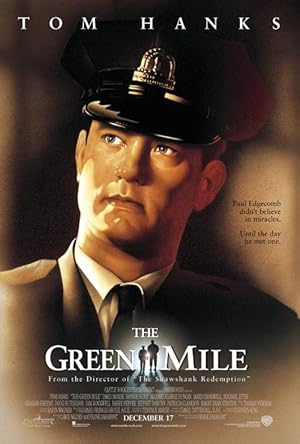
The Green Mile
Death Row guards at a penitentiary, in the 1930's, have a moral dilemma with their job when they discover one of their prisoners, a convicted murderer, has a special gift.
Despite a respectable budget of $60.0M, The Green Mile became a box office success, earning $286.8M worldwide—a 378% return.
Nominated for 4 Oscars. 15 wins & 37 nominations


Plot Structure
Story beats plotted across runtime


Narrative Arc
Emotional journey through the story's key moments
Story Circle
Blueprint 15-beat structure
Arcplot Score Breakdown
Weighted: Precision (70%) + Arc (15%) + Theme (15%)
The Green Mile (1999) exemplifies strategically placed dramatic framework, characteristic of Frank Darabont's storytelling approach. This structural analysis examines how the film's 15-point plot structure maps to proven narrative frameworks across 3 hours and 9 minutes. With an Arcplot score of 3.8, the film takes an unconventional approach to traditional narrative frameworks.
Characters
Cast & narrative archetypes

Paul Edgecomb
John Coffey
Brutus "Brutal" Howell
Percy Wetmore
Warden Hal Moores
"Wild Bill" Wharton
Eduard Delacroix
Jan Edgecomb
Main Cast & Characters
Paul Edgecomb
Played by Tom Hanks
Head guard on death row's E Block who discovers John Coffey's miraculous healing powers and faces a moral crisis about his execution.
John Coffey
Played by Michael Clarke Duncan
A gentle giant on death row convicted of murdering two young girls, who possesses mysterious healing powers and supernatural perception.
Brutus "Brutal" Howell
Played by David Morse
Paul's trusted second-in-command on E Block, compassionate and professional guard who treats prisoners with dignity.
Percy Wetmore
Played by Doug Hutchison
Sadistic young guard who abuses his political connections and torments prisoners, particularly Eduard Delacroix.
Warden Hal Moores
Played by James Cromwell
The prison warden whose wife Melinda is dying of a brain tumor, caught between duty and desperation.
"Wild Bill" Wharton
Played by Sam Rockwell
Psychotic prisoner who feigns catatonia but is actually a violent, unrepentant killer responsible for the crime Coffey was convicted of.
Eduard Delacroix
Played by Michael Jeter
Simple-minded prisoner on death row who befriends a mouse named Mr. Jingles and becomes Percy's primary victim.
Jan Edgecomb
Played by Bonnie Hunt
Paul's supportive and understanding wife who provides emotional stability during his moral crisis.
Structural Analysis
The Status Quo at 2 minutes (1% through the runtime) establishes Elderly Paul Edgecomb weeps while watching the Fred Astaire film "Top Hat" in a nursing home, haunted by memories he cannot escape. This establishes his profound emotional burden before revealing its source.. Significantly, this early placement immediately immerses viewers in the story world.
The inciting incident occurs at 20 minutes when John Coffey, a massive Black man convicted of murdering two young girls, arrives on the Mile. His gentleness and childlike fear immediately contradict expectations, disrupting Paul's routine understanding of condemned men.. At 11% through the film, this Disruption aligns precisely with traditional story structure. This beat shifts the emotional landscape, launching the protagonist into the central conflict.
The First Threshold at 43 minutes marks the transition into Act II, occurring at 22% of the runtime. This illustrates the protagonist's commitment to John Coffey reaches through the bars, takes Paul's hand, and miraculously heals his urinary infection. Paul experiences John's supernatural gift firsthand, forever changing his perception of the condemned man and committing him to understanding this mystery., moving from reaction to action.
At 85 minutes, the Midpoint arrives at 45% of the runtime—arriving early, accelerating into Act IIb complications. Notably, this crucial beat Paul orchestrates John's secret nighttime journey to heal Warden Moores' wife Melinda, who is dying of a brain tumor. John absorbs her cancer, demonstrating his power over life and death, but also revealing the terrible cost these healings take on him., fundamentally raising what's at risk. The emotional intensity shifts, dividing the narrative into clear before-and-after phases.
The Collapse moment at 128 minutes (67% through) represents the emotional nadir. Here, John tells Paul he cannot be saved and doesn't want to be—he is tired of feeling the world's pain and cruelty. Paul realizes he must execute an innocent man, a saint who heals others, because John himself accepts death as release from his suffering., indicates the protagonist at their lowest point. This beat's placement in the final quarter sets up the climactic reversal.
The Second Threshold at 136 minutes initiates the final act resolution at 72% of the runtime. Paul accepts the burden John has given him: to let John die as John wishes, carrying the weight of this act for the rest of his life. He chooses to honor John's request rather than fight an unwinnable battle, entering the final act with tragic acceptance., demonstrating the transformation achieved throughout the journey.
Emotional Journey
The Green Mile's emotional architecture traces a deliberate progression across 15 carefully calibrated beats.
Narrative Framework
This structural analysis employs structural analysis methodology used to understand storytelling architecture. By mapping The Green Mile against these established plot points, we can identify how Frank Darabont utilizes or subverts traditional narrative conventions. The plot point approach reveals not only adherence to structural principles but also creative choices that distinguish The Green Mile within the crime genre.
Frank Darabont's Structural Approach
Among the 4 Frank Darabont films analyzed on Arcplot, the average structural score is 6.4, demonstrating varied approaches to story architecture. The Green Mile takes a more unconventional approach compared to the director's typical style. For comparative analysis, explore the complete Frank Darabont filmography.
Comparative Analysis
Additional crime films include The Bad Guys, Rustom and The Whole Ten Yards. For more Frank Darabont analyses, see The Shawshank Redemption, The Majestic and The Mist.
Plot Points by Act
Act I
SetupStatus Quo
Elderly Paul Edgecomb weeps while watching the Fred Astaire film "Top Hat" in a nursing home, haunted by memories he cannot escape. This establishes his profound emotional burden before revealing its source.
Theme
Brutal Howell tells Paul, "Dead man walking," as John Coffey arrives on the Mile. This phrase encapsulates the film's meditation on death, judgment, and who truly deserves to die.
Worldbuilding
The dual timeline establishes Paul's present isolation in the nursing home and his past as head guard of Cold Mountain's death row in 1935. We meet the guards—Brutus, Dean, Harry—and witness the harsh realities of E Block, including the cruel guard Percy Wetmore.
Disruption
John Coffey, a massive Black man convicted of murdering two young girls, arrives on the Mile. His gentleness and childlike fear immediately contradict expectations, disrupting Paul's routine understanding of condemned men.
Resistance
Paul struggles with a painful urinary infection while managing the volatile dynamics of the Mile. Wild Bill Wharton arrives as a dangerous new inmate. Paul observes John's unusual behavior and gentleness, debating internally whether this man could truly be a child killer.
Act II
ConfrontationFirst Threshold
John Coffey reaches through the bars, takes Paul's hand, and miraculously heals his urinary infection. Paul experiences John's supernatural gift firsthand, forever changing his perception of the condemned man and committing him to understanding this mystery.
Mirror World
Mr. Jingles, the mouse befriended by inmate Del, becomes a symbol of innocence and connection on death row. John resurrects the mouse after Percy stomps it, revealing the depth of his gift and establishing the theme that miracles exist even in places of death.
Premise
The guards witness more of John's miracles and gentle nature. Del's execution is sabotaged by Percy, who deliberately doesn't wet the sponge, causing a horrific death. Paul and the guards grapple with the injustice of executing innocent or redeemable men while monsters like Percy walk free.
Midpoint
Paul orchestrates John's secret nighttime journey to heal Warden Moores' wife Melinda, who is dying of a brain tumor. John absorbs her cancer, demonstrating his power over life and death, but also revealing the terrible cost these healings take on him.
Opposition
John transfers Melinda's disease into Percy, who then shoots Wild Bill dead before going catatonic. Through this act, John reveals that Wild Bill was the true killer of the girls. Paul faces an impossible moral crisis: he now knows John is innocent but cannot prove it legally.
Collapse
John tells Paul he cannot be saved and doesn't want to be—he is tired of feeling the world's pain and cruelty. Paul realizes he must execute an innocent man, a saint who heals others, because John himself accepts death as release from his suffering.
Crisis
Paul wrestles with the moral weight of executing John, questioning how he will face God's judgment. He and the guards share final moments with John, who comforts them despite being the one condemned. Paul's dark night is knowing he must kill a miracle.
Act III
ResolutionSecond Threshold
Paul accepts the burden John has given him: to let John die as John wishes, carrying the weight of this act for the rest of his life. He chooses to honor John's request rather than fight an unwinnable battle, entering the final act with tragic acceptance.
Synthesis
John Coffey's execution proceeds with dignity and sorrow. The guards, especially Paul, treat John with profound respect. John asks not to have the hood placed over his head because he is afraid of the dark, and Paul grants this final mercy. John dies peacefully.
Transformation
Elderly Paul reveals to Elaine that he is 108 years old—John's healing touch cursed him with unnatural longevity. He has outlived everyone he loved, including his wife. Mr. Jingles still lives. Paul's punishment is to watch everyone die, paying eternally for executing a miracle.