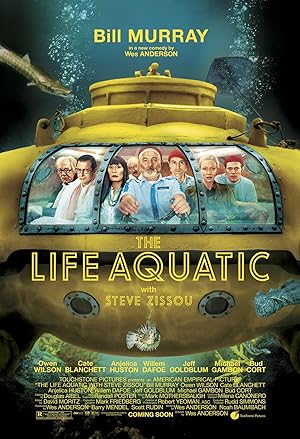
The Life Aquatic with Steve Zissou
When his partner is killed by the mysterious and possibly nonexistent Jaguar Shark, Steve Zissou (Bill Murray) and his Team Zissou crew set off for an expedition to hunt down the creature. Along with his estranged wife, a beautiful journalist and a co-pilot who could possibly be Zissou's son, the crew set off for one wild expedition.
The film disappointed at the box office against its moderate budget of $50.0M, earning $34.8M globally (-30% loss). While initial box office returns were modest, the film has gained appreciation for its unconventional structure within the action genre.
3 wins & 10 nominations
Roger Ebert
"Ebert called this "the damnedest film," acknowledging he couldn't recommend it while refusing to discourage anyone from seeing it. He described Steve Zissou as a man in "the later stages of entropy," whose crew and career seem caught in drift toward standstill. However, he praised the film's moments of genuine beauty, particularly the submarine descent sequence, comparing it to a scene from "20,000 Leagues Under the Sea if Captain Nemo had been a pothead." The production design earned admiration, especially the cross-section ship set. Ebert noted that Bill Murray brings his signature combination of deadpan melancholy to a character who seems simultaneously depressed that life is passing him by and that it is taking so long to do it."Read Full Review


Narrative Tropes
18 totalPlot Structure
Story beats plotted across runtime


Narrative Arc
Emotional journey through the story's key moments
Story Circle
Blueprint 15-beat structure
Arcplot Score Breakdown
Weighted: Precision (70%) + Arc (15%) + Theme (15%)
The Life Aquatic with Steve Zissou (2004) demonstrates precise narrative architecture, characteristic of Wes Anderson's storytelling approach. This structural analysis examines how the film's 15-point plot structure maps to proven narrative frameworks across 1 hour and 59 minutes. With an Arcplot score of 7.7, the film showcases strong structural fundamentals.
Characters
Cast & narrative archetypes

Steve Zissou

Ned Plimpton

Eleanor Zissou

Jane Winslett-Richardson

Klaus Daimler

Alistair Hennessey

Pelé dos Santos

Bill Ubell
Character Screen Time
Screen time mapped to story structure
Main Cast & Characters
Steve Zissou
Played by Bill Murray
100% screen time (111 min)
A once-famous oceanographer and documentary filmmaker whose career is fading. He embarks on a revenge mission against the jaguar shark that killed his partner.
Ned Plimpton
Played by Owen Wilson
68% screen time (75 min)
A Kentucky airline pilot who may be Steve's son, seeking connection with the father he never knew.
Eleanor Zissou
Played by Anjelica Huston
41% screen time (45 min)
Steve's estranged wife and the brains behind Team Zissou's operations. She's considering leaving him.
Jane Winslett-Richardson
Played by Cate Blanchett
57% screen time (63 min)
A pregnant journalist from Oceanographic Explorer magazine profiling Steve, drawn into the adventure.
Klaus Daimler
Played by Willem Dafoe
57% screen time (63 min)
Team Zissou's German first mate, fiercely loyal but jealous of Ned's relationship with Steve.
Alistair Hennessey
Played by Jeff Goldblum
28% screen time (31 min)
Steve's wealthy rival oceanographer and Eleanor's ex-husband, who crosses paths during the voyage.
Pelé dos Santos
Played by Seu Jorge
19% screen time (21 min)
Brazilian musician and safety expert on the Belafonte, provides the film's David Bowie covers.
Bill Ubell
Played by Bud Cort
20% screen time (22 min)
Team Zissou's bond company stooge, sent to monitor their expenses and behavior.
Structural Analysis
The Status Quo at 0 minutes (0% through the runtime) establishes At the Loquasto International Film Festival, Steve Zissou presents his latest documentary about his partner Esteban's death by a "Jaguar Shark." The audience watches in uncomfortable silence. The lukewarm reception reveals Steve as a man past his prime, clinging to relevance while his glory days fade.. Structural examination shows that this early placement immediately immerses viewers in the story world.
The inciting incident occurs at 10 minutes when Ned Plimpton approaches Steve after the screening. His mother recently died, and before her death told him Steve might be his father—the result of a brief affair decades ago. Ned has come seeking connection with the father he never knew. This revelation disrupts everything.. At 9% through the film, this Disruption arrives earlier than typical, accelerating the narrative momentum. This beat shifts the emotional landscape, launching the protagonist into the central conflict.
The First Threshold at 23 minutes marks the transition into Act II, occurring at 20% of the runtime. This demonstrates the protagonist's commitment to Steve makes the active choice to accept Ned onto the expedition as his co-captain and brings Jane aboard to document everything. He secures partial funding and sets sail on the Belafonte to hunt the Jaguar Shark. The crew assembles and a new world begins., moving from reaction to action. The emotional journey here reflects 3.
At 53 minutes, the Midpoint arrives at 45% of the runtime—arriving early, accelerating into Act IIb complications. Notably, this crucial beat FALSE VICTORY: The rescue mission succeeds spectacularly—Steve saves Hennessey and destroys the pirate compound. His crew is united, he's bonding with Ned. But beneath the surface, cracks form: Jane is conflicted, Steve and Ned's rivalry over her intensifies, and Klaus's jealousy boils over., fundamentally raising what's at risk. The emotional state shifts to 4, dividing the narrative into clear before-and-after phases.
The Collapse moment at 79 minutes (67% through) represents the emotional nadir. Here, During a helicopter reconnaissance mission, the aircraft crashes. Ned is mortally wounded. Despite Steve's desperate attempts, Ned dies in his arms. Steve has lost the son he only just found—before he could fully accept him, before he could tell him the truth about his uncertain paternity., shows the protagonist at their lowest point. This beat's placement in the final quarter sets up the climactic reversal.
The Second Threshold at 89 minutes initiates the final act resolution at 74% of the runtime. Steve decides to complete the expedition—not for revenge, but to honor Ned's memory. He realizes the hunt was never really about killing; it was about confronting death, about finding meaning. Eleanor supports him. The crew rallies. The quest continues, transformed in purpose from revenge to witness., demonstrating the transformation achieved throughout the journey.
Emotional Journey
The Life Aquatic with Steve Zissou's emotional architecture traces a deliberate progression across 15 carefully calibrated beats. The narrative's emotional pivot at the midpoint—4—divides the journey into distinct phases, with the first half building toward this moment of transformation and the second half exploring its consequences. With 3 core emotional states, the narrative maintains focused emotional clarity, allowing sustained thematic development.
Narrative Framework
This structural analysis employs structural analysis methodology used to understand storytelling architecture. By mapping The Life Aquatic with Steve Zissou against these established plot points, we can identify how Wes Anderson utilizes or subverts traditional narrative conventions. The plot point approach reveals not only adherence to structural principles but also creative choices that distinguish The Life Aquatic with Steve Zissou within the action genre.
Wes Anderson's Structural Approach
Among the 12 Wes Anderson films analyzed on Arcplot, the average structural score is 6.3, demonstrating varied approaches to story architecture. The Life Aquatic with Steve Zissou represents one of the director's most structurally precise works. For comparative analysis, explore the complete Wes Anderson filmography.
Comparative Analysis
Additional action films include The Bad Guys, Puss in Boots and Venom: The Last Dance. For more Wes Anderson analyses, see Asteroid City, The French Dispatch and Moonrise Kingdom.
Plot Points by Act
Act I
SetupStatus Quo
At the Loquasto International Film Festival, Steve Zissou presents his latest documentary about his partner Esteban's death by a "Jaguar Shark." The audience watches in uncomfortable silence. The lukewarm reception reveals Steve as a man past his prime, clinging to relevance while his glory days fade.
Theme
During the Q&A, a festival director questions the scientific purpose of killing an endangered species. Steve answers simply: "Revenge." Eleanor later tells Steve his work has become "wildly self-indulgent." She articulates the theme—Steve has lost his way, substituting spectacle for substance.
Worldbuilding
Steve's world is in disarray: his documentaries no longer receive funding or acclaim, his marriage to Eleanor is strained, his rival Hennessey is thriving, and his ship the Belafonte is falling apart. The death of Esteban has hollowed him out. He announces his next documentary will hunt and kill the Jaguar Shark.
Disruption
Ned Plimpton approaches Steve after the screening. His mother recently died, and before her death told him Steve might be his father—the result of a brief affair decades ago. Ned has come seeking connection with the father he never knew. This revelation disrupts everything.
Resistance
Steve grapples with Ned's claim. He's skeptical but intrigued. He struggles to fund the Jaguar Shark expedition while debating whether to let Ned join the crew. Pregnant journalist Jane wants to document the voyage. Klaus becomes jealous of Ned's sudden closeness to Steve.
Act II
ConfrontationFirst Threshold
Steve makes the active choice to accept Ned onto the expedition as his co-captain and brings Jane aboard to document everything. He secures partial funding and sets sail on the Belafonte to hunt the Jaguar Shark. The crew assembles and a new world begins.
Mirror World
The true B Story emerges: Steve and Ned's father-son relationship. Ned is earnest and supportive where Steve is guarded. Their tentative bond—with Ned calling him "Stevesy"—carries the thematic weight. Both men also become interested in Jane, creating a triangle that will test their relationship.
Premise
The expedition delivers adventure and comedy: the crew raids Hennessey's station, stealing his espresso machine. Filipino pirates board the Belafonte; Steve retakes his ship single-handedly in bathrobe and Speedo. The crew discovers fantastical stop-motion sea creatures. Steve launches a raid to rescue the kidnapped Hennessey using copious dynamite.
Midpoint
FALSE VICTORY: The rescue mission succeeds spectacularly—Steve saves Hennessey and destroys the pirate compound. His crew is united, he's bonding with Ned. But beneath the surface, cracks form: Jane is conflicted, Steve and Ned's rivalry over her intensifies, and Klaus's jealousy boils over.
Opposition
External and internal pressures mount. Steve and Ned fight over Jane—literally coming to blows. Jane writes increasingly critical assessments. Klaus has an emotional breakdown. Eleanor confronts Steve about his emotional unavailability. The expedition loses focus as financial pressures mount and Steve's behavior becomes erratic.
Collapse
During a helicopter reconnaissance mission, the aircraft crashes. Ned is mortally wounded. Despite Steve's desperate attempts, Ned dies in his arms. Steve has lost the son he only just found—before he could fully accept him, before he could tell him the truth about his uncertain paternity.
Crisis
Steve is shattered. He sits in silence, unable to process. The crew mourns. The expedition seems pointless. Steve confronts his grief and his failures, finally admitting to Eleanor that he didn't know if Ned was really his son—and realizing it didn't matter. The connection was real.
Act III
ResolutionSecond Threshold
Steve decides to complete the expedition—not for revenge, but to honor Ned's memory. He realizes the hunt was never really about killing; it was about confronting death, about finding meaning. Eleanor supports him. The crew rallies. The quest continues, transformed in purpose from revenge to witness.
Synthesis
The crew descends in the submarine to find the Jaguar Shark. Bioluminescent creatures surround them. They see it: massive, beautiful, terrifying. Steve doesn't take revenge. He whispers: "I wonder if it remembers me." Each crew member—including Hennessey—places a hand on his shoulder in comfort. As Sigur Rós plays, Steve weeps.
Transformation
At the premiere of the documentary dedicated to Ned (acknowledged as Steve's son), Steve waits outside the theater. A standing ovation erupts inside. He doesn't need to see it. Young Werner, Klaus's nephew, takes Steve's hand as they walk to the Belafonte. The crew returns triumphantly together. Steve has found his real legacy—not fame, but family.