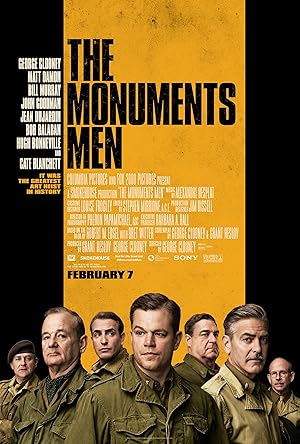
The Monuments Men
Based on the true story of the greatest treasure hunt in history, The Monuments Men is an action drama focusing on an unlikely World War II platoon, tasked by FDR with going into Germany to rescue artistic masterpieces from Nazi thieves and returning them to their rightful owners. It would be an impossible mission: with the art trapped behind enemy lines, and with the German army under orders to destroy everything as the Reich fell, how could these guys - seven museum directors, curators, and art historians, all more familiar with Michelangelo than the M-1 - possibly hope to succeed? But as the Monuments Men, as they were called, found themselves in a race against time to avoid the destruction of 1000 years of culture, they would risk their lives to protect and defend mankind's greatest achievements.
Despite a respectable budget of $70.0M, The Monuments Men became a box office success, earning $155.0M worldwide—a 121% return.
3 wins & 3 nominations


Plot Structure
Story beats plotted across runtime


Narrative Arc
Emotional journey through the story's key moments
Story Circle
Blueprint 15-beat structure
Arcplot Score Breakdown
Weighted: Precision (70%) + Arc (15%) + Theme (15%)
The Monuments Men (2014) exhibits deliberately positioned dramatic framework, characteristic of George Clooney's storytelling approach. This structural analysis examines how the film's 15-point plot structure maps to proven narrative frameworks across 1 hour and 58 minutes. With an Arcplot score of 6.7, the film balances conventional beats with creative variation.
Structural Analysis
The Status Quo at 1 minutes (1% through the runtime) establishes Opening montage shows Nazi soldiers systematically looting European art treasures, establishing the massive cultural theft underway during WWII while Allied forces focus solely on military objectives.. Notably, this early placement immediately immerses viewers in the story world.
The inciting incident occurs at 14 minutes when President Roosevelt approves Stokes' mission. The Monuments Men are officially commissioned to enter the war zone and recover stolen art before the Nazis can destroy it. Their comfortable civilian lives are over.. At 12% through the film, this Disruption aligns precisely with traditional story structure. This beat shifts the emotional landscape, launching the protagonist into the central conflict.
The First Threshold at 30 minutes marks the transition into Act II, occurring at 25% of the runtime. This reveals the protagonist's commitment to The Monuments Men deploy to Europe, splitting into teams across France, Belgium, and Germany. They actively choose to enter the war zone despite knowing the dangers, crossing from theory into the reality of combat., moving from reaction to action.
At 59 minutes, the Midpoint arrives at 50% of the runtime—precisely centered, creating perfect narrative symmetry. Significantly, this crucial beat Donald Jeffries is killed by German soldiers while trying to protect Michelangelo's Madonna of Bruges. The first death among the Monuments Men transforms the mission from adventure to tragedy, proving art can indeed cost lives., fundamentally raising what's at risk. The emotional intensity shifts, dividing the narrative into clear before-and-after phases.
The Collapse moment at 89 minutes (75% through) represents the emotional nadir. Here, Jean Claude Clermont is killed in combat. With two men dead and the war ending chaotically, Stokes questions whether the mission was worth the cost. The team confronts the possibility that the art may be lost forever despite their sacrifices., demonstrates the protagonist at their lowest point. This beat's placement in the final quarter sets up the climactic reversal.
The Second Threshold at 94 minutes initiates the final act resolution at 80% of the runtime. Claire finally trusts Granger and gives him her detailed records of Nazi art storage locations. Combined with intelligence from captured Germans, the team now has a roadmap to the hidden salt mines where the masterpieces are stored., demonstrating the transformation achieved throughout the journey.
Emotional Journey
The Monuments Men's emotional architecture traces a deliberate progression across 15 carefully calibrated beats.
Narrative Framework
This structural analysis employs a 15-point narrative structure framework that maps key story moments. By mapping The Monuments Men against these established plot points, we can identify how George Clooney utilizes or subverts traditional narrative conventions. The plot point approach reveals not only adherence to structural principles but also creative choices that distinguish The Monuments Men within the biography genre.
George Clooney's Structural Approach
Among the 7 George Clooney films analyzed on Arcplot, the average structural score is 6.9, demonstrating varied approaches to story architecture. The Monuments Men takes a more unconventional approach compared to the director's typical style. For comparative analysis, explore the complete George Clooney filmography.
Comparative Analysis
Additional biography films include After Thomas, Taking Woodstock and The Fire Inside. For more George Clooney analyses, see The Ides of March, Good Night, and Good Luck. and Leatherheads.
Plot Points by Act
Act I
SetupStatus Quo
Opening montage shows Nazi soldiers systematically looting European art treasures, establishing the massive cultural theft underway during WWII while Allied forces focus solely on military objectives.
Theme
Frank Stokes presents to President Roosevelt, asking: "If you destroy an entire generation of a people's culture, it's as if they never existed." The theme is stated: art represents civilization's soul and is worth preserving at any cost.
Worldbuilding
We meet each of the seven Monuments Men being recruited: art historians, architects, sculptors, and curators from civilian life. Their world of academia and museums contrasts sharply with the war they're about to enter. The scope of Nazi art theft is established.
Disruption
President Roosevelt approves Stokes' mission. The Monuments Men are officially commissioned to enter the war zone and recover stolen art before the Nazis can destroy it. Their comfortable civilian lives are over.
Resistance
The team undergoes basic military training, revealing their comical unsuitability for combat. They debate whether art is truly worth risking their lives for. Stokes struggles to convince military brass that their mission matters amid the larger war effort.
Act II
ConfrontationFirst Threshold
The Monuments Men deploy to Europe, splitting into teams across France, Belgium, and Germany. They actively choose to enter the war zone despite knowing the dangers, crossing from theory into the reality of combat.
Mirror World
Claire Simone is introduced in occupied Paris. A French museum curator forced to catalog Nazi-stolen art, she represents the theme embodied: someone who has already risked everything to secretly document the theft, preserving hope for eventual recovery.
Premise
The teams work separately across Europe, combining war-movie adventure with art-heist intrigue. They discover the scale of Nazi plunder, find clues to hidden caches, and navigate both combat dangers and military bureaucracy that doesn't prioritize their mission.
Midpoint
Donald Jeffries is killed by German soldiers while trying to protect Michelangelo's Madonna of Bruges. The first death among the Monuments Men transforms the mission from adventure to tragedy, proving art can indeed cost lives.
Opposition
The team faces mounting obstacles: the Nero Decree orders destruction of all art if Germany falls, the Soviets race to claim treasures as war reparations, Claire refuses to trust Granger with her records, and military priorities keep overriding their mission.
Collapse
Jean Claude Clermont is killed in combat. With two men dead and the war ending chaotically, Stokes questions whether the mission was worth the cost. The team confronts the possibility that the art may be lost forever despite their sacrifices.
Crisis
The surviving team members process their losses and face despair. The Soviet army advances rapidly, threatening to claim the art. Time runs out as Germany collapses. Was it all for nothing?
Act III
ResolutionSecond Threshold
Claire finally trusts Granger and gives him her detailed records of Nazi art storage locations. Combined with intelligence from captured Germans, the team now has a roadmap to the hidden salt mines where the masterpieces are stored.
Synthesis
Racing against both the Nero Decree and Soviet forces, the team locates the Altaussee salt mine and other caches. They discover thousands of masterpieces including the Ghent Altarpiece and the Bruges Madonna. The art is saved and returned to its rightful owners.
Transformation
Decades later, elderly Stokes stands with his grandson before the Ghent Altarpiece, answering "Yes" when asked if it was worth it. The art endures, civilization's soul was preserved, and the sacrifice of his friends was not in vain.