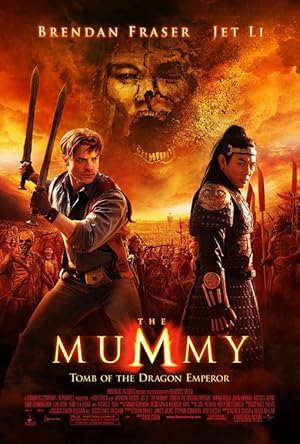
The Mummy: Tomb of the Dragon Emperor
Centuries ago, the evil Emperor Han was cursed by the sorceress Zi Yuan who transformed him and his army into mummies. In 1946, the explorer Rick O'Connell and his wife Evelyn O'Connell are invited by the British government to take a relic, the diamond "The Eye of Shangri-La" to China. The ancient stone is capable of resurrecting the Emperor Han and of pointing the way to Shangri-La and the eternal pool of life. When the couple reaches China, they meet their son Alex O'Connell, who has discovered the tomb of Han, and Evelyn's brother Jonathan Carnahan. The O'Connells are betrayed by their friend Prof. Roger Wilson, who is associated with General Yang. Yang wants to serve Emperor Han, so he resurrects the mummy and they head for Shangri-La. The guardian of Han's tomb (and Zi's daughter) Lin tells them that the only ways to destroy Han are to prevent him from reaching Shangri-La or by stabbing his heart with a cursed dagger.
Despite a substantial budget of $145.0M, The Mummy: Tomb of the Dragon Emperor became a box office success, earning $403.4M worldwide—a 178% return.
2 wins & 6 nominations


Plot Structure
Story beats plotted across runtime


Narrative Arc
Emotional journey through the story's key moments
Story Circle
Blueprint 15-beat structure
Arcplot Score Breakdown
Weighted: Precision (70%) + Arc (15%) + Theme (15%)
The Mummy: Tomb of the Dragon Emperor (2008) exhibits deliberately positioned story structure, characteristic of Rob Cohen's storytelling approach. This structural analysis examines how the film's 15-point plot structure maps to proven narrative frameworks across 1 hour and 52 minutes. With an Arcplot score of 7.0, the film balances conventional beats with creative variation.
Structural Analysis
The Status Quo at 1 minutes (1% through the runtime) establishes Ancient China prologue: Emperor Han conquers nations and seeks immortality, establishing the mythological stakes. The sorceress Zi Yuan curses him and his army to eternal terracotta imprisonment.. Structural examination shows that this early placement immediately immerses viewers in the story world.
The inciting incident occurs at 14 minutes when The British government recruits Rick and Evelyn for a diplomatic mission to China—to deliver the Eye of Shangri-La to a museum. This offers the adventure they've been craving and sets them on a collision course with their estranged son.. At 12% through the film, this Disruption aligns precisely with traditional story structure. This beat shifts the emotional landscape, launching the protagonist into the central conflict.
The First Threshold at 29 minutes marks the transition into Act II, occurring at 25% of the runtime. This reveals the protagonist's commitment to Emperor Han is resurrected in the museum using the Eye of Shangri-La. The O'Connells witness his terrifying awakening and must now stop an immortal tyrant. There's no going back to their quiet retirement—they're in this fight together., moving from reaction to action.
At 56 minutes, the Midpoint arrives at 50% of the runtime—precisely centered, creating perfect narrative symmetry. Of particular interest, this crucial beat The O'Connells reach Shangri-La and meet the immortal Zi Yuan. She reveals the Pool of Eternal Life can make Han truly invincible—or destroy him. False victory: they have allies and knowledge, but Han is already en route with his army., fundamentally raising what's at risk. The emotional intensity shifts, dividing the narrative into clear before-and-after phases.
The Collapse moment at 85 minutes (75% through) represents the emotional nadir. Here, Zi Yuan sacrifices her immortality to raise the army of Han's ancient enemies from beneath the Great Wall. As she dies, she passes her mission to Lin and the O'Connells. The whiff of death is literal—an immortal guardian falls., demonstrates the protagonist at their lowest point. This beat's placement in the final quarter sets up the climactic reversal.
The Second Threshold at 90 minutes initiates the final act resolution at 80% of the runtime. Rick realizes Han's weakness: the cursed dagger that originally killed Zi Yuan's lover can destroy Han. With this knowledge and the undead army rising, the O'Connells charge into the final battle with renewed hope and a clear plan., demonstrating the transformation achieved throughout the journey.
Emotional Journey
The Mummy: Tomb of the Dragon Emperor's emotional architecture traces a deliberate progression across 15 carefully calibrated beats.
Narrative Framework
This structural analysis employs a 15-point narrative structure framework that maps key story moments. By mapping The Mummy: Tomb of the Dragon Emperor against these established plot points, we can identify how Rob Cohen utilizes or subverts traditional narrative conventions. The plot point approach reveals not only adherence to structural principles but also creative choices that distinguish The Mummy: Tomb of the Dragon Emperor within the action genre.
Rob Cohen's Structural Approach
Among the 11 Rob Cohen films analyzed on Arcplot, the average structural score is 7.2, reflecting strong command of classical structure. The Mummy: Tomb of the Dragon Emperor takes a more unconventional approach compared to the director's typical style. For comparative analysis, explore the complete Rob Cohen filmography.
Comparative Analysis
Additional action films include The Bad Guys, Puss in Boots and Venom: The Last Dance. For more Rob Cohen analyses, see The Hurricane Heist, Daylight and Stealth.
Plot Points by Act
Act I
SetupStatus Quo
Ancient China prologue: Emperor Han conquers nations and seeks immortality, establishing the mythological stakes. The sorceress Zi Yuan curses him and his army to eternal terracotta imprisonment.
Theme
Evelyn tells Rick that retirement doesn't suit them—they need adventure and purpose. The theme is stated: finding meaning through family bonds and shared adventure, not settling into complacency.
Worldbuilding
The O'Connells' restless retirement is established. Rick struggles with fishing and boredom while Evelyn writes adventure novels. Meanwhile, their adult son Alex leads an archaeological dig in China, discovering Emperor Han's tomb.
Disruption
The British government recruits Rick and Evelyn for a diplomatic mission to China—to deliver the Eye of Shangri-La to a museum. This offers the adventure they've been craving and sets them on a collision course with their estranged son.
Resistance
Rick and Evelyn travel to Shanghai and reunite awkwardly with Alex. Family tensions surface as Rick disapproves of Alex following in his footsteps. General Yang and his forces reveal their plan to resurrect Emperor Han using the Eye.
Act II
ConfrontationFirst Threshold
Emperor Han is resurrected in the museum using the Eye of Shangri-La. The O'Connells witness his terrifying awakening and must now stop an immortal tyrant. There's no going back to their quiet retirement—they're in this fight together.
Mirror World
Lin, the immortal guardian and daughter of Zi Yuan, joins the O'Connells. She reveals she and Alex have history from the dig. Lin represents the thematic mirror—she's devoted her eternal life to stopping Han, embodying duty and sacrifice.
Premise
The O'Connells pursue Han across China. Action sequences include chases through Shanghai, a firefight at a monastery, and the journey toward Shangri-La. Rick and Alex begin mending their relationship through shared combat and adventure.
Midpoint
The O'Connells reach Shangri-La and meet the immortal Zi Yuan. She reveals the Pool of Eternal Life can make Han truly invincible—or destroy him. False victory: they have allies and knowledge, but Han is already en route with his army.
Opposition
Han reaches Shangri-La and bathes in the Pool, gaining shapeshifting powers and full immortality. The O'Connells barely escape. Han raises the terracotta army and marches toward the Great Wall to cross into the mortal realm and conquer the world.
Collapse
Zi Yuan sacrifices her immortality to raise the army of Han's ancient enemies from beneath the Great Wall. As she dies, she passes her mission to Lin and the O'Connells. The whiff of death is literal—an immortal guardian falls.
Crisis
The O'Connells grieve Zi Yuan's sacrifice. Lin mourns her mother. The terracotta army vastly outnumbers the undead warriors. Rick and Alex share a moment acknowledging they might not survive—but they'll fight together as family.
Act III
ResolutionSecond Threshold
Rick realizes Han's weakness: the cursed dagger that originally killed Zi Yuan's lover can destroy Han. With this knowledge and the undead army rising, the O'Connells charge into the final battle with renewed hope and a clear plan.
Synthesis
Epic battle at the Great Wall between the terracotta army and undead warriors. Rick and Alex fight Han together as father and son. Alex ultimately stabs Han with the cursed dagger, destroying him. The terracotta army crumbles.
Transformation
The O'Connells are a united family again. Rick accepts Alex as a capable adult and adventurer. Alex and Lin begin a relationship. Rick and Evelyn joke about their next adventure—they've found purpose through family, not retirement.