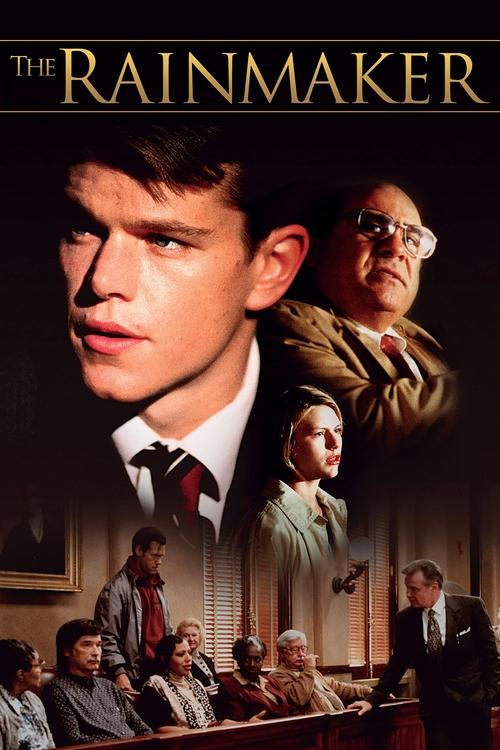
The Rainmaker
Fresh out of law school and desperate for work, idealistic rookie Rudy Baylor takes on a powerful insurance company accused of denying a dying boy’s claim. Teaming up with a scrappy, unlicensed paralegal, he finds himself in a David-versus-Goliath courtroom battle that tests his ethics, courage, and belief in justice.
Working with a moderate budget of $40.0M, the film achieved a modest success with $45.9M in global revenue (+15% profit margin).
2 wins & 10 nominations


Plot Structure
Story beats plotted across runtime


Narrative Arc
Emotional journey through the story's key moments
Story Circle
Blueprint 15-beat structure
Arcplot Score Breakdown
Weighted: Precision (70%) + Arc (15%) + Theme (15%)
The Rainmaker (1997) showcases deliberately positioned dramatic framework, characteristic of Francis Ford Coppola's storytelling approach. This structural analysis examines how the film's 15-point plot structure maps to proven narrative frameworks across 2 hours and 15 minutes. With an Arcplot score of 7.2, the film balances conventional beats with creative variation.
Structural Analysis
The Status Quo at 1 minutes (1% through the runtime) establishes Rudy Baylor, a broke law student, sits in his final class knowing he has no job prospects. His ordinary world is one of desperation and idealism not yet tested by reality.. Of particular interest, this early placement immediately immerses viewers in the story world.
The inciting incident occurs at 15 minutes when Dot Black tells Rudy her son Donny Ray is dying because Great Benefit Insurance denied his leukemia treatment claim. Rudy realizes this is a clear case of corporate malfeasance that demands action.. At 11% through the film, this Disruption aligns precisely with traditional story structure. This beat shifts the emotional landscape, launching the protagonist into the central conflict.
The First Threshold at 33 minutes marks the transition into Act II, occurring at 25% of the runtime. This shows the protagonist's commitment to Rudy passes the bar exam and makes the active choice to file the lawsuit against Great Benefit on behalf of the Black family, committing himself to the case despite having never tried a case in court., moving from reaction to action.
At 66 minutes, the Midpoint arrives at 49% of the runtime—precisely centered, creating perfect narrative symmetry. The analysis reveals that this crucial beat Rudy and Deck discover the "stupid letter" - internal Great Benefit documents proving the company systematically denies all claims. This is a false victory: they have the smoking gun, but Donny Ray is deteriorating rapidly., fundamentally raising what's at risk. The emotional intensity shifts, dividing the narrative into clear before-and-after phases.
The Collapse moment at 99 minutes (74% through) represents the emotional nadir. Here, Donny Ray Black dies before the verdict, never seeing justice. The whiff of death is literal - the young man Rudy fought for is gone, and the case feels hollow despite its legal merit., demonstrates the protagonist at their lowest point. This beat's placement in the final quarter sets up the climactic reversal.
The Second Threshold at 108 minutes initiates the final act resolution at 80% of the runtime. Rudy delivers his closing argument with renewed conviction, synthesizing his idealism with hard-won courtroom experience. He realizes winning is not about the money but about exposing corporate evil and honoring Donny Ray's memory., demonstrating the transformation achieved throughout the journey.
Emotional Journey
The Rainmaker's emotional architecture traces a deliberate progression across 15 carefully calibrated beats.
Narrative Framework
This structural analysis employs systematic plot point analysis that identifies crucial turning points. By mapping The Rainmaker against these established plot points, we can identify how Francis Ford Coppola utilizes or subverts traditional narrative conventions. The plot point approach reveals not only adherence to structural principles but also creative choices that distinguish The Rainmaker within the drama genre.
Francis Ford Coppola's Structural Approach
Among the 16 Francis Ford Coppola films analyzed on Arcplot, the average structural score is 6.5, demonstrating varied approaches to story architecture. The Rainmaker represents one of the director's most structurally precise works. For comparative analysis, explore the complete Francis Ford Coppola filmography.
Comparative Analysis
Additional drama films include After Thomas, South Pacific and Dirty Dancing: Havana Nights. For more Francis Ford Coppola analyses, see Apocalypse Now, The Conversation and The Godfather Part II.
Plot Points by Act
Act I
SetupStatus Quo
Rudy Baylor, a broke law student, sits in his final class knowing he has no job prospects. His ordinary world is one of desperation and idealism not yet tested by reality.
Theme
Professor Leuberg tells Rudy and his class: "Idealism is great, but in the real world, lawyers have to make a living." The theme of idealism versus pragmatism is stated.
Worldbuilding
Rudy discovers his job offer fell through, meets alcoholic ambulance-chaser Bruiser Stone, and volunteers at a senior center where he encounters the Black family whose son is dying because their insurance company denied a life-saving claim.
Disruption
Dot Black tells Rudy her son Donny Ray is dying because Great Benefit Insurance denied his leukemia treatment claim. Rudy realizes this is a clear case of corporate malfeasance that demands action.
Resistance
Rudy debates whether to take the case, joins Bruiser's shady firm, studies for the bar exam, and begins investigating Great Benefit. He meets Kelly Riker, a battered wife who becomes his mirror world relationship. Deck Shifflet becomes his mentor figure.
Act II
ConfrontationFirst Threshold
Rudy passes the bar exam and makes the active choice to file the lawsuit against Great Benefit on behalf of the Black family, committing himself to the case despite having never tried a case in court.
Mirror World
Rudy's relationship with Kelly deepens as he helps her escape her abusive husband. She represents the human cost of systemic injustice and mirrors the theme of standing up against powerful oppressors.
Premise
Rudy navigates his first case as a real lawyer, facing off against the high-powered defense firm led by Leo Drummond. The fun and games of courtroom maneuvering, depositions, and discovering the conspiracy within Great Benefit. Bruiser's firm is raided by FBI.
Midpoint
Rudy and Deck discover the "stupid letter" - internal Great Benefit documents proving the company systematically denies all claims. This is a false victory: they have the smoking gun, but Donny Ray is deteriorating rapidly.
Opposition
The trial begins. Drummond's defense team pressures Rudy at every turn. Kelly's husband stalks her. Rudy struggles with inexperience as the defense exploits every procedural advantage. The establishment closes ranks against the idealistic rookie.
Collapse
Donny Ray Black dies before the verdict, never seeing justice. The whiff of death is literal - the young man Rudy fought for is gone, and the case feels hollow despite its legal merit.
Crisis
Rudy processes the loss and questions whether legal victory means anything when his client died. He sits in darkness contemplating whether justice in the courtroom equals justice in life.
Act III
ResolutionSecond Threshold
Rudy delivers his closing argument with renewed conviction, synthesizing his idealism with hard-won courtroom experience. He realizes winning is not about the money but about exposing corporate evil and honoring Donny Ray's memory.
Synthesis
The jury awards fifty million dollars in damages, bankrupting Great Benefit. Kelly's husband attacks her and Rudy kills him in self-defense. Rudy must reconcile his victory with its costs and what kind of lawyer he will become.
Transformation
Rudy walks away from the law entirely, choosing teaching over practice. The idealistic student has transformed into someone who fought the system, won, but learned that true integrity sometimes means walking away from the game itself.