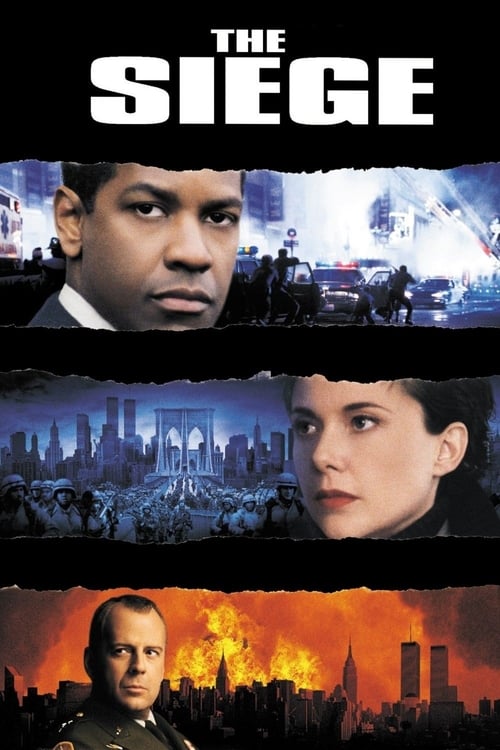
The Siege
The secret US abduction of a suspected terrorist from his Middle East homeland leads to a wave of terrorist attacks in New York. An FBI senior agent and his team attempt to locate and decommission the enemy cells, but must also deal with an Army General gone rogue and a female CIA agent of uncertain loyalties.
Working with a mid-range budget of $70.0M, the film achieved a respectable showing with $116.7M in global revenue (+67% profit margin).
2 wins & 4 nominations


Plot Structure
Story beats plotted across runtime


Narrative Arc
Emotional journey through the story's key moments
Story Circle
Blueprint 15-beat structure
Arcplot Score Breakdown
Weighted: Precision (70%) + Arc (15%) + Theme (15%)
The Siege (1998) showcases carefully calibrated story structure, characteristic of Edward Zwick's storytelling approach. This structural analysis examines how the film's 15-point plot structure maps to proven narrative frameworks across 1 hour and 56 minutes. With an Arcplot score of 7.1, the film balances conventional beats with creative variation.
Structural Analysis
The Status Quo at 1 minutes (1% through the runtime) establishes FBI Agent Anthony Hubbard and his partner Frank Haddad work counterterrorism in New York City, establishing their routine of tracking threats while maintaining the rule of law.. The analysis reveals that this early placement immediately immerses viewers in the story world.
The inciting incident occurs at 14 minutes when A city bus is hijacked and painted with threatening messages. Though the passengers are released unharmed, it signals that terrorist cells have activated in New York, disrupting the ordinary world.. At 12% through the film, this Disruption aligns precisely with traditional story structure. This beat shifts the emotional landscape, launching the protagonist into the central conflict.
The First Threshold at 29 minutes marks the transition into Act II, occurring at 25% of the runtime. This reveals the protagonist's commitment to A devastating bomb explodes on a New York City bus, killing dozens. Hubbard commits fully to the investigation, partnering reluctantly with Elise despite his distrust of the CIA's methods., moving from reaction to action.
At 58 minutes, the Midpoint arrives at 50% of the runtime—precisely centered, creating perfect narrative symmetry. Significantly, this crucial beat The FBI headquarters itself is bombed in a devastating attack. The President declares martial law and General Devereaux's troops occupy Brooklyn—the rules of the game fundamentally change as the Army takes over from civilian law enforcement., fundamentally raising what's at risk. The emotional intensity shifts, dividing the narrative into clear before-and-after phases.
The Collapse moment at 87 minutes (75% through) represents the emotional nadir. Here, Elise is killed by a terrorist—the woman who embodied the moral complexity and was Hubbard's key source of intelligence is gone. Meanwhile, Devereaux tortures and kills a suspect, fully crossing the line into tyranny., demonstrates the protagonist at their lowest point. This beat's placement in the final quarter sets up the climactic reversal.
The Second Threshold at 93 minutes initiates the final act resolution at 80% of the runtime. Hubbard identifies the final bomber: Samir, Elise's asset who was tortured and radicalized. He realizes he must stop both the terrorist and Devereaux—choosing to uphold the law against the military's illegal actions., demonstrating the transformation achieved throughout the journey.
Emotional Journey
The Siege's emotional architecture traces a deliberate progression across 15 carefully calibrated beats.
Narrative Framework
This structural analysis employs structural analysis methodology used to understand storytelling architecture. By mapping The Siege against these established plot points, we can identify how Edward Zwick utilizes or subverts traditional narrative conventions. The plot point approach reveals not only adherence to structural principles but also creative choices that distinguish The Siege within the drama genre.
Edward Zwick's Structural Approach
Among the 10 Edward Zwick films analyzed on Arcplot, the average structural score is 6.8, demonstrating varied approaches to story architecture. The Siege represents one of the director's most structurally precise works. For comparative analysis, explore the complete Edward Zwick filmography.
Comparative Analysis
Additional drama films include After Thomas, South Pacific and Dirty Dancing: Havana Nights. For more Edward Zwick analyses, see Courage Under Fire, Jack Reacher: Never Go Back and Love & Other Drugs.
Plot Points by Act
Act I
SetupStatus Quo
FBI Agent Anthony Hubbard and his partner Frank Haddad work counterterrorism in New York City, establishing their routine of tracking threats while maintaining the rule of law.
Theme
During a briefing, the tension between security and civil liberties is raised—the question of how far America will go to protect itself and what values it might sacrifice in the process.
Worldbuilding
The FBI counterterrorism unit is introduced along with their methods. The kidnapping of Sheik Ahmed bin Talal by U.S. forces in the Middle East is shown, setting up the motivation for retaliation. The world of surveillance and intelligence is established.
Disruption
A city bus is hijacked and painted with threatening messages. Though the passengers are released unharmed, it signals that terrorist cells have activated in New York, disrupting the ordinary world.
Resistance
Hubbard investigates the bus incident and encounters CIA operative Elise Kraft, who has murky connections to the terrorists. He debates whether to trust her while the FBI races to identify the threat before another attack.
Act II
ConfrontationFirst Threshold
A devastating bomb explodes on a New York City bus, killing dozens. Hubbard commits fully to the investigation, partnering reluctantly with Elise despite his distrust of the CIA's methods.
Mirror World
Elise reveals her deep entanglement with the cell—she trained some of these men during the CIA's covert operations. She represents the moral ambiguity Hubbard must navigate, embodying the theme of ends justifying means.
Premise
The FBI hunts terrorist cells across New York. Hubbard and Elise pursue leads through Brooklyn's Arab-American community. The investigation intensifies as more attacks occur—a Broadway theater bombing raises the stakes dramatically.
Midpoint
The FBI headquarters itself is bombed in a devastating attack. The President declares martial law and General Devereaux's troops occupy Brooklyn—the rules of the game fundamentally change as the Army takes over from civilian law enforcement.
Opposition
Under martial law, Devereaux rounds up Arab-American men into detention camps. Hubbard watches constitutional rights dissolve while trying to maintain his investigation. Frank's son is detained, making the conflict personal. Hubbard clashes openly with Devereaux over torture and civil liberties.
Collapse
Elise is killed by a terrorist—the woman who embodied the moral complexity and was Hubbard's key source of intelligence is gone. Meanwhile, Devereaux tortures and kills a suspect, fully crossing the line into tyranny.
Crisis
Hubbard grieves Elise and confronts the reality that Devereaux has become exactly what they were supposed to be fighting against. America is losing its soul in the name of security. The investigation seems hopeless.
Act III
ResolutionSecond Threshold
Hubbard identifies the final bomber: Samir, Elise's asset who was tortured and radicalized. He realizes he must stop both the terrorist and Devereaux—choosing to uphold the law against the military's illegal actions.
Synthesis
Hubbard confronts Samir and talks him down, then turns to arrest General Devereaux for the murder of the detainee. In a tense standoff, Hubbard asserts civilian law over military authority. Devereaux's own soldiers stand down, and he is taken into custody.
Transformation
The detention camps are emptied and martial law ends. Hubbard stands as a symbol that the Constitution survived the siege. The rule of law prevailed over fear—America's values were tested but ultimately upheld.