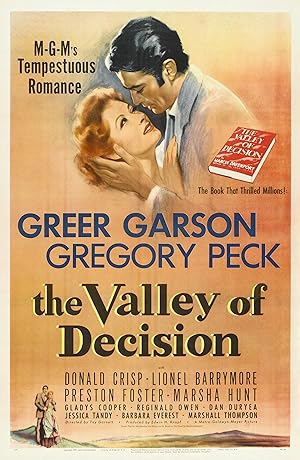
The Valley of Decision
Mary Rafferty comes from a poor family of steel mill workers in 19th Century Pittsburgh. Her family objects when she goes to work as a maid for the wealthy Scott family which controls the mill. Mary catches the attention of handsome scion Paul Scott, but their romance is complicated by Paul's engagement to someone else and a bitter strike among the mill workers.
Despite its limited budget of $2.2M, The Valley of Decision became a solid performer, earning $9.1M worldwide—a 323% return. The film's compelling narrative engaged audiences, confirming that strong storytelling can transcend budget limitations.

Plot Structure
Story beats plotted across runtime


Narrative Arc
Emotional journey through the story's key moments
Story Circle
Blueprint 15-beat structure
Arcplot Score Breakdown
Weighted: Precision (70%) + Arc (15%) + Theme (15%)
The Valley of Decision (1945) exemplifies strategically placed narrative design, characteristic of Tay Garnett's storytelling approach. This structural analysis examines how the film's 15-point plot structure maps to proven narrative frameworks across 1 hour and 59 minutes. With an Arcplot score of 7.4, the film balances conventional beats with creative variation.
Characters
Cast & narrative archetypes

Mary Rafferty
Paul Scott
William Scott Sr.
Pat Rafferty
Constance Scott
Louise Kane
William Scott Jr.
Main Cast & Characters
Mary Rafferty
Played by Greer Garson
An Irish immigrant maid who falls in love with the mill owner's son while navigating class barriers in Pittsburgh.
Paul Scott
Played by Gregory Peck
The idealistic son of a steel mill owner torn between family duty and his love for Mary.
William Scott Sr.
Played by Donald Crisp
The patriarch of the Scott family and owner of the steel mill, a traditional industrialist.
Pat Rafferty
Played by Lionel Barrymore
Mary's father, a steel worker and labor organizer who fights for workers' rights.
Constance Scott
Played by Gladys Cooper
Paul's mother, a gracious woman who comes to appreciate Mary's character despite class differences.
Louise Kane
Played by Marsha Hunt
A wealthy society woman engaged to Paul, representing the expected match for his social class.
William Scott Jr.
Played by Preston Foster
Paul's brother, more aligned with their father's business-first approach to running the mill.
Structural Analysis
The Status Quo at 1 minutes (1% through the runtime) establishes Mary Rafferty arrives in Pittsburgh as a young Irish immigrant seeking work, establishing her humble origins and optimistic spirit in the industrial city.. Structural examination shows that this early placement immediately immerses viewers in the story world.
The inciting incident occurs at 15 minutes when Mary and Paul Scott develop a deep mutual attraction that crosses class boundaries, disrupting the established social order and Mary's role as a servant.. At 13% through the film, this Disruption is delayed, allowing extended setup of the story world. This beat shifts the emotional landscape, launching the protagonist into the central conflict.
The First Threshold at 30 minutes marks the transition into Act II, occurring at 25% of the runtime. This illustrates the protagonist's commitment to Mary chooses to stay in the Scott household despite the risks, fully committing to her love for Paul and accepting the consequences of crossing class lines., moving from reaction to action.
At 60 minutes, the Midpoint arrives at 50% of the runtime—precisely centered, creating perfect narrative symmetry. Of particular interest, this crucial beat A violent labor strike erupts at the mill, with Mary's own family members involved, forcing her to choose between her working-class loyalty and her love for Paul., fundamentally raising what's at risk. The emotional intensity shifts, dividing the narrative into clear before-and-after phases.
The Collapse moment at 89 minutes (75% through) represents the emotional nadir. Here, The strike turns deadly when Mary's father or brother is killed in the conflict, representing the ultimate cost of the class divide and threatening to destroy any hope of reconciliation., shows the protagonist at their lowest point. This beat's placement in the final quarter sets up the climactic reversal.
The Second Threshold at 95 minutes initiates the final act resolution at 80% of the runtime. Mary realizes that honoring her father's memory means fighting for the reconciliation he would have wanted, choosing to return and help Paul reform the mill's labor practices., demonstrating the transformation achieved throughout the journey.
Emotional Journey
The Valley of Decision's emotional architecture traces a deliberate progression across 15 carefully calibrated beats.
Narrative Framework
This structural analysis employs a 15-point narrative structure framework that maps key story moments. By mapping The Valley of Decision against these established plot points, we can identify how Tay Garnett utilizes or subverts traditional narrative conventions. The plot point approach reveals not only adherence to structural principles but also creative choices that distinguish The Valley of Decision within the drama genre.
Tay Garnett's Structural Approach
Among the 2 Tay Garnett films analyzed on Arcplot, the average structural score is 7.3, reflecting strong command of classical structure. The Valley of Decision represents one of the director's most structurally precise works. For comparative analysis, explore the complete Tay Garnett filmography.
Comparative Analysis
Additional drama films include After Thomas, South Pacific and Dirty Dancing: Havana Nights. For more Tay Garnett analyses, see The Postman Always Rings Twice.
Plot Points by Act
Act I
SetupStatus Quo
Mary Rafferty arrives in Pittsburgh as a young Irish immigrant seeking work, establishing her humble origins and optimistic spirit in the industrial city.
Theme
An older character speaks about class divisions and the impossibility of bridging the gap between labor and ownership, foreshadowing Mary's central conflict.
Worldbuilding
Mary enters service at the wealthy Scott family's steel mill household, meeting the family members including young Paul Scott, and navigating the rigid class structure of 1870s Pittsburgh.
Disruption
Mary and Paul Scott develop a deep mutual attraction that crosses class boundaries, disrupting the established social order and Mary's role as a servant.
Resistance
Mary wrestles with her feelings for Paul while navigating family expectations, labor conflicts at the mill, and warnings from both her working-class community and the Scott family matriarch.
Act II
ConfrontationFirst Threshold
Mary chooses to stay in the Scott household despite the risks, fully committing to her love for Paul and accepting the consequences of crossing class lines.
Mirror World
Mary and Paul's relationship deepens into genuine partnership, with Paul beginning to see the mill workers' perspectives through Mary's eyes, introducing the thematic reconciliation.
Premise
Mary influences the Scott family from within, advocating for workers while Paul courts her, exploring the possibility of love transcending class and bridging labor-management divides.
Midpoint
A violent labor strike erupts at the mill, with Mary's own family members involved, forcing her to choose between her working-class loyalty and her love for Paul.
Opposition
Pressure mounts from both sides as the strike intensifies, family members condemn Mary's relationship, and Paul faces opposition from his own class about his progressive sympathies.
Collapse
The strike turns deadly when Mary's father or brother is killed in the conflict, representing the ultimate cost of the class divide and threatening to destroy any hope of reconciliation.
Crisis
Mary grieves and questions whether love can survive such tragedy, contemplating leaving the Scott household forever and abandoning the impossible dream of bridging two worlds.
Act III
ResolutionSecond Threshold
Mary realizes that honoring her father's memory means fighting for the reconciliation he would have wanted, choosing to return and help Paul reform the mill's labor practices.
Synthesis
Mary and Paul work together to implement fair labor reforms, proving that love and understanding can bridge class divides and create meaningful change in the industrial world.
Transformation
Mary, now accepted by both worlds, stands as an equal partner to Paul, transformed from servant to advocate, proving that human dignity transcends social class.