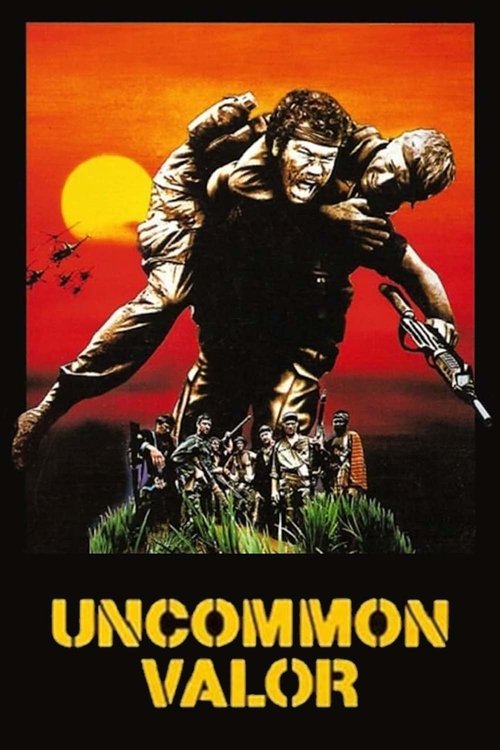
Uncommon Valor
A group of Vietnam War veterans re-unite to rescue one of their own left behind and taken prisoner by the Vietnamese.
Despite its modest budget of $11.0M, Uncommon Valor became a solid performer, earning $30.5M worldwide—a 177% return.


Plot Structure
Story beats plotted across runtime


Narrative Arc
Emotional journey through the story's key moments
Story Circle
Blueprint 15-beat structure
Arcplot Score Breakdown
Weighted: Precision (70%) + Arc (15%) + Theme (15%)
Uncommon Valor (1983) showcases deliberately positioned narrative design, characteristic of Ted Kotcheff's storytelling approach. This structural analysis examines how the film's 15-point plot structure maps to proven narrative frameworks across 1 hour and 45 minutes. With an Arcplot score of 6.5, the film balances conventional beats with creative variation.
Characters
Cast & narrative archetypes

Colonel Jason Rhodes
Kevin Scott
Blaster
Wilkes
Sailor
Charts
MacGregor
Jiang
Main Cast & Characters
Colonel Jason Rhodes
Played by Gene Hackman
A retired Marine colonel who organizes a mission to rescue POWs in Laos, including his missing son.
Kevin Scott
Played by Patrick Swayze
A former soldier and tunnel rat who joins Rhodes' rescue mission despite personal struggles.
Blaster
Played by Reb Brown
An explosives expert and demolitions specialist recruited for the POW rescue operation.
Wilkes
Played by Fred Ward
A tough, streetwise veteran who brings combat experience and loyalty to the team.
Sailor
Played by Randall 'Tex' Cobb
A former Navy man and skilled fighter who joins the unconventional rescue mission.
Charts
Played by Harold Sylvester
The team's communications and intelligence specialist with technical expertise.
MacGregor
Played by Robert Stack
A wealthy businessman who finances the rescue mission for his own son held as a POW.
Jiang
Played by Kwan Hi Lim
A Thai drug lord who provides intelligence and support for the rescue operation.
Structural Analysis
The Status Quo at 1 minutes (1% through the runtime) establishes Colonel Rhodes in his ordinary world, obsessed and haunted by his son's MIA status in Vietnam, unable to move forward with his life.. The analysis reveals that this early placement immediately immerses viewers in the story world.
The inciting incident occurs at 13 minutes when MacGregor offers Rhodes unlimited funding to mount a private rescue mission to find the POWs, including Rhodes' son. This opportunity disrupts Rhodes' passive grief.. At 12% through the film, this Disruption aligns precisely with traditional story structure. This beat shifts the emotional landscape, launching the protagonist into the central conflict.
The First Threshold at 27 minutes marks the transition into Act II, occurring at 25% of the runtime. This demonstrates the protagonist's commitment to The team commits fully to the mission and departs for Thailand. Rhodes and his men cross the point of no return, actively choosing to enter the dangerous world of the rescue operation., moving from reaction to action.
At 53 minutes, the Midpoint arrives at 51% of the runtime—precisely centered, creating perfect narrative symmetry. Notably, this crucial beat The team infiltrates Laos and confirms POWs are actually there. False victory: they've found them! But stakes raise - now they must execute the dangerous extraction under time pressure., fundamentally raising what's at risk. The emotional intensity shifts, dividing the narrative into clear before-and-after phases.
The Collapse moment at 80 minutes (76% through) represents the emotional nadir. Here, Team members die in the extraction (Blaster and others killed). Rhodes discovers his son is not among the prisoners - his personal quest fails even as the mission continues., indicates the protagonist at their lowest point. This beat's placement in the final quarter sets up the climactic reversal.
The Second Threshold at 85 minutes initiates the final act resolution at 81% of the runtime. Rhodes realizes the mission was never just about his son - it's about all the men left behind. He chooses to complete the extraction, synthesizing personal loss with larger duty., demonstrating the transformation achieved throughout the journey.
Emotional Journey
Uncommon Valor's emotional architecture traces a deliberate progression across 15 carefully calibrated beats.
Narrative Framework
This structural analysis employs proven narrative structure principles that track dramatic progression. By mapping Uncommon Valor against these established plot points, we can identify how Ted Kotcheff utilizes or subverts traditional narrative conventions. The plot point approach reveals not only adherence to structural principles but also creative choices that distinguish Uncommon Valor within the drama genre.
Ted Kotcheff's Structural Approach
Among the 6 Ted Kotcheff films analyzed on Arcplot, the average structural score is 7.2, reflecting strong command of classical structure. Uncommon Valor takes a more unconventional approach compared to the director's typical style. For comparative analysis, explore the complete Ted Kotcheff filmography.
Comparative Analysis
Additional drama films include After Thomas, South Pacific and Dirty Dancing: Havana Nights. For more Ted Kotcheff analyses, see Fun with Dick and Jane, Folks! and First Blood.
Plot Points by Act
Act I
SetupStatus Quo
Colonel Rhodes in his ordinary world, obsessed and haunted by his son's MIA status in Vietnam, unable to move forward with his life.
Theme
MacGregor or another character suggests the government has abandoned the POWs: "They left them behind" - establishing the theme of loyalty, abandonment, and what we owe those who served.
Worldbuilding
Rhodes learns from CIA that POWs may still be alive in Laos. We meet his world: a father consumed by loss, government bureaucracy that won't help, and the introduction of wealthy oil tycoon MacGregor who offers funding.
Disruption
MacGregor offers Rhodes unlimited funding to mount a private rescue mission to find the POWs, including Rhodes' son. This opportunity disrupts Rhodes' passive grief.
Resistance
Rhodes debates whether this mission is possible, recruits his old team (Wilkes, Blaster, Sailor, Charts), faces their skepticism and damaged lives. Preparation and training montage begins.
Act II
ConfrontationFirst Threshold
The team commits fully to the mission and departs for Thailand. Rhodes and his men cross the point of no return, actively choosing to enter the dangerous world of the rescue operation.
Mirror World
The team bonds in Thailand, particularly through Jiang (their local contact) and interactions that remind them why they fight - the brotherhood of soldiers and the debt owed to those left behind.
Premise
The fun and games of the rescue mission: final training in Thailand, reconnaissance, planning the assault, navigating local politics, and preparing for the raid on the prison camp.
Midpoint
The team infiltrates Laos and confirms POWs are actually there. False victory: they've found them! But stakes raise - now they must execute the dangerous extraction under time pressure.
Opposition
The prison camp assault begins. Enemy forces close in, the extraction becomes chaotic, casualties mount, and everything that can go wrong does. Government forces move to stop them.
Collapse
Team members die in the extraction (Blaster and others killed). Rhodes discovers his son is not among the prisoners - his personal quest fails even as the mission continues.
Crisis
Rhodes processes the devastating loss of his son's last hope and his fallen team members. The survivors must decide whether to complete the extraction or give up in grief.
Act III
ResolutionSecond Threshold
Rhodes realizes the mission was never just about his son - it's about all the men left behind. He chooses to complete the extraction, synthesizing personal loss with larger duty.
Synthesis
Final battle and escape with the freed POWs. Rhodes leads the survivors through enemy territory to the extraction point, fighting off pursuing forces. The rescue succeeds despite terrible cost.
Transformation
Rhodes watches the freed POWs reunite with families. Though his son is gone, he has found peace through honoring his commitment. He has transformed from obsessed father to selfless leader.