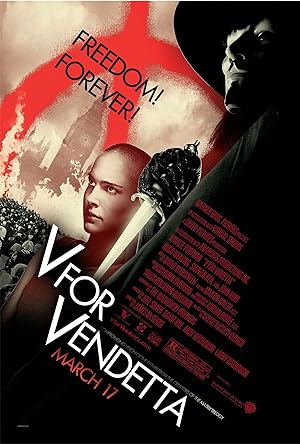
V for Vendetta
In the distant future, Evey Hammond is an average citizen of the United Kingdom, which is under the rule of the fascist and tyrannical Norsefire Party. She is an employee of the state-run British Television Network, but soon, she becomes the number one enemy of the state together with an enigmatic and larger-than-life freedom fighter known only by the letter "V". V informs Evey that she must hide in his underground lair for at least one year, and while she is reluctant to the idea at first, a bond soon forms between the two individuals. In the meanwhile, the mysterious past of V is gradually revealed to the police inspector tasked with capturing him, Eric Finch, and it is not long until he starts questioning everything his government stands for.
Despite a mid-range budget of $54.0M, V for Vendetta became a solid performer, earning $134.7M worldwide—a 149% return.
7 wins & 29 nominations


Plot Structure
Story beats plotted across runtime


Narrative Arc
Emotional journey through the story's key moments
Story Circle
Blueprint 15-beat structure
Arcplot Score Breakdown
Weighted: Precision (70%) + Arc (15%) + Theme (15%)
V for Vendetta (2005) exemplifies deliberately positioned narrative design, characteristic of James McTeigue's storytelling approach. This structural analysis examines how the film's 15-point plot structure maps to proven narrative frameworks across 2 hours and 12 minutes. With an Arcplot score of 3.9, the film takes an unconventional approach to traditional narrative frameworks.
Structural Analysis
The Status Quo at 2 minutes (1% through the runtime) establishes Evey Hammond prepares to go out after curfew in dystopian London, while parallel scenes show V donning his Guy Fawkes mask. The oppressive Norsefire regime controls Britain through fear, surveillance, and propaganda.. The analysis reveals that this early placement immediately immerses viewers in the story world.
The inciting incident occurs at 14 minutes when V hijacks the BTN broadcast and addresses the nation, calling citizens to join him at Parliament in one year's time on November 5th. This public act of defiance disrupts both the government's control and Evey's attempt to live invisibly within the system.. At 11% through the film, this Disruption aligns precisely with traditional story structure. This beat shifts the emotional landscape, launching the protagonist into the central conflict.
The First Threshold at 30 minutes marks the transition into Act II, occurring at 23% of the runtime. This shows the protagonist's commitment to Evey chooses to help V by posing as a young girl to get close to Bishop Lilliman. Though she backs out at the last moment, her involvement makes her a wanted fugitive. She cannot return to her old life and takes refuge with Gordon Deitrich., moving from reaction to action.
At 59 minutes, the Midpoint arrives at 45% of the runtime—arriving early, accelerating into Act IIb complications. Notably, this crucial beat Evey is captured by hooded men and imprisoned. She is tortured, shaved, and interrogated, finding solace only in letters from Valerie, a lesbian actress killed at Larkhill. This false defeat begins her transformation as she faces her deepest fears., fundamentally raising what's at risk. The emotional intensity shifts, dividing the narrative into clear before-and-after phases.
The Collapse moment at 87 minutes (66% through) represents the emotional nadir. Here, Evey chooses death over betrayal, only to discover her imprisonment was orchestrated by V himself. Her mentor has tortured her. Evey is shattered by this revelation, feeling utterly betrayed by the one person she trusted. Everything she believed collapses., shows the protagonist at their lowest point. This beat's placement in the final quarter sets up the climactic reversal.
The Second Threshold at 93 minutes initiates the final act resolution at 70% of the runtime. Evey's rooftop epiphany in the rain marks her transformation. She has died metaphorically and been reborn without fear. She tells V "I don't want you to die" but understands his purpose. She has synthesized V's ideology with her own humanity., demonstrating the transformation achieved throughout the journey.
Emotional Journey
V for Vendetta's emotional architecture traces a deliberate progression across 15 carefully calibrated beats.
Narrative Framework
This structural analysis employs systematic plot point analysis that identifies crucial turning points. By mapping V for Vendetta against these established plot points, we can identify how James McTeigue utilizes or subverts traditional narrative conventions. The plot point approach reveals not only adherence to structural principles but also creative choices that distinguish V for Vendetta within the action genre.
James McTeigue's Structural Approach
Among the 4 James McTeigue films analyzed on Arcplot, the average structural score is 6.1, demonstrating varied approaches to story architecture. V for Vendetta takes a more unconventional approach compared to the director's typical style. For comparative analysis, explore the complete James McTeigue filmography.
Comparative Analysis
Additional action films include The Bad Guys, Puss in Boots and Venom: The Last Dance. For more James McTeigue analyses, see The Raven, Ninja Assassin and Breaking In.
Plot Points by Act
Act I
SetupStatus Quo
Evey Hammond prepares to go out after curfew in dystopian London, while parallel scenes show V donning his Guy Fawkes mask. The oppressive Norsefire regime controls Britain through fear, surveillance, and propaganda.
Theme
V rescues Evey from Fingermen and declares: "People should not be afraid of their governments. Governments should be afraid of their people." This statement encapsulates the film's thematic core about power, fear, and revolution.
Worldbuilding
The fascist state of Britain is established through BTN propaganda broadcasts, the secret police (Fingermen), curfews, and surveillance. V's destruction of the Old Bailey and his broadcast hijacking reveal both the regime's control and the existence of organized resistance.
Disruption
V hijacks the BTN broadcast and addresses the nation, calling citizens to join him at Parliament in one year's time on November 5th. This public act of defiance disrupts both the government's control and Evey's attempt to live invisibly within the system.
Resistance
Evey is drawn into V's world as Inspector Finch begins investigating. V kills Lewis Prothero (the Voice of London) and Bishop Lilliman. Evey struggles with her involvement, torn between fear of the regime and growing awareness of its evil. She debates whether to help V or flee.
Act II
ConfrontationFirst Threshold
Evey chooses to help V by posing as a young girl to get close to Bishop Lilliman. Though she backs out at the last moment, her involvement makes her a wanted fugitive. She cannot return to her old life and takes refuge with Gordon Deitrich.
Mirror World
Evey finds sanctuary with Gordon Deitrich, a closeted TV host who hides forbidden art, a Quran, and his true identity. Gordon represents those who resist internally but lack courage for open defiance. His warmth provides emotional contrast to V's masked intensity.
Premise
V continues his vendetta, killing those responsible for Larkhill. Inspector Finch uncovers the conspiracy behind the St. Mary's virus. Gordon's satirical show mocking Sutler leads to his arrest. Evey experiences brief happiness before Gordon is taken, showing what the regime destroys.
Midpoint
Evey is captured by hooded men and imprisoned. She is tortured, shaved, and interrogated, finding solace only in letters from Valerie, a lesbian actress killed at Larkhill. This false defeat begins her transformation as she faces her deepest fears.
Opposition
Evey endures imprisonment and torture, refusing to betray V even facing execution. Finch gets closer to the truth about Larkhill and the government's role in creating both the virus and V. The regime tightens control as unrest grows among the populace.
Collapse
Evey chooses death over betrayal, only to discover her imprisonment was orchestrated by V himself. Her mentor has tortured her. Evey is shattered by this revelation, feeling utterly betrayed by the one person she trusted. Everything she believed collapses.
Crisis
Evey confronts V about his methods, processing her trauma and rage. V explains that he gave her the only gift he could: freedom from fear. Evey stands in the rain, reborn, finally understanding that without fear, she is truly free. She leaves V.
Act III
ResolutionSecond Threshold
Evey's rooftop epiphany in the rain marks her transformation. She has died metaphorically and been reborn without fear. She tells V "I don't want you to die" but understands his purpose. She has synthesized V's ideology with her own humanity.
Synthesis
November 5th arrives. V sends thousands of Guy Fawkes masks to citizens. Creedy kills Sutler per V's demand, then V kills Creedy and his men despite being mortally wounded. Evey finds the dying V, who asks her to give him a Viking funeral by sending the train.
Transformation
Evey pulls the lever, sending V's body and the explosives to Parliament. Thousands of masked citizens watch as Parliament explodes. When asked who V was, Evey answers he was her father, brother, friend - he was all of us. Ideas have become immortal.