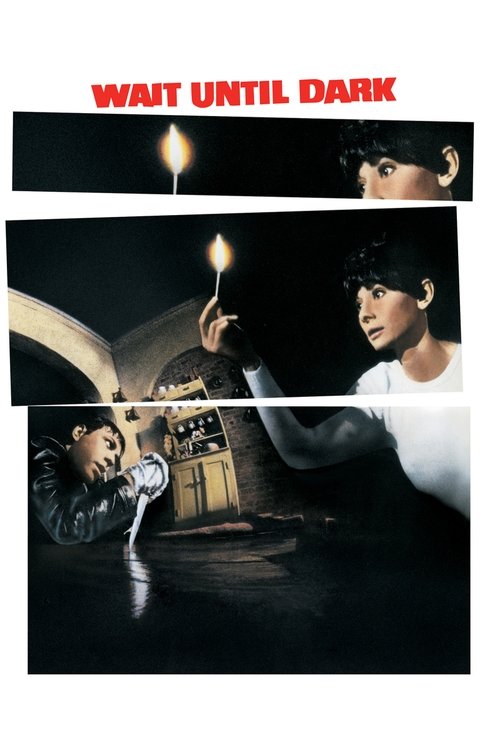
Wait Until Dark
After a flight back home, Sam Hendrix returns with a doll he innocently acquired along the way. As it turns out, the doll is actually stuffed with heroin, and a group of criminals led by the ruthless Roat has followed Hendrix back to his place to retrieve it. When Hendrix leaves for business, the crooks make their move -- and find his blind wife, Susy, alone in the apartment. Soon, a life-threatening game begins between Susy and the thugs.
Despite its limited budget of $4.0M, Wait Until Dark became a financial success, earning $11.0M worldwide—a 175% return.
Nominated for 1 Oscar. 6 nominations


Plot Structure
Story beats plotted across runtime


Narrative Arc
Emotional journey through the story's key moments
Story Circle
Blueprint 15-beat structure
Arcplot Score Breakdown
Weighted: Precision (70%) + Arc (15%) + Theme (15%)
Wait Until Dark (1967) demonstrates carefully calibrated narrative architecture, characteristic of Terence Young's storytelling approach. This structural analysis examines how the film's 15-point plot structure maps to proven narrative frameworks across 1 hour and 48 minutes. With an Arcplot score of 7.0, the film balances conventional beats with creative variation.
Structural Analysis
The Status Quo at 1 minutes (1% through the runtime) establishes A woman named Lisa smuggles a heroin-stuffed doll through customs at an airport, establishing the criminal underworld that will soon intersect with an innocent couple's life.. Significantly, this early placement immediately immerses viewers in the story world.
The inciting incident occurs at 13 minutes when Criminal mastermind Harry Roat murders Lisa in the apartment building and begins orchestrating a scheme to recover the heroin doll, which has ended up in Susy's possession without her knowledge.. At 12% through the film, this Disruption aligns precisely with traditional story structure. This beat shifts the emotional landscape, launching the protagonist into the central conflict.
The First Threshold at 27 minutes marks the transition into Act II, occurring at 25% of the runtime. This reveals the protagonist's commitment to The criminals put their plan into motion, entering Susy's apartment under false pretenses. Mike poses as an old friend of Sam's, beginning the psychological siege that will trap Susy in a web of lies and manipulation., moving from reaction to action.
At 54 minutes, the Midpoint arrives at 50% of the runtime—precisely centered, creating perfect narrative symmetry. The analysis reveals that this crucial beat Susy discovers Lisa's body in the apartment and realizes she is in genuine mortal danger—this is not merely about finding a doll but about silencing witnesses. The stakes escalate from deception to survival., fundamentally raising what's at risk. The emotional intensity shifts, dividing the narrative into clear before-and-after phases.
The Collapse moment at 81 minutes (75% through) represents the emotional nadir. Here, Roat kills Carlino and Mike, eliminating all witnesses. Susy is now completely isolated with a psychopath who knows she can identify him by voice. Gloria has been sent away, and Sam cannot be reached., indicates the protagonist at their lowest point. This beat's placement in the final quarter sets up the climactic reversal.
The Second Threshold at 86 minutes initiates the final act resolution at 80% of the runtime. Susy has her breakthrough realization: in darkness, she is the master. She methodically smashes every light bulb in the apartment, turning her blindness from vulnerability into power—leveling the playing field against Roat., demonstrating the transformation achieved throughout the journey.
Emotional Journey
Wait Until Dark's emotional architecture traces a deliberate progression across 15 carefully calibrated beats.
Narrative Framework
This structural analysis employs a 15-point narrative structure framework that maps key story moments. By mapping Wait Until Dark against these established plot points, we can identify how Terence Young utilizes or subverts traditional narrative conventions. The plot point approach reveals not only adherence to structural principles but also creative choices that distinguish Wait Until Dark within the thriller genre.
Terence Young's Structural Approach
Among the 5 Terence Young films analyzed on Arcplot, the average structural score is 6.7, demonstrating varied approaches to story architecture. Wait Until Dark represents one of the director's most structurally precise works. For comparative analysis, explore the complete Terence Young filmography.
Comparative Analysis
Additional thriller films include The Warriors, Rustom. For more Terence Young analyses, see Thunderball, Bloodline and From Russia with Love.
Plot Points by Act
Act I
SetupStatus Quo
A woman named Lisa smuggles a heroin-stuffed doll through customs at an airport, establishing the criminal underworld that will soon intersect with an innocent couple's life.
Theme
Sam tells Susy she must learn to function independently as a blind person, stating that she cannot always rely on others—foreshadowing her ultimate need to trust her own abilities in darkness.
Worldbuilding
We meet Susy Hendrix, a recently blinded woman adjusting to life in her Greenwich Village basement apartment with her photographer husband Sam. Their neighbor Gloria, a young girl, helps around the house. Sam unknowingly receives the heroin doll from Lisa at the airport.
Disruption
Criminal mastermind Harry Roat murders Lisa in the apartment building and begins orchestrating a scheme to recover the heroin doll, which has ended up in Susy's possession without her knowledge.
Resistance
Roat recruits two small-time criminals, Mike Talman and Carlino, to help retrieve the doll. They develop an elaborate con to manipulate blind Susy into finding and surrendering the doll, while Sam is away on a photography assignment.
Act II
ConfrontationFirst Threshold
The criminals put their plan into motion, entering Susy's apartment under false pretenses. Mike poses as an old friend of Sam's, beginning the psychological siege that will trap Susy in a web of lies and manipulation.
Mirror World
Gloria, the young neighbor girl, becomes Susy's eyes and ally. Their relationship represents trust and the power of human connection—Gloria's innocent help will prove crucial to Susy's survival.
Premise
The elaborate con unfolds as the criminals take turns visiting Susy with fabricated stories about Sam being involved in Lisa's murder. Susy, unable to see their coordination, struggles to piece together the truth while unknowingly being manipulated at every turn.
Midpoint
Susy discovers Lisa's body in the apartment and realizes she is in genuine mortal danger—this is not merely about finding a doll but about silencing witnesses. The stakes escalate from deception to survival.
Opposition
Susy begins to suspect the men are working together and desperately tries to contact Sam. Roat eliminates his accomplices one by one, revealing himself as a psychopathic killer. The apartment becomes a claustrophobic trap as Susy realizes she is alone with a murderer.
Collapse
Roat kills Carlino and Mike, eliminating all witnesses. Susy is now completely isolated with a psychopath who knows she can identify him by voice. Gloria has been sent away, and Sam cannot be reached.
Crisis
Susy realizes she is utterly alone and that Roat will kill her. In her darkest moment, she must accept that no one is coming to save her—she must save herself using the only advantage she has.
Act III
ResolutionSecond Threshold
Susy has her breakthrough realization: in darkness, she is the master. She methodically smashes every light bulb in the apartment, turning her blindness from vulnerability into power—leveling the playing field against Roat.
Synthesis
The legendary climax unfolds in near-total darkness. Susy uses her heightened senses and knowledge of the apartment to evade and fight Roat. The refrigerator light becomes the final battleground as Susy struggles for survival in a terrifying game of cat and mouse.
Transformation
Susy defeats Roat and survives. Sam and Gloria arrive to find her alive. The woman who began the film dependent and uncertain has proven she can protect herself—her blindness is no longer her defining limitation but a source of unexpected strength.